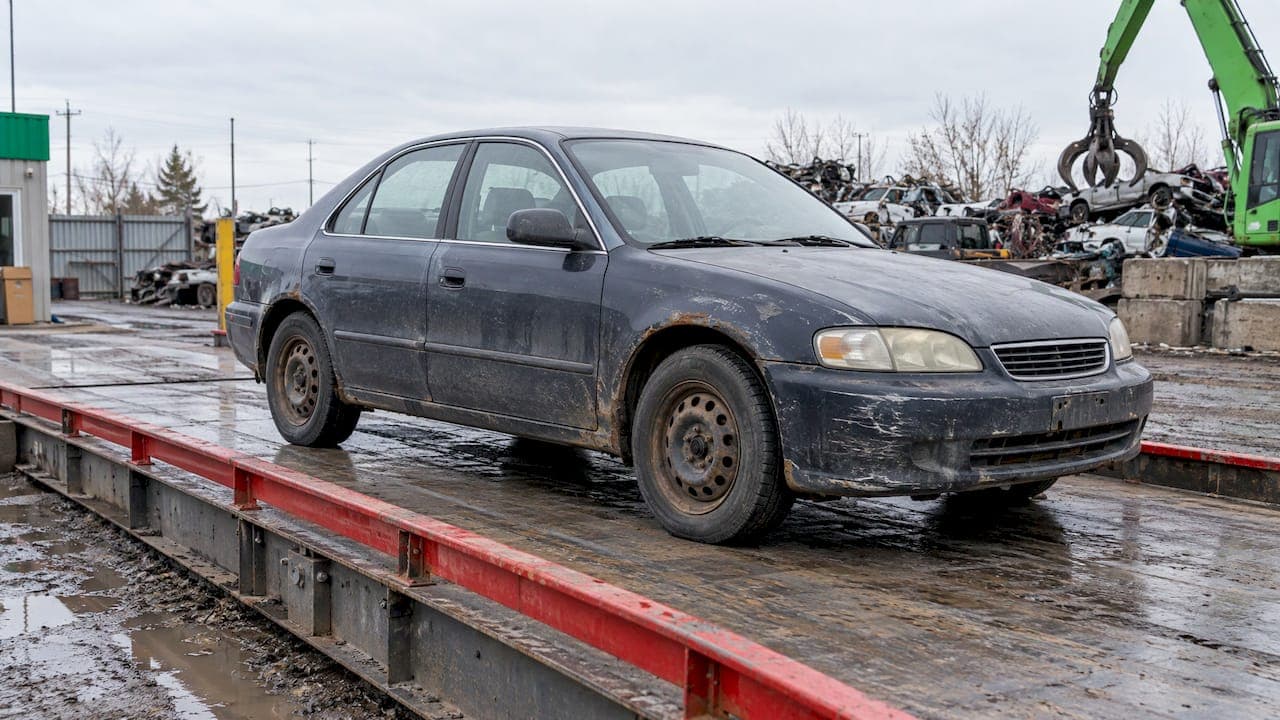
A junk car's value comes down to five things: how much metal it holds, what scrap metal is paying right now, whether it is complete, whether its parts can be reused, and how far a buyer has to travel to collect it. Mileage matters much less than most people expect. Below, we explain how each factor moves an offer and what you can do before you call anyone.
TL;DR
- Weight and the current scrap metal market set the base price. Heavier, complete vehicles contain more recyclable metal.
- Missing parts such as the engine, transmission, catalytic converter or battery lower the offer. Reusable parts and sought-after models can raise it.
- Mileage barely matters on a car that no longer runs. It only counts when the vehicle still drives and has resale or parts appeal.
- Location and pickup cost matter. A local buyer who tows for free usually keeps more money in your pocket than one who deducts a towing fee.
- Ask for two or three offers, confirm the amount before the tow truck arrives and keep your paperwork ready.
Table of Contents
- The base of every offer: weight and scrap metal prices
- Completeness: what is still on the car
- Reusable parts and demand for your model
- Does mileage matter for scrap cars in Alberta?
- Condition: running, non-running, damaged or failed inspection
- Location, towing and who is buying
- Paperwork and timing
- How to increase what you are paid
- What a junkyard will pay at most
- Our perspective
- Sell your junk car in Calgary or Okotoks
- FAQ
- Sources
The base of every offer: weight and scrap metal prices
Every junk car is, at minimum, a pile of steel, aluminum, copper and other metals. A buyer who cannot resell the car whole or strip it for parts will price it by weight, using the going rate for scrap metal.
That is why a full-size pickup or SUV usually brings more than a small hatchback in the same condition. There is simply more steel in it. The same car can also be worth a little more or less from one month to the next, because scrap prices move with commodity markets. If you want a closer look at how big that swing really is for a single vehicle, our guide on how scrap prices change your car's value walks through it.
Two details are worth knowing:
- Curb weight is what counts. Buyers think in terms of the vehicle as it sits, with its body, frame, engine and drivetrain. A car stripped of its heavy components weighs less and is priced accordingly.
- Cars contain less metal than they used to. Natural Resources Canada has noted that as vehicles use more non-metal materials, there is less metal per car and recycling becomes less economically viable. That is one reason newer, plastic-heavy vehicles do not always beat older steel-heavy ones on weight alone.
The practical takeaway: do not expect a fixed number you can look up once. Ask for a current quote, and treat any figure you read online as a rough guide.
Completeness: what is still on the car
A complete car is worth more than a shell. Buyers look at whether the major components are still there:
- Engine and transmission, even if they no longer work
- Catalytic converter
- Battery
- Wheels and tires
- Body panels, doors, seats and interior
A blown engine or failed transmission does not make a car worthless. Those components still hold metal, and many other parts on the car may still be reusable. What lowers the offer is when something is missing entirely, because the buyer has to account for the gap in weight and in recoverable value.
Catalytic converters deserve a special mention. They contain precious metals and are among the most valuable single components on an end-of-life vehicle. A car that arrives without one will normally be priced lower, and the buyer should be told honestly at the quote stage so the number does not change at pickup.

If a previous owner or a shop removed parts, say so. A quote built on accurate information holds up at the curb.
Reusable parts and demand for your model
Beyond the metal, some cars are worth more as a source of parts. The federal National Code of Practice for end-of-life vehicle recycling says recyclers should reuse high-quality tires, batteries and parts where economically feasible, and it notes that end-of-life vehicles yield reusable parts as well as recyclable copper, lead, aluminum and steel.
What that means for your offer:
- Popular models with plenty of vehicles still on Alberta roads, such as common trucks and compact cars, have steady demand for body panels, mirrors, alternators and similar parts.
- Newer vehicles with undamaged doors, lights and electronics tend to have more reusable value than a rusted, stripped-out older car.
- Damage location matters. A rear-end collision may leave the engine, front end and interior in good shape. A car with fire damage or a flooded interior has fewer parts worth recovering.
- Some old parts are restricted. Under the Retire Your Ride program rules in that same code, resale of vehicles, engines and internal engine parts from model year 1995 or earlier was barred. Very old vehicles can therefore be valued closer to their scrap weight in programs that follow that code.
Want to see how this plays out for a specific car? Our breakdown of what a parts car is worth explains how buyers think about individual components.
Does mileage matter for scrap cars in Alberta?
For a car that does not run, mileage rarely changes the price. A scrapyard prices the vehicle on weight, completeness and parts value, and an odometer reading says little about how much steel is in the body.
Mileage can matter in a narrower set of cases:
- The car still drives and could be resold or used for parts. Lower mileage suggests the engine and transmission have more life left in them.
- The buyer wants to pull the drivetrain. A low-mileage engine in a popular model can be worth more than a worn one.
- The vehicle sits in a gray zone between a junk car and a cheap used car. Here, condition and mileage together decide which side of that line it falls on.
If your car is on the border, it helps to read our piece on what qualifies as a junk car in Alberta. It covers checking the vehicle's status first so you sell it the right way.
Condition: running, non-running, damaged or failed inspection
The reason for the car's retirement shapes the offer less than people fear. Buyers who purchase junk vehicles routinely take:
- Non-running cars with seized or blown engines
- Cars with transmission failure
- Accident-damaged vehicles
- Cars that failed a safety inspection
- Old, rusted vehicles that have sat for years
What does matter is how much work is needed to get the car out. A vehicle that is buried in a snowbank, parked behind a fence or sitting with flat tires and no keys takes more time and equipment to load. The equipment and time are a cost to the buyer, and a buyer who has to price that in may offer less. Clear access on pickup day keeps the offer clean.
A car that still starts and moves can sometimes earn more than a non-runner, because the buyer has more options for it. If you are weighing a repair against selling, when repair costs exceed market value is a useful yardstick.
Location, towing and who is buying
In Calgary and Okotoks, location affects value in two ways.
Distance. The farther a buyer's truck must go, the more of your offer is eaten by fuel and time. A local buyer who covers Calgary and Okotoks can keep the towing cost low or free.
Type of buyer. A scrapyard, an auto wrecker and a general online car-buying platform each price differently. A wrecker values parts and metal. A national aggregator may pass your listing along to a local buyer and take a margin on the way. Dealing directly with a local buyer usually means a faster answer and a quote you can rely on. Our comparison of a junkyard versus a scrapyard shows how the two differ.
The cost of towing is where many sellers lose money without noticing. Some buyers advertise a high number and then subtract a towing fee at pickup. Before you accept any offer, ask whether the figure is the final amount you receive with the tow included. If you are deciding between driving the car in and having it collected, our checklist on driving to the scrapyard or getting free pickup lays out the trade-offs.
Paperwork and timing
An offer is only as good as the sale behind it. A buyer will usually want proof that you own the vehicle, and a clean handover avoids delays. Have your registration and a piece of photo ID on hand, and remove your license plates and personal belongings before the car leaves.
Timing matters too. Scrap prices shift, and a car that sits in a yard for another winter keeps rusting, losing tires to flat spots and gathering debris. Selling sooner generally protects the value you have.
If your car is being removed from an Alberta property, remember that the vehicle's fluids and batteries are regulated. Alberta's guidance for businesses says those handling hazardous recyclables such as used batteries and oil must follow the Environmental Protection and Enhancement Act requirements, which protect air, soil and water. This is one more reason to hand the vehicle to a buyer who handles these properly, rather than draining fluids yourself on the driveway.
How to increase what you are paid
You cannot change a car's weight, but you can influence most of the other factors.
- Keep the car whole. Do not strip it unless you have a buyer lined up for the parts. A complete vehicle is simpler to price and often brings more as a single sale.
- Be exact about its condition. Tell the buyer the make, model, year, whether it runs, what is missing and where it is parked. Accurate details protect the quote.
- Make pickup easy. Clear the access, have the keys if you have them and be present with your documents.
- Get two or three offers. Quotes for the same car can differ noticeably. Our guide on comparing offers and confirming before the tow shows how to do it without wasting a week.
- Confirm the final number. Ask whether towing is included and whether the quote can change at pickup.
- Consider selling certain parts separately, with care. Some owners sell a battery, tires or other parts privately and then sell the remaining vehicle. One Canadian guide to scrapping a car describes this approach of treating the vehicle as a collection of commodities. It takes more effort and can leave the buyer with an incomplete car, so tell your buyer before the quote, not after. If you remove brake parts yourself, a guide to removing rusted brake rotors covers the soaking and puller technique used in Canadian conditions.
Want the whole picture of how the process ends? What happens to a scrapped car in Canada follows a vehicle from your driveway to the recycling stream, and our Calgary recycling guide covers local options.
What a junkyard will pay at most
There is no universal ceiling. The top of the range goes to complete, heavy vehicles with strong parts demand: late-model trucks and SUVs, cars with undamaged major components and cars whose engine or drivetrain can be reused. The bottom goes to small, stripped, rusted cars valued purely on weight.

That is why a published "up to" figure on a website tells you little. What matters is the quote for your vehicle, in writing or by phone, with a clear statement of what is included.
Our perspective
Most people who call us expect a number based on how the car looks. We price it on what is actually there: weight, completeness, the condition of the major components and what the market is paying for scrap and parts that week.
We have spent years buying vehicles in Calgary and Okotoks, running or not. Our approach is simple: one honest quote, free same-day towing, no hidden fees and cash paid on pickup. We believe that is how a seller keeps the full value of the car, because a quote that shrinks at the curb was never a real quote.
If you tell us exactly what the car is, we can tell you quickly what we can offer. The more accurate the details, the more reliable the number.
Franz
Sell your junk car in Calgary or Okotoks
We buy junk, non-running, damaged, scrap and failed-inspection cars, plus ATVs and side-by-sides, including vehicles with blown engines or transmission failure. The process has three steps: contact us, we pick up the vehicle, and you get paid in cash.
For a quote, visit our cash for cars page or see our scrap car removal service. If you would like to read more first, our guide to selling a junk car online explains how the process works from start to finish.
FAQ
Does a bigger car always pay more?
Usually, but not always. A heavier vehicle holds more metal, which raises the base value. A smaller car with strong parts demand or an intact drivetrain can still outearn a stripped larger one.
Does it matter if my car does not run?
Not much. Buyers of junk cars expect non-runners and price them on weight, completeness and parts. What changes the offer is missing components or hard access for the tow truck, not the fact that the engine will not start.
Will a missing catalytic converter lower the offer?
Yes, in most cases. The catalytic converter is one of the more valuable components on an end-of-life vehicle, so its absence reduces the amount a buyer can recover. Tell the buyer when you ask for a quote so the number does not change at pickup.
Should I sell parts before selling the car?
Only if you have a buyer ready and the time to do it. Removing parts can raise your total in some cases, but it also leaves an incomplete vehicle that may be priced lower. Tell your buyer exactly what has been removed before accepting a quote.
How do I know the quote is final?
Ask whether towing is included, whether any fees apply and whether the amount can change at pickup. A trustworthy buyer will tell you plainly and pay the quoted amount when the vehicle is collected.
Sources
- Metals & Minerals Recycling Scan, Natural Resources Canada
- National Code of Practice, Government of Canada
- Businesses Managing Hazardous Waste, Government of Alberta
- Scrap Your Car in Canada: The Legal, Ethical & Profitable Guide
- Removing rusted rotors