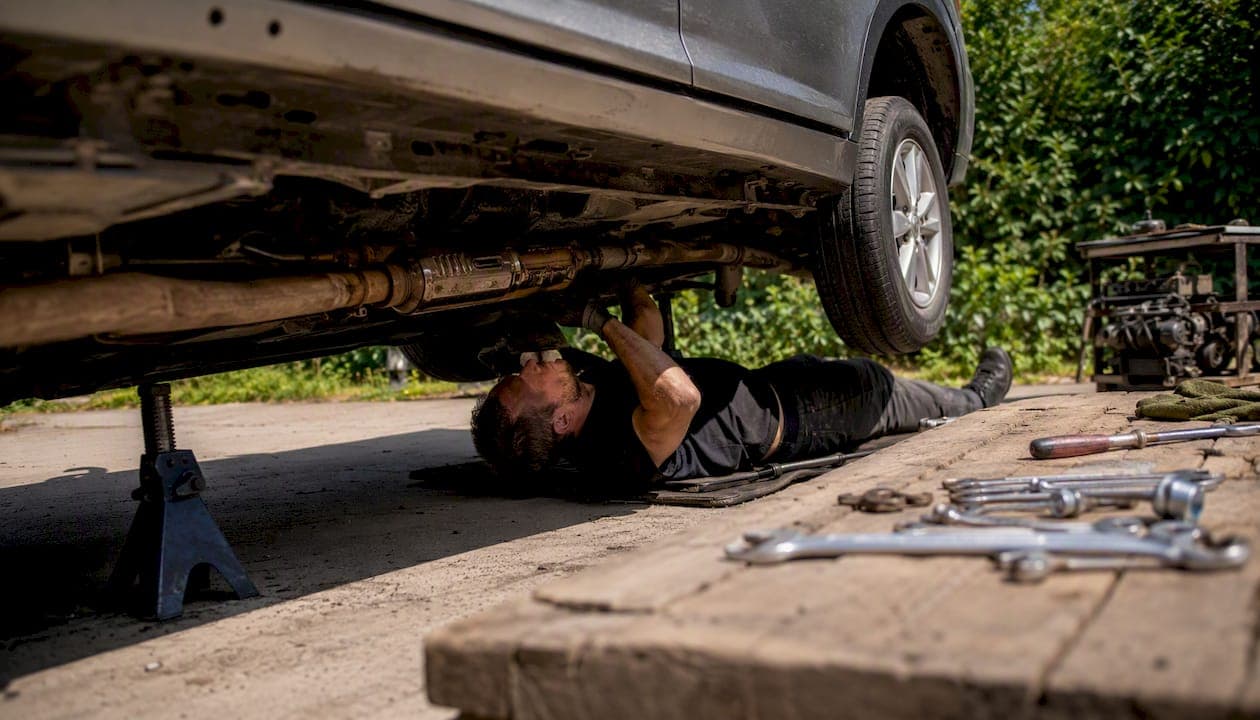
Most junk cars in the U.S. are worth between $200 and $750 in combined scrap and parts value, according to current junk car value estimates. Heavy trucks, SUVs, and any vehicle with an intact catalytic converter or clean drivetrain regularly push past $1,000. Or skip the math and request a quote from a local yard today.
Quick benchmarks to orient your estimate:
- Compact sedan, scrap only: $150–$350
- Mid-size SUV with intact converter: in a moderate range, reflecting larger vehicle and parts value
- Full-size pickup, running engine: generally higher due to weight and running drivetrain.
- Any vehicle with a missing or cut converter: subtract a significant amount reflecting lost converter value
- Cross-check tools: Kelley Blue Book (KBB) for a vehicle baseline, Car-part for used-parts comparables, and Pick-n-Pull's pricing page for yard-level benchmarks
Key Takeaways
A car's parts and scrap value depends primarily on weight, current scrap steel prices, and whether the catalytic converter and engine are intact, with most U.S. junk cars falling between $200 and $750.
| Point | Details |
|---|---|
| Baseline scrap range | Most junk cars are worth $200–$750; trucks and SUVs with intact converters often exceed $1,000. |
| Converter is the biggest variable | A present, intact converter adds $150–$400 or more; a missing one cuts the offer by $200–$500. |
| DIY formula | (Curb weight × 75%) × scrap $/ton ÷ 2,000, plus parts overlays, minus tow reserve. |
| Parts-out vs. whole sale | Parting out yields 2–3x higher gross but rarely nets more after time, fees, and storage costs. |
| Southsidecashforjunkcars | Offers same-day pickup and instant cash for junk vehicles in Calgary and Okotoks, no hidden fees. |
Table of Contents
- How yards and buyers calculate parts car value
- How to estimate your car's parts value yourself
- Which parts sell for the most money
- Is it worth selling parts yourself vs. selling the whole vehicle?
- Channels to sell your car or parts and what to expect
- How to prepare your car and negotiate to maximize the payout
- Sample estimates for common vehicle types
- Paperwork, pickup logistics, and what to expect on the day
- What most sellers get wrong about parts car value
- Southsidecashforjunkcars makes the whole-car route worth it
- Sources
- FAQ
How yards and buyers calculate parts car value
Before a buyer quotes you a number, they sort your vehicle into an economic category. Buyers typically classify vehicles as roadworthy, a parts vehicle, an export-demand drivetrain candidate, or pure scrap. That category, not raw weight alone, drives the offer.
The four economic categories:
- Roadworthy: Minor repairs needed; buyer may retail or auction the car. Highest payout.
- Parts vehicle: Too damaged to drive but has high-demand components. Buyer strips and resells parts individually.
- Export-demand drivetrain: Engine or transmission has strong overseas demand. Buyer pays a premium for the drivetrain.
- Pure scrap: No salvageable parts worth pulling. Price is almost entirely weight × scrap steel rate.
Once the category is set, the math layers on top. From there, buyers add parts overlays for a working converter, engine, or transmission, then subtract a tow and margin reserve.
Scrap steel prices move week to week, and that volatility matters. A $20-per-ton swing on a 3,500-pound car changes the offer by roughly $26. That sounds small, but scrap price swings can shift offers by hundreds of dollars over a few weeks for heavier vehicles. Getting quotes on different days is a real tactic, not just a cliché.
How to estimate your car's parts value yourself
You do not need a dealer account or special software. Here is the formula and a worked example you can run in under five minutes.
The one-line formula:
Typical assumptions:
- Ferrous yield: 70–75% (use 75% as your working default)
- Scrap steel price: check iScrap App or your local yard's posted rate; a common U.S. range is $150–$250 per ton, though it moves frequently
- Tow/reserve: $75–$150 for local pickup; more for rural distances
- Parts overlays: add $150–$400 for a working converter, $200–$600 for a running engine, $100–$300 for a good transmission
Worked example — 2010 Honda Accord sedan:
- Curb weight: 3,200 lbs
- Ferrous yield: 3,200 × 75% = 2,400 lbs of recoverable metal
- Scrap steel at $180/ton: 2,400 ÷ 2,000 × $180 = $216
- Add intact catalytic converter overlay: +$250
- Add running engine overlay: +$300
- Subtract tow reserve: −$100
- Estimated offer: ~$666
This formula captures the primary drivers yards use and gives you a defensible baseline before you pick up the phone.
| Condition variable | Effect on estimate |
|---|---|
| Intact catalytic converter | adds noticeably to value |
| Running engine | adds a moderate premium |
| Missing/stolen converter | deducts a significant amount |
| Stripped or gutted vehicle | lowers value due to missing parts |
| High-demand model (e.g., F-150, Camry) | adds some premium |
Pro Tip: Always confirm catalytic converter status before you call a yard. Whether the converter is present, intact, or missing will often shift the quote more than the vehicle's weight does. Buyers check this immediately.
According to junk car value data, most junk cars in 2026 are worth between $200 and $750, with heavy trucks and SUVs with intact converters regularly exceeding $1,000.
Which parts sell for the most money
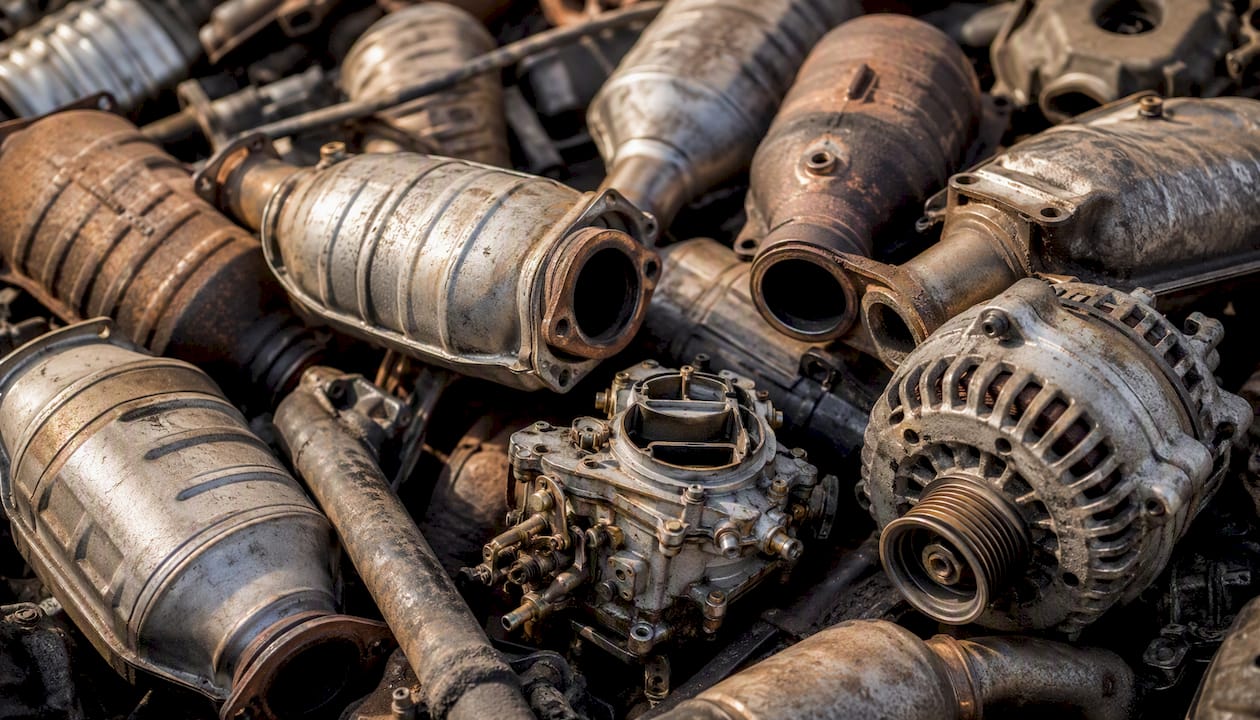
Not all parts are equal. A catalytic converter on a Toyota Prius is worth far more than the same component on a base economy car. Here are the components that move the needle most, with realistic U.S. ranges.
| Part | Typical scrap/resale range | Key caveat |
|---|---|---|
| Catalytic converter | $50–$1,140+ | Platinum/palladium/rhodium content varies sharply by model |
| Engine (OEM, good condition) | $300–$2,500 | Mileage, compression test results, and model demand matter |
| Transmission | $250–$2,000 | Automatic vs. manual; high-demand models command premiums |
| Hybrid battery module | $500–$1,140+ | Capacity test required; EV packs can exceed this range |
| ECU / infotainment unit | $50–$400 | VIN-specific fitment limits the buyer pool |
| Alternator / starter | $30–$150 | Commodity parts; high volume, lower per-unit margin |
| Radiator | $25–$150 | Condition-sensitive; cracks kill value immediately |
| Wheels and tires | $50–$400 per set | Brand, size, and tread depth drive the range |
Catalytic converters are typically the single highest-value component on most vehicles, with specific units ranging from roughly $50 to over $1,140 depending on precious metal content and vehicle type. Engines and transmissions follow, with wide value bands tied to condition and model demand.
One thing most sellers miss: the marketplace you sell through changes the effective price. A converter sold to a specialist buyer nets more than the same converter handed to a general scrap yard. A running engine listed on eBay Motors with photos and a compression test result will outperform the same engine sold to a local yard with no documentation.
Is it worth selling parts yourself vs. selling the whole vehicle?
The short answer: parting out can yield 2–3 times more gross revenue than a whole-vehicle sale, but it rarely nets 2–3 times more cash after time, storage, and listing costs. A parts-out strategy commonly yields higher gross proceeds but requires accurate fitment knowledge, listing skills, and patience.
Reasons to part out:
- Your car has a high-demand engine, transmission, or converter
- The vehicle is a popular model with an active parts market (Camry, F-150, Civic)
- You have storage space, basic tools, and time to list and ship
- You are comfortable handling buyer questions and returns
Reasons to sell whole:
- You need cash within 24–48 hours
- The car is stripped, heavily damaged, or a low-demand model
- You lack storage or tools for disassembly
- The hassle of listing, negotiating, and shipping parts exceeds the upside
If the net falls below $500, the yard offer wins.
Decision checklist:
- Is the model popular enough that parts sell within 30 days?
- Do you have a clean title and can you document part condition?
- Is the converter intact and worth pulling separately?
- Do you have 10–20 hours to invest over the next few weeks?
- Is storage available without cost?
If you answer "no" to three or more of these, selling whole is almost always the better financial decision once you account for your time.
Channels to sell your car or parts and what to expect
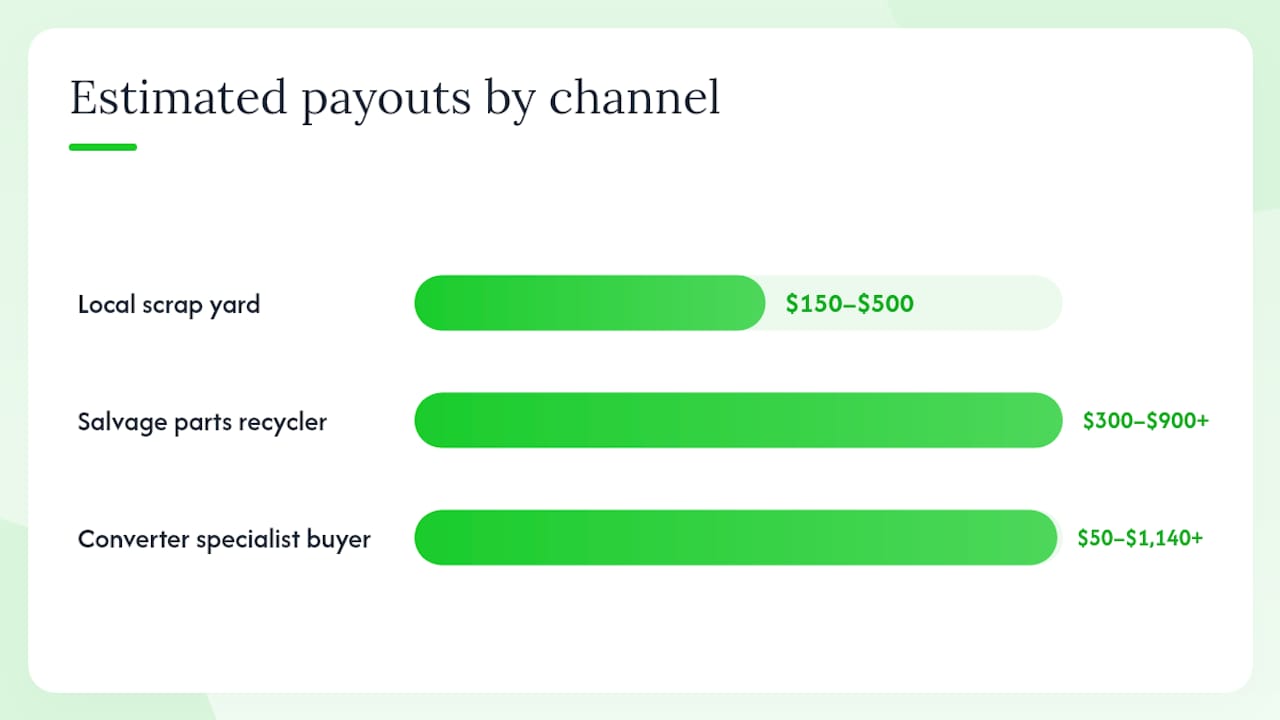
| Channel | Estimation method | Expected payout | Time and effort | Typical payment |
|---|---|---|---|---|
| Local scrap/junk yard | Weight × scrap rate | $150–$500 | Low; same-day | Cash or check on pickup |
| Salvage/parts recycler | Parts overlay + scrap | $300–$900+ | Low-medium | Cash or check |
| Online marketplaces (eBay, Facebook) | Parts-level retail | Highest gross | High; weeks to months | PayPal, Venmo, cash |
| Converter specialist buyer | Precious metal assay | $50–$1,140+ | Low | Cash or wire |
| Cash-for-junk buyer (e.g., Southsidecashforjunkcars) | Parts + scrap formula | Competitive whole-car | Very low; same-day | Cash on pickup |
Pick-n-Pull publishes fixed part pricing for common components, which makes their pages a practical benchmark before you accept any offer. Check their alternator, engine, and transmission prices against what a private buyer is offering you.
Red flags to watch for:
- Buyers who quote high on the phone and drop the offer at pickup without explanation
- No written quote or confirmation before they arrive
- Requests for your title before payment is in hand
- "We'll mail the check" from a buyer you have never met
Always get a quote in writing, confirm the tow is included, and hand over the signed title only when cash or a verified payment is in your hand.
How to prepare your car and negotiate to maximize the payout
Preparation takes under an hour and routinely adds $100–$300 to an offer. Here is what actually moves the number.
- Confirm the catalytic converter is present and intact. Mention it on the call. Buyers price this immediately, and it often changes the quote more than any other single factor.
- Take clear photos. Shoot the VIN plate, all four corners, the engine bay, and the interior. Buyers who can see condition upfront quote faster and more accurately.
- Be honest about running status. "Starts but won't drive" is different from "hasn't started in two years." Accurate information prevents lowball adjustments at pickup.
- List intact high-value parts. If the wheels are good, the battery is new, or the tires have tread, say so. These are real overlays.
- Have the title ready. A clean, signed title removes the single most common reason offers get cut or delayed.
- Use the weight-based baseline as your floor. If a buyer quotes below your formula estimate with no explanation, ask specifically: "Is the converter accounted for?" and "What's your current scrap rate?" A legitimate buyer can answer both.
- Get at least two quotes. Scrap prices vary by yard and by day. A second call on a different day can return a meaningfully different number.
Pro Tip: Minor fixes that pay: a charged battery (so the car starts for the buyer), clean tires with visible tread, and a legible VIN plate. None of these cost more than $20–$30 and each one removes a reason for a price reduction.
One legal note: selling removed catalytic converters is regulated in most U.S. states. Many states now require sellers to provide proof of ownership (VIN documentation) when selling a converter separately. Check your state's current rules before pulling and selling a converter on its own.
Sample estimates for common vehicle types
Here is how the formula plays out across four common archetypes. These are illustrative estimates based on a scrap steel rate of $180/ton and a local tow reserve of $100.
-
Compact sedan (e.g., 2009 Toyota Corolla, ~2,700 lbs): Scrap-only estimate: ~$182. With intact converter and running engine: ~$582. A missing converter drops this to roughly $282.
-
Mid-size SUV (e.g., 2011 Ford Explorer, ~4,400 lbs): Scrap-only: ~$297. With converter and running drivetrain: ~$797. A popular model with good tires and a clean interior can push toward $900 with the right buyer.
-
Full-size pickup (e.g., 2008 Chevrolet Silverado 1500, ~4,800 lbs): Scrap-only: ~$324. With intact converter, running engine, and good transmission: ~$1,024+. F-150s and Silverados have strong parts demand, which pushes the parts overlay higher than the formula alone suggests.
-
Older hybrid (e.g., 2007 Toyota Prius, ~2,900 lbs): Scrap-only: ~$196. The Prius converter is among the most valuable in the market, often adding $400–$800 on its own. With a functional hybrid battery, total estimate: $800–$1,200+.
A stolen or cut converter does not just remove the converter's value. Buyers penalize missing major components more than the part's standalone scrap value, because a stripped vehicle costs more to process. That is why a missing converter can reduce the whole-car offer by more than the converter itself would have fetched.
Paperwork, pickup logistics, and what to expect on the day
Getting the paperwork right prevents the most common delays. Here is what you need and what to expect.
Documents to have ready:
- Signed certificate of title (your name must match the title)
- Government-issued photo ID
- Bill of sale (many yards provide a template; some states require it)
- Lien release if the vehicle had a loan that is now paid off
- Keys (not always required, but missing keys can reduce the offer)
Typical timeline:
- Quote: Same-day by phone or online form; most yards confirm within 1–2 hours.
- Scheduling: Pickup usually available within 24–48 hours; same-day service is common with cash-for-junk buyers.
- Towing: The tow truck arrives, confirms the vehicle matches the description, and loads the car. This takes 20–40 minutes on-site.
- Payment: Cash on pickup is standard for junk buyers. Some yards issue a check; electronic transfer is less common but available with some buyers.
- Post-sale: Notify your state DMV that the vehicle has been sold (requirements vary by state). Cancel your insurance immediately after pickup.
Common delays and how to avoid them:
- Unclear title: If the title has a lien, get the lien release from your lender before scheduling pickup. This is the single most common reason a sale falls through at the last minute.
- VIN mismatch: The VIN on the car must match the title. Check before the buyer arrives.
- Condition discrepancy: If the car's condition differs significantly from what you described, expect a revised offer. Accurate descriptions prevent this.
For a detailed walkthrough of the Calgary pickup process, including what to expect from towing to payment, Southsidecashforjunkcars has published a step-by-step guide.
What most sellers get wrong about parts car value
The conventional wisdom says "part it out and make more money." That is true in gross terms. It is often false in net terms, and the gap between the two is where most sellers lose time and patience.
The real problem is that sellers anchor to retail prices. They look up an engine on eBay, see $1,200, and assume that is what they will get. They will not. A private seller without a warranty, a return policy, or a reputation is competing against reman suppliers and established parts dealers. Buyers discount accordingly, and they should.
The smarter frame is this: treat the yard's whole-car offer as your guaranteed floor, not your ceiling. Every part you sell above that floor is a bonus. If the converter alone fetches $300 and the yard offered $400 for the whole car, pulling the converter first and then selling the rest for $200 is a rational move. But only if you can actually sell the converter legally and quickly.
The other thing sellers underestimate is how much the scrap price moves. Checking current Calgary scrap car prices before you call a yard takes two minutes and can tell you whether this week is a good time to sell or whether waiting ten days might add $50–$100 to the offer.
Southsidecashforjunkcars makes the whole-car route worth it
If you have run the formula and decided selling whole is the right call, the next question is who to call. Southsidecashforjunkcars offers same-day free towing and instant cash payment for junk, non-running, damaged, and scrap vehicles in Calgary and Okotoks. No hidden fees, no lengthy back-and-forth, and no surprise price cuts at pickup when the description matches. The process is three steps: contact them with your vehicle details, schedule a pickup time, and collect cash when the tow truck arrives.
For sellers who want the fastest path from "I need to sell this car" to cash in hand, get a same-day cash offer and find out what your vehicle is worth today.
Sources
For live scrap steel prices, the iScrap App updates rates by region and is the most practical free tool for U.S. sellers. Car-Part.com is the industry standard for checking what salvage yards are currently asking for specific used parts, and it gives private sellers a realistic ceiling for their own listings. KBB provides a whole-vehicle baseline that is useful for context, though it does not reflect scrap or parts-only value directly.
Pick-n-Pull's pricing page lists fixed consumer-facing prices for common parts, including alternators, starters, engines, transmissions, and radiators. These are yard-level prices, not retail, which makes them a conservative but honest benchmark for what a private buyer might reasonably pay.
For sellers in Calgary and Okotoks, Southsidecashforjunkcars's guide to selling a car for parts in Calgary covers local market conditions and the step-by-step process for getting the most from a junk vehicle in the area.
- Junk Car Value Calculator — What's My Junk Car Worth? (2026)
- How to Price Junk Cars in 2026: The Auto Recycler's Guide
- Auto Parts Recycling Value Guide 2025: Which Components Pay Best | ScrapMonster
- How Junk Car Buyers Calculate Value | Dalo Auto Recycling
- Pick-n-Pull | Used Auto Parts Pricing
FAQ
How do you value a car for parts?
Cross-check the result against Car-Part.com comparables and your local yard's posted rates.
What car parts sell for the most money?
Catalytic converters are typically the highest-value single component, ranging from roughly $50 to over $1,140 depending on precious metal content and vehicle model. Engines ($300–$2,500) and transmissions ($250–$2,000) follow, with hybrid battery modules and ECUs also commanding significant premiums on the right vehicles.
What is the $3,000 rule for cars?
The rule is an informal guideline about repair spending relative to vehicle value in running condition; it does not directly consider salvage or parts resale values.
What is the best website to sell used car parts?
eBay Motors and Facebook Marketplace are the two largest platforms for private used-parts sales in the U.S. Car-Part.com is the standard tool for checking what salvage yards are asking for specific parts, making it the best comparables resource before you price anything. For whole-vehicle sales, local cash-for-junk buyers like Southsidecashforjunkcars offer the fastest turnaround with no listing effort.
Does a missing catalytic converter significantly reduce the offer?
Yes, and by more than just the converter's standalone value. Buyers penalize missing major components because a stripped vehicle costs more to process, so a missing converter can reduce a whole-car offer by $200–$500 or more, often exceeding what the converter itself would have fetched at a scrap yard.