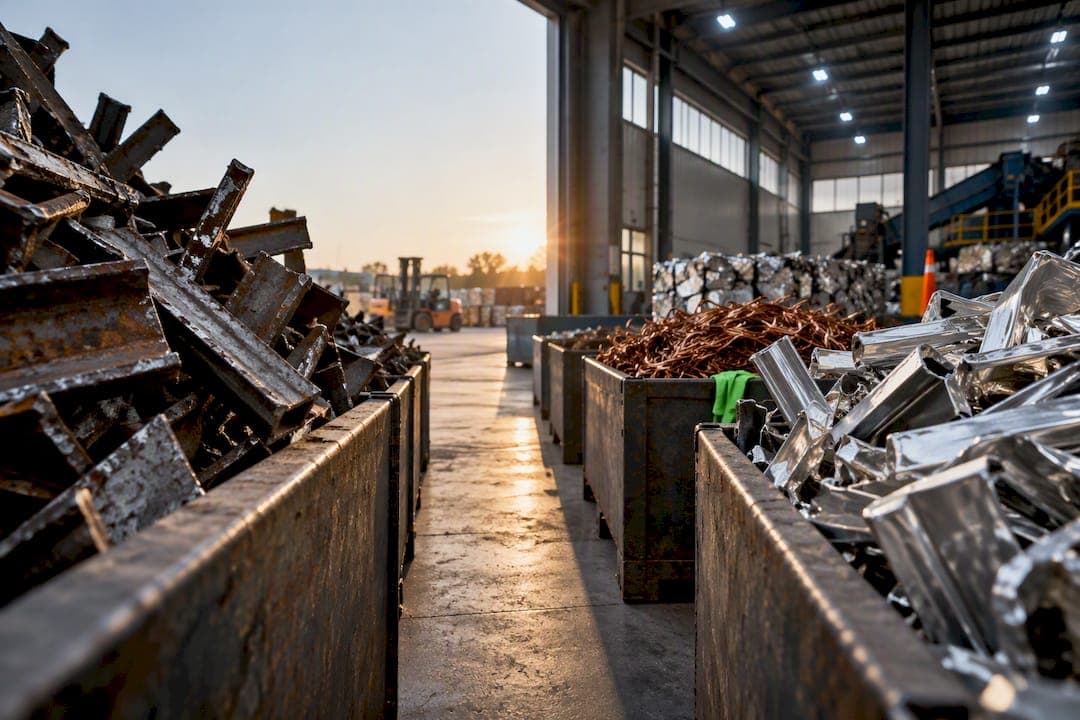
Yes, scrap metal prices move your payout, but for most cars the swing is modest. Weight and price per ton set the floor, while condition and an intact catalytic converter usually decide whether you get a bigger check. Yards start with a straightforward math problem: tons of steel times the going rate, then they add value for parts and non-ferrous metal before subtracting fees.
TL;DR:
- Scrap metal prices influence a car's base value, but the catalytic converter and high-value parts often provide the largest separate contributions.
- The calculation formula is weight divided by 2,000, multiplied by the current price per ton, plus separate non-ferrous and parts values, minus fees.
- Short-term scrap price fluctuations usually result in only a $15 to $40 difference per month, making timing less critical for most owners.
- Selling a whole car typically yields more money than parting it out if the vehicle runs and paperwork are in order, but parting can be more profitable for high-demand models.
- A same-day cash offer with pickup and payment on the spot provides greater certainty and can outweigh potential gains from waiting for higher prices or market swings.
Table of Contents
- How Scrap Metal Prices Feed Into a Car's Base Value
- How Yards Calculate Offers: The Formula Behind the Number
- Which Vehicle Traits Actually Move Your Quote
- Does Waiting for Higher Scrap Prices Actually Pay Off?
- A Step-by-Step Checklist for Getting Paid More
- Long-Term Scrap Trends and What They Mean for Used Car Values
- Why Your Location Changes What Your Car Is Worth
- How Environmental Rules Shape What Buyers Will Pay
- Scrapping vs. Selling Whole vs. Parting Out: Which Nets More?
- Why Convenience Often Beats Chasing a Few Extra Dollars
- Get a Same-Day Cash Offer Without the Wait-and-See Game
- Sources
- FAQ
How Scrap Metal Prices Feed Into a Car's Base Value
Every junk car quote starts with shredded auto scrap, the crushed steel body that mills melt down and reuse. Yards price this by the ton, and that rate shifts with steel demand from construction, manufacturing, and export markets. Recycled metal is a real commodity that feeds directly back into industrial supply chains, which is why Natural Resources Canada tracks it as part of the country's material flows rather than treating it as waste.
But steel is only one line on the invoice. Cars carry three distinct metal streams that yards price separately:
- Ferrous scrap (steel body and frame) — priced per ton, the largest single component by weight but often the smallest dollar contributor per pound.
- Non-ferrous metals (aluminum wheels, copper wiring, radiators) — priced separately because aluminum and copper trade on different markets than steel and typically fetch far more per pound.
- Catalytic converter (platinum, palladium, rhodium) — tied to precious-metal markets that move independently of steel prices entirely, according to U-Pull-It's market analysis.
Here's how that plays out on a real vehicle. A mid-size sedan weighing around 3,000 pounds works out to 1.5 tons. Using the standard consumer formula of weight in pounds divided by 2,000, then multiplied by the price per ton, SellCarAdvisor's guide shows how that base number gets built before anything else is added. If a yard is paying a typical rate per ton for shred that week, the base steel value lands around a few hundred dollars. Add a working catalytic converter, a decent set of aluminum wheels, and usable copper wiring, and that number can climb well past the base steel figure alone. The converter, not the steel, is frequently the biggest line item on the ticket.
How Yards Calculate Offers: The Formula Behind the Number
Every legitimate quote traces back to one formula: (weight in pounds ÷ 2,000) × price per ton, plus non-ferrous value, plus parts value, minus fees. Once you know this, a vague phone quote stops sounding like a mystery and starts looking like a math problem you can check yourself.
The deductions are where offers diverge, sometimes sharply, between buyers. Common subtractions include:
- Towing fees, though many local buyers waive this if you're selling the whole vehicle rather than just parts.
- Title or paperwork issues, since a missing title can slow payment or reduce the offer entirely, as explained in rebuilt title cars explained.
- Missing or stripped parts, particularly a removed catalytic converter, engine, or transmission.
- Environmental handling charges for fluids like oil, coolant, and refrigerant that must be drained and disposed of properly.
The type of buyer matters just as much as the formula. A straight scrapyard pays mostly for weight and metal content. A part-out buyer, someone reselling your alternator, doors, or transmission individually, often pays more because they're monetizing components at retail-adjacent prices rather than scrap rates. Online resellers and national aggregator sites sit somewhere in between, frequently taking a cut before a local buyer ever sees your car. Knowing the difference between a junkyard and a scrapyard before you call around saves you from comparing quotes that aren't actually comparable.
Which Vehicle Traits Actually Move Your Quote
Scrap price sets the baseline, but four vehicle-specific factors decide how far above that baseline your offer lands.
- Weight class: A compact sedan around 2,800 pounds nets a smaller base payout than a full-size pickup at 5,000 pounds or more, simply because more steel means more tons.
- Running condition: A drivable car commands a real premium over a non-running one, since buyers can resell it whole or part it out without paying for extraction labor.
- High-value components: Catalytic converters, engines, transmissions, and aluminum wheels can individually add more value than the entire steel body, especially on trucks and SUVs with larger converters.
- Model and year demand: A popular model with parts still in circulation, think a Honda Civic or Ford F-150, often draws a premium because part-out buyers know they can resell components quickly.
Pro Tip: Ask any buyer for a breakdown of base scrap value versus parts value versus converter value before accepting an offer. If they can't itemize it, they're likely lowballing one category to inflate another.
The U-Pull-It market data makes clear that the converter alone can exceed the entire base scrap value of the vehicle on many models, which is exactly why serious buyers price it as its own line rather than folding it into the general weight calculation.
Does Waiting for Higher Scrap Prices Actually Pay Off?
Weekly and monthly scrap price swings are real, but they rarely translate into meaningful money for a single car. Industry survey data on shredded scrap pricing shows the kind of month-to-month volatility that traders track closely, driven by structural forces like tariff policy and electric arc furnace demand rather than daily noise, according to the Steel Market Update scrap survey. Those forces move markets over months and years, not the week you happen to be selling.
For a typical sedan, that volatility usually shows up as a difference of $15 to $40 across a month, not hundreds of dollars, based on consumer-facing estimates from Car Amaze's junk car value guide. Tariff shifts and mill demand can nudge prices structurally higher over a year or two, but betting on a short-term spike for one car is closer to guessing than strategy.
Pro Tip: If your car has been sitting for weeks anyway, don't lose sleep over a $20 swing in scrap rates. Get it picked up. The exception is a large fleet vehicle or an OEM catalytic converter known to carry unusually high PGM content, where a real market surge can matter.
A Step-by-Step Checklist for Getting Paid More
Getting a fair offer isn't about luck. It's about showing up prepared and asking the right questions.
- Gather your title, registration, and a few photos. Buyers move faster, and pay faster, when ownership is clear upfront.
- Leave high-value parts intact until you get quotes. Pulling the battery or catalytic converter yourself before calling around almost always costs you more than it saves.
- Get two or three quotes and ask for itemized numbers. A buyer willing to break down base scrap, parts, and converter value separately is generally more transparent about how they arrived at the total.
If your car is worth more disassembled, a rare engine, low-mileage transmission, intact wheels, that math sometimes favors selling parts individually. But factor in the weeks of listing, shipping, and buyer negotiation that takes. For most owners, the time cost outweighs the marginal gain.
Pro Tip: Before agreeing to a pickup, confirm three things out loud: whether towing is free, what documentation they need at pickup, and whether payment happens on the spot or after. Reputable buyers answer all three without hesitation. Checking what a same-day pickup actually involves before you call helps you spot a buyer who's organized versus one who's stalling.
Long-Term Scrap Trends and What They Mean for Used Car Values
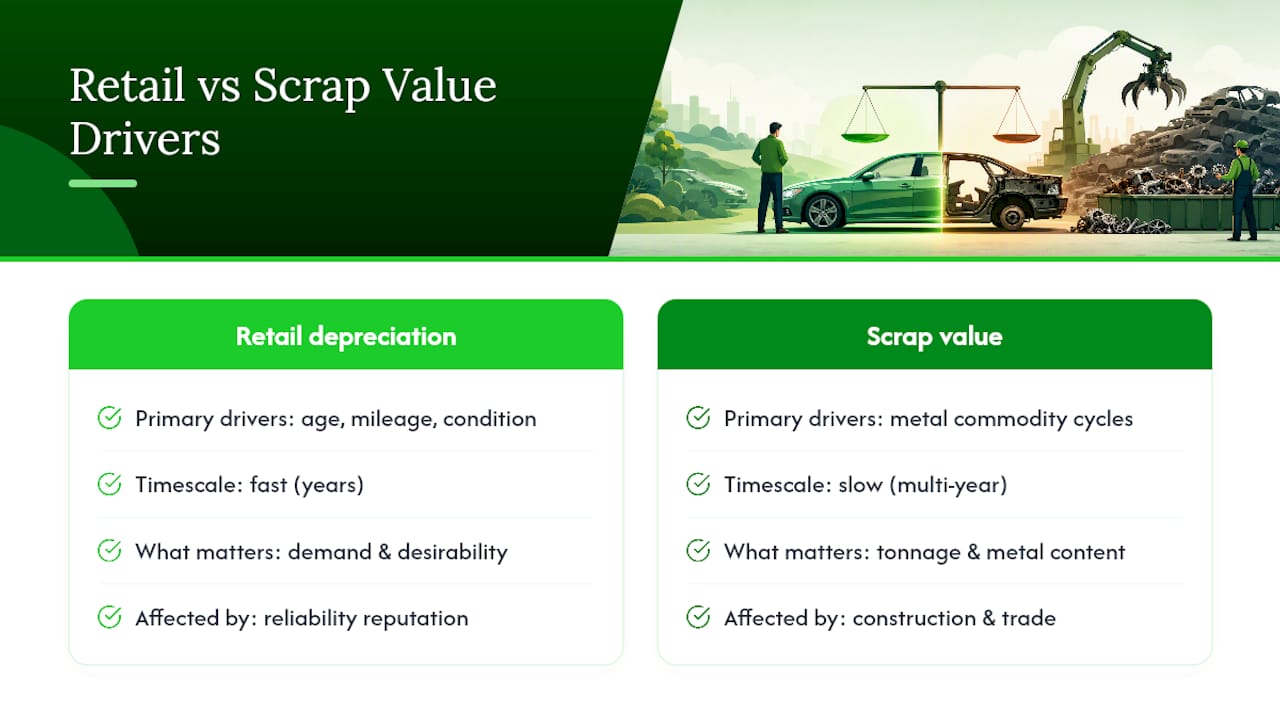
Scrap prices and used car values move on different clocks, and mixing them up leads to bad decisions. Retail depreciation, the value drop a car experiences on the used car market, is driven by age, mileage, and condition, and can strip a large share of a vehicle's original price within the first several years, according to Experian's analysis of car depreciation. That's a demand-and-desirability story tied to reliability reputations and market taste.
Scrap value follows commodity cycles instead, tracking steel, aluminum, and copper markets that respond to construction activity, manufacturing output, and global trade policy. A car can be nearly worthless on the resale market while its scrap value stays fairly stable, because scrap buyers care about tonnage and metal content, not brand reputation or curb appeal.
Over multi-year stretches, rising steel demand from infrastructure spending or expanding electric arc furnace capacity can lift the entire scrap price floor, meaning even heavily depreciated cars retain a slightly higher baseline value than they would in a soft market. That's a slow structural shift, though, not something that shows up meaningfully between one quote and the next.
Why Your Location Changes What Your Car Is Worth
Scrap prices vary by region because transportation costs and local mill demand differ significantly city to city. A car sitting near an active steel mill or a major port with export access to Asian steel markets tends to fetch a better scrap rate than the identical car in a region far from processing infrastructure, since buyers factor in what it costs them to move that metal to a mill or shredder.
Trade-in values at dealerships follow separate regional logic entirely, driven more by local demand for that specific model (trucks command a premium in rural markets, hybrids do better in cities with high fuel costs) than by scrap metal rates. Understanding which regional force is actually driving your offer, metal logistics for scrap, or model demand for trade-in, keeps you from comparing apples to oranges when you're shopping quotes across different types of buyers in your area.
How Environmental Rules Shape What Buyers Will Pay
Environmental regulations affect scrap pricing more than most owners realize. Buyers must properly drain and dispose of fluids, oil, coolant, refrigerant, and brake fluid, before a vehicle can be legally shredded, and that disposal work costs money that often gets subtracted from your offer as a handling fee.
On the flip side, stricter emissions standards have pushed automakers toward higher-PGM catalytic converters over the past two decades, which has quietly made converters more valuable at scrap time even as it made cars more expensive to manufacture new. Regulatory pressure on mills to source more recycled steel, rather than virgin ore, also supports long-term scrap demand, reinforcing the same structural trend covered in the long-term pricing section above.
Scrapping vs. Selling Whole vs. Parting Out: Which Nets More?
Selling a car whole to a private buyer typically nets the highest total dollar figure, assuming the car runs and has clean paperwork, because you're capturing functional value on top of metal value. That path also takes the longest: listing, showings, negotiating, and the real risk of a buyer backing out.
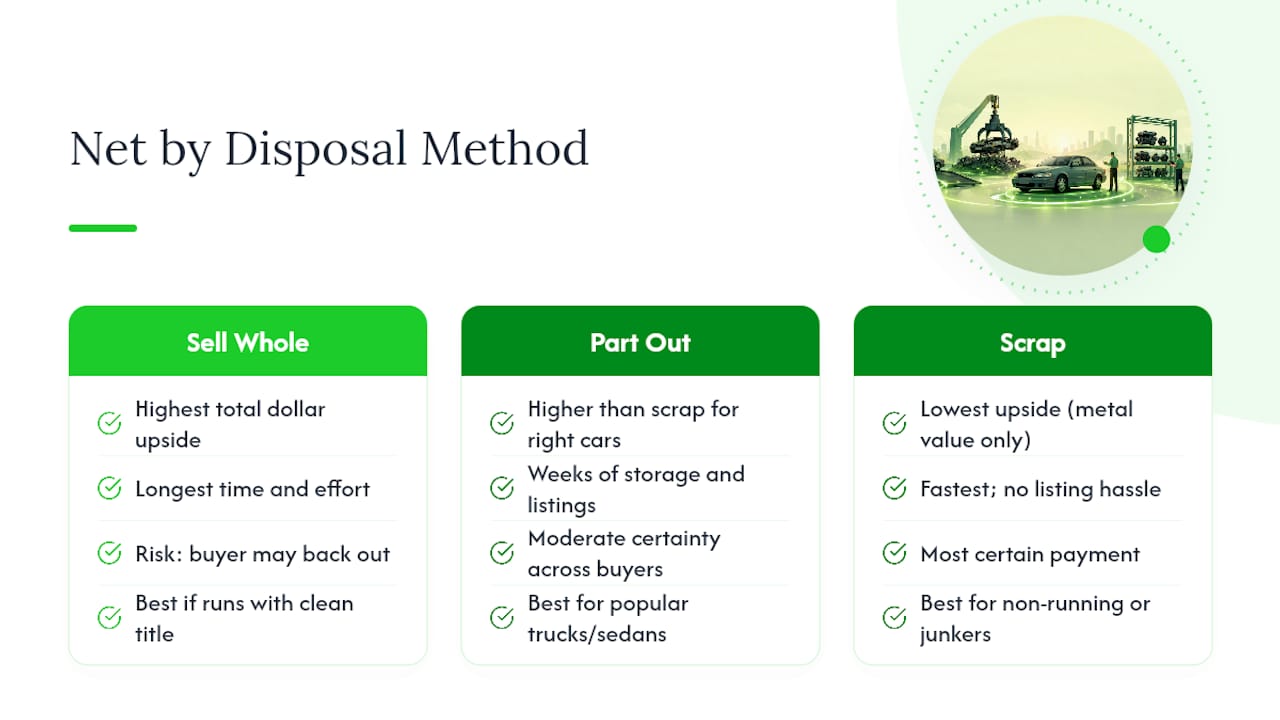
Parting out a vehicle, selling the engine, transmission, wheels, and electronics individually, can outperform a scrap sale by a meaningful margin on the right vehicle, particularly popular trucks and sedans with strong demand for used parts. It also demands storage space, listing effort across multiple platforms, and weeks of buyer coordination.
Scrapping the whole car is the fastest and most certain path, and often the only sensible one for a non-running vehicle with title complications or extensive damage. You trade some upside for speed, certainty, and zero listing hassle, a trade that makes sense for anyone who values their time as much as the marginal dollar. If your vehicle shows these signs of being officially a junker, that decision usually makes itself.
Why Convenience Often Beats Chasing a Few Extra Dollars
Chasing a slightly better scrap rate rarely pays off the way people expect. A $20 or $30 swing in monthly pricing means almost nothing against the real cost of a car sitting in your driveway for another three weeks: insurance you're still paying, space you can't use, and the risk that a stripped part shows up before you finally sell.
Certain sellers benefit most from immediate removal regardless of market timing: anyone with a non-running vehicle, anyone dealing with a lapsed or complicated title, and anyone who just needs the space back today. For that seller, a same-day cash offer isn't a compromise. It's the better math once you count the full cost of waiting, not just the metal price on the sticker.
The owners who regret their decision are rarely the ones who took a fair offer quickly. They're the ones who held out for a market swing that never came while the car kept losing usable parts to weather and time.
— Franz
Get a Same-Day Cash Offer Without the Wait-and-See Game
Some local buyers offer an alternative to guessing at scrap timing: instead of watching weekly price charts for a $20 swing, they provide a straightforward cash number today, same-day pickup, and no hidden fees subtracted after the fact.
The three-step process is built for sellers who value certainty over speculation: contact the team, get your vehicle picked up, and get paid in cash on the spot. That fits running and non-running vehicles alike, including cars with a blown engine, failed transmission, or a title that's more paperwork headache than asset. Have your vehicle's year, make, model, and general condition ready when you call. That's what lets an offer come together fast rather than requiring a second call to fill in details. Whether you're clearing driveway space or finally letting go of a car that failed inspection one too many times, request your cash offer for junk cars and see the number before you commit to anything.
Sources
- What is depreciation on a car? | Experian
- How Much Is Your Junk Car Worth? | SellCarAdvisor
- Scrap Metal Price Trends 2026: What Is Your Junk Car Worth Today? | U-Pull-It
FAQ
Who Pays the Highest Price for Scrap Cars?
Local buyers who both scrap and part out vehicles typically pay more than pure scrapyards or national aggregator sites, because they can capture parts value on top of base scrap value. A same-day cash buyer that eliminates towing fees and pays on the spot often nets you more than a listing site that takes a cut before connecting you to a local buyer.
How Do I Calculate the Scrap Value of My Car?
Divide your car's weight in pounds by 2,000 to get tons, then multiply by the current price per ton for shredded auto scrap, as explained in SellCarAdvisor's calculation guide. Add separate value for non-ferrous metals like aluminum and copper, plus catalytic converter value, since those price on entirely different markets than the steel body.
How Much Scrap Do You Get for a Car?
It depends heavily on weight, condition, and whether the catalytic converter is intact, but base steel value alone on a typical sedan is often a few hundred dollars before parts and converter value get added. A running vehicle with a working converter and usable aluminum wheels can push well past that base figure.
How Much Value Does a Car Lose Per 1,000 Miles?
Retail depreciation from mileage varies by model and market demand, and it's a separate calculation from scrap value entirely, according to Experian's depreciation research. A high-mileage car can still carry solid scrap value even after its trade-in price has dropped significantly, since scrap buyers price weight and metal content, not odometer readings.