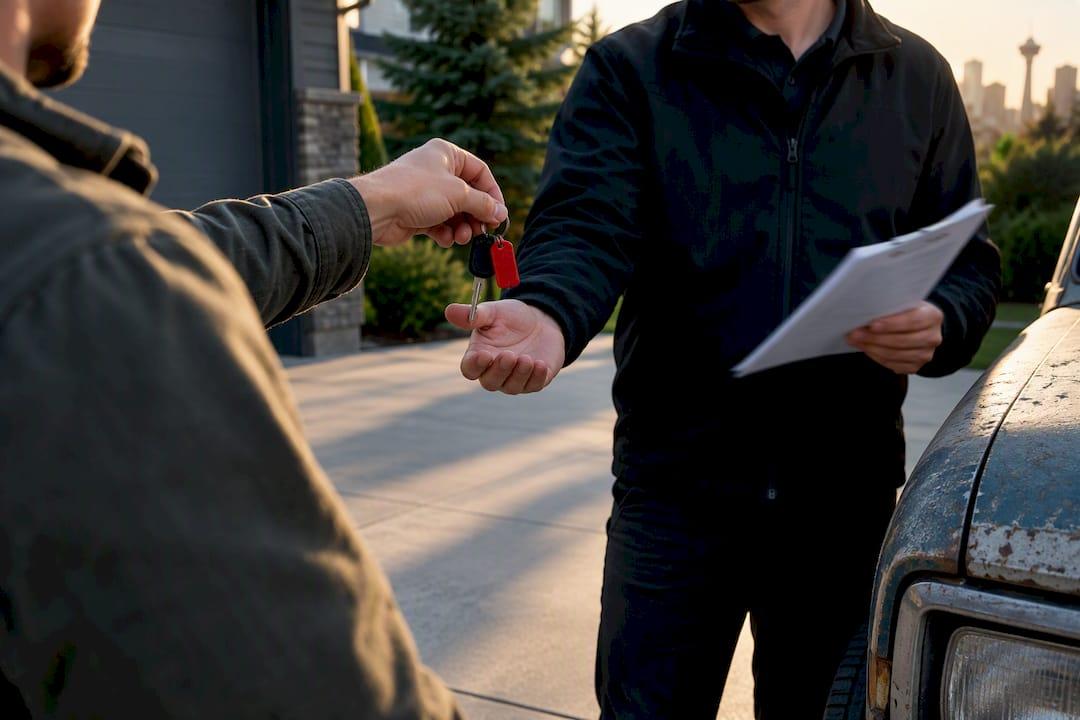
Most Canadians who sell a personal junk car do not owe income tax on the sale. Exceptions apply if the vehicle was used in a business, if the seller is a GST/HST registrant, or if the transaction involves a charitable donation receipt. The sections below walk through the CRA rules, provincial registration taxes, and the paperwork you need to close the deal cleanly.
TL;DR:
- Most Canadians selling junk cars do not owe income tax unless the vehicle was used in a business, involved in a charitable donation, or the sale results in a rare capital gain.
- Private sales between individuals typically do not involve GST/HST or provincial sales tax, which are paid by the buyer at registration rather than the seller.
- Tax obligations for scrap or dismantling are minimal for private owners, and most sales under $1,000 are deemed to be valued at $1,000 by CRA, eliminating capital gain concerns.
- Sales involving a business vehicle trigger complexity, including recaptured depreciation or terminal losses, requiring detailed recordkeeping and proper reporting.
- Completing ownership transfer, canceling insurance, and securing signed receipts are crucial steps to avoid future liability, regardless of sale value or method.
Table of Contents
- Why private sales of personal junk cars are usually tax free
- How GST/HST and provincial taxes apply when a car changes hands
- If the car was used in a business: CCA, recapture, and terminal loss
- Finishing the paperwork after you sell or scrap the car
- Donating a junk car: does it beat selling for cash?
- How Southside Cash For Junk Cars handles the paperwork side
- Selling parts separately from the vehicle: does that change the tax picture?
- Environmental and disposal fees: what actually gets charged
- Beyond Ontario: how other provinces handle the same transaction
- What actually matters when you sell a junk car
- If you prefer a fast local option, here is where to start
- Sources
- FAQ
Why private sales of personal junk cars are usually tax free
The Canada Revenue Agency treats most vehicles as personal-use property, meaning you bought and drove the car for your own enjoyment rather than to earn income. Personal-use property rarely gains value over time, so selling your beat-up sedan for less than you paid for it does not usually create a taxable event. The CRA's guidance on capital gains confirms that a disposal of personal-use property, including an automobile, typically does not produce a reportable capital gain because these assets tend to depreciate rather than appreciate.
There is a narrow exception. If you happened to sell your junk car for more than its adjusted cost base, that gain is technically taxable and belongs on Schedule 3 of your tax return. In practice this almost never happens with a vehicle destined for the scrapyard, since cars lose value every year they are driven.
Personal-use property basics:
- The car must have been used mainly for personal transportation, not primarily for business.
- A capital loss on personal-use property is generally not deductible, so you cannot write off the drop in value from purchase price to scrap price.
- Reporting is only required when your proceeds exceed your adjusted cost base.
- Junk cars sold for amounts generally under the CRA's deeming threshold almost never trigger a filing requirement.
A CRA reporting shortcut helps here too. When both your adjusted cost base and your sale proceeds are $1,000 or less, the CRA deems both figures to be $1,000. Since most junk cars sell for scrap or parts value well under that threshold, this rule usually zeroes out any capital gain calculation before it starts. The upshot is straightforward: if you are an ordinary owner selling a vehicle you drove for years and it is now worth more as metal than transportation, you almost certainly owe nothing and report nothing.
How GST/HST and provincial taxes apply when a car changes hands
Sales tax on a used vehicle depends less on the car and more on who is selling it. A private individual selling their own car is not collecting sales tax on the deal, but the buyer may still owe money to their province when they register the vehicle.
- In a private sale between two individuals, GST/HST generally does not apply because the seller is not acting as a GST/HST registrant.
- If the seller is a GST/HST registrant, such as a dealership or a business disposing of a company vehicle, GST/HST must be charged on the sale.
- Provincial registration tax is usually collected from the buyer, not the seller, when the vehicle is registered in the buyer's name.
- Vehicles moved across provincial lines can sometimes qualify for a rebate of the provincial portion of HST paid, using Form GST495.
Ontario offers the clearest example of how this plays out at the counter. Ontario charges Retail Sales Tax on specified vehicles bought privately, calculated on whichever is higher: the price the buyer actually paid or the vehicle's wholesale value from the Canadian Red Book. A buyer registering a privately purchased car at ServiceOntario pays this tax directly at that counter, not to the seller.
| Scenario | Who collects tax | Tax type |
|---|---|---|
| Private sale, non-registrant seller | Nobody at sale; buyer pays at registration | Provincial RST (Ontario example) |
| Sale by a dealership or GST/HST registrant | Seller | GST/HST |
| Interprovincial vehicle transfer | Buyer may apply for rebate | GST495 rebate of provincial HST portion |
A junk car headed for parts or scrap rarely triggers RST at all, since many buyers in that situation are dismantlers or recyclers rather than private individuals registering the car for the road. Still, if you sell to a private buyer who intends to drive the vehicle, expect them to pay provincial tax when they register it, not you.
If the car was used in a business: CCA, recapture, and terminal loss
The math changes entirely once a vehicle has been claimed as a business asset. If you deducted capital cost allowance (CCA) on the car through your business, the CRA compares your sale proceeds to the vehicle's undepreciated capital cost at the time of sale, not to what you originally paid.
- Proceeds higher than the UCC create recaptured CCA, which counts as taxable business income.
- Proceeds lower than the UCC create a terminal loss, which you can generally deduct against business income.
- Both outcomes get reported through your business tax filing, using figures pulled from your T2125.
- Vehicles used partly for personal driving require an allocation between business and personal use before any of this math applies.
Recordkeeping matters more here than anywhere else in this article. The CRA expects a mileage logbook, purchase and repair invoices, and a running CCA schedule showing how the UCC declined year over year. Sellers who claimed generous vehicle deductions but cannot produce logs to back them up are the ones who draw audit attention when the vehicle is finally sold or scrapped.
Pro Tip: Pull your CCA schedule from last year's tax file before you sell a business vehicle. Knowing the UCC ahead of time tells you whether the sale will help or hurt your tax bill.
Finishing the paperwork after you sell or scrap the car
Closing out a junk car sale properly protects you from liability the buyer might otherwise leave on your plate, from unpaid tickets to registration issues months later.
- Transfer ownership through your provincial registry; in Ontario this happens at ServiceOntario, where the buyer also pays any provincial tax owed.
- Cancel your insurance and registration the same day the vehicle leaves your possession, not weeks later.
- Keep a signed bill of sale or wrecking receipt listing the date, price, odometer reading, and both parties' names.
- Bring photo ID and the vehicle's ownership documents to the transfer appointment or handoff.
- If the car is going to a dismantler, get a receipt confirming the vehicle was received for scrap, and confirm the buyer will handle any salvage title paperwork on their end.
Readers in Alberta can check our proof-of-ownership checklist for scrapping in Alberta and Calgary transfer instructions for province-specific detail.
Donating a junk car: does it beat selling for cash?
Some charities accept vehicle donations and issue a tax receipt, but the rules around valuation vary by charity, and a junk vehicle rarely produces a receipt large enough to outweigh a cash sale.
- A charity typically values the donated vehicle based on its condition and resale or scrap value, not its original purchase price.
- The resulting donation tax credit reduces the tax you owe rather than putting cash in your pocket immediately.
- Selling for cash usually pays out faster and, for a genuinely non-running vehicle, often for more than the credit a donation would generate.
- Pickup timing matters for donations too: a receipt dated late in the year lands on that year's return, while one issued in January counts toward the following year.
For most owners of a scrap-bound vehicle, a straight cash sale is the simpler and often more valuable path, though donation remains worth considering for a charity you already support.
How Southside Cash For Junk Cars handles the paperwork side
Southside Cash For Junk Cars pays cash on the spot for junk, non-running, and damaged vehicles in Calgary and Okotoks, with same-day pickup and no hidden fees. At pickup, sellers receive documentation of the sale, the kind of signed record this article recommends keeping for your own protection once a vehicle leaves your name. Proper paperwork helps close out the ownership and liability side of a sale quickly.
Selling parts separately from the vehicle: does that change the tax picture?
Some owners strip a junk car for valuable parts, such as a working transmission or catalytic converter, and sell those pieces separately from the shell. For most private sellers, the tax treatment does not really change: parts sold individually are still personal-use property proceeds, and the same personal-use rules and the $1,000 deeming threshold described earlier still apply to the totals involved.
Where it gets more complicated is volume and intent. Someone who regularly buys wrecks, parts them out, and resells the components on a recurring basis starts to look less like a private seller disposing of personal property and more like someone carrying on a business, which brings GST/HST registration and income reporting into play. An occasional seller stripping one car they owned and drove does not typically cross that line. Keep a simple record of what sold for what, since it makes any future conversation with the CRA far easier, even if you never end up needing to report anything.
Environmental and disposal fees: what actually gets charged
Junk car removal sometimes involves fees tied to environmental handling, such as fluid draining, tire disposal, or battery recycling, depending on the dismantler or scrap yard involved. These are typically operational charges set by the recycler rather than a government tax, and they can be deducted from what a seller is quoted or built into the price a buyer pays for the vehicle.

Reputable buyers who offer same-day pickup, including services in the Calgary and Okotoks area, generally absorb these costs into their standard offer rather than billing the seller separately. If you are comparing quotes, ask directly whether the number you are given is the amount you will actually receive in hand, since a lower headline price with no fees can beat a higher one with deductions.
Beyond Ontario: how other provinces handle the same transaction
Ontario's RST example makes provincial registration tax concrete, but every province runs its own version of this at registration time. British Columbia charges provincial sales tax on used vehicle purchases based on a similar comparison between purchase price and average wholesale value. Quebec applies the Quebec Sales Tax at registration through the Société de l'assurance automobile du Québec, again generally the buyer's responsibility rather than the seller's.

Alberta, where Southside Cash For Junk Cars operates, has no provincial sales tax at all, which simplifies the picture for Calgary and Okotoks sellers considerably: there is no RST-style tax to calculate on either side of a private junk car sale. Wherever you sell, the pattern holds across provinces: the seller of a personal vehicle is rarely the one collecting or remitting sales tax, and the paperwork obligation is mostly about proving the transfer happened, not about tax withholding. Our breakdown of junk car prices by province covers how payouts themselves differ across the country.
What actually matters when you sell a junk car
The tax question around junk cars gets more attention than it deserves, and the paperwork question gets less. Most sellers spend their worry on whether the CRA will come after them for a $400 scrap sale, when the real risk sitting in front of them is a buyer who never transfers the registration and leaves a parking ticket or a liability claim attached to the seller's name months later.
The conventional advice online treats every used car sale like a small business transaction requiring forms and receipts for the tax authority. For a genuine junk car owned and driven personally, that is mostly noise. The CRA's own personal-use property rules and the $1,000 deeming threshold quietly resolve the tax question for almost everyone in this position. What deserves the reader's attention instead is the bill of sale, the registration cancellation, and confirming who takes responsibility for the vehicle once it leaves the driveway. Get that part right first, and the tax side of a junk car sale mostly takes care of itself.
— Franz
If you prefer a fast local option, here is where to start
If you would rather skip the negotiating and get a straightforward cash number today, Southside Cash For Junk Cars buys junk, non-running, damaged, and scrap vehicles across Calgary and Okotoks with same-day pickup and no hidden fees.
The process often covers cash for cars, junk car towing, and scrap car removal, so whether the vehicle runs or not, it can be gone the same day you call. Visit the scrap car removal page to request a quote and arrange pickup. Whichever buyer you choose, hold onto the receipt or bill of sale they hand over: it is the document that closes out both the tax and liability side of the sale.
Sources
FAQ
Do I owe tax when I sell my personal junk car in Canada?
Most Canadians selling a personal junk car owe no income tax, since these vehicles count as personal-use property that typically depreciates rather than gains value. A capital gain only arises if your proceeds somehow exceed your original cost, which is rare for a scrap-bound vehicle.
How much do you get for scrapping a car in Ontario?
Payouts depend on the vehicle's weight, condition, and current scrap metal prices, so there is no single fixed amount across Ontario. Getting a quote directly from a local buyer or dismantler is the only reliable way to know what a specific vehicle is worth.
What tax do you pay on a used car in Manitoba?
Manitoba, like other provinces, generally collects a retail sales tax on used vehicle purchases at the point of registration, with the buyer responsible for that payment. The exact calculation method can differ from Ontario's Red Book approach, so confirming the current rate with Manitoba's registration office is worthwhile before you buy or sell.
What is the tax on a used car in Nova Scotia?
Nova Scotia applies its own provincial tax rules at vehicle registration, separate from the GST/HST that may apply on a dealership sale. As with other provinces, a private sale between individuals typically does not involve the seller collecting tax, since that obligation falls to the buyer at registration.
Are there taxes on trade-ins or scrap metal value when I sell a junk car?
Trading in a vehicle or selling it for scrap metal value does not usually create a separate tax event for a personal-use vehicle, since the same personal-use property rules apply regardless of who buys it. The exception remains business-use vehicles, where sale proceeds are compared against undepreciated capital cost to determine recapture or a terminal loss.