
You can only scrap a car in Alberta if you show government-issued photo ID proving your 18 or older, and for high-theft items like catalytic converters, dealers also need a VIN or vehicle-specific ownership proof before they'll touch the deal. Dealers are required to log the transaction details and typically want a traceable payment method, not cash in an envelope. Skip any of this and you'll likely get turned away at the gate.
TL;DR:
- Proof of ownership can be a current Alberta vehicle registration or a signed bill of sale with vehicle details and signatures, which must be physically signed.
- Acceptable ID includes Alberta driver's licenses, ID cards, or valid passports; catalytic converter transactions require VIN verification and ownership proof before acceptance.
- Bring government-issued photo ID, vehicle documents, keys, photos, and a traceable, pre-arranged payment method for a quick, straightforward scrap process.
- Handling scrapping for someone else or an estate requires additional documents like notarized power of attorney or probate paperwork, along with owner authorization.
- Dealers are required to log transaction details such as name, address, vehicle info, date, payment, and payment method to ensure traceability and prevent theft.
Table of Contents
- What Counts as Proof of Ownership for Scrapping in Alberta?
- How Do Dealers Verify Ownership and Check Age?
- What Should You Bring to the Scrap Dealer?
- Selling or Scrapping a Vehicle You Don't Own
- What Will the Dealer Record About Your Transaction?
- How to Scrap a Car in Alberta Step by Step
- Can You Scrap an Abandoned Vehicle or One Without Clear Title?
- Do Business-Owned Vehicles Need Different Paperwork?
- What if You've Lost Your Ownership Documents?
- Are There Alberta-Specific Forms for Vehicle Scrapping?
- Local Perspective: Why Alberta's Rules Matter
- Ready to Scrap Your Car? Here's What Southsidecashforjunkcars Handles for You
- Sources
- FAQ
What Counts as Proof of Ownership for Scrapping in Alberta?
Alberta's scrap dealers don't ask for a title. The province doesn't issue vehicle titles the way some U.S. states do. What they want instead is a paper trail showing the vehicle is legitimately yours to sell, along with your own identity check.
Here's what typically satisfies that requirement:
- Alberta vehicle registration (current or the most recent one issued) showing your name matching your ID.
- A bill of sale, dated and signed by both buyer and seller, with a full vehicle description including year, make, and the serial number or VIN. According to Alberta's required ownership documents, electronic signatures may not be accepted on some of these forms, so a physical signature is the safer bet.
- A probated will or letters of administration, needed when the vehicle belonged to someone who has passed away and the estate is settling.
- An Authorization for Vehicle Services form, used when someone other than the registered owner is handling the transaction on the owner's behalf.
- Out-of-province or salvage paperwork, including inspection reports, a Certificate of Origin, or relevant Transport Canada import documents, if the vehicle came from outside Alberta or has a salvage brand.
Registry agents follow similar rules when processing vehicle registration, which tells you these aren't arbitrary hoops. They're the same standard the province already applies elsewhere.
How Do Dealers Verify Ownership and Check Age?
Every scrap transaction in Alberta starts with an ID check. The seller has to prove they're 18 or older, and dealers won't complete a purchase without it. Acceptable identification generally includes:
- Alberta driver's licence
- Alberta identification card
- Valid passport
The Scrap Metal Dealers and Recyclers Regulation puts the burden on the dealer to take reasonable steps confirming that ID hasn't been altered, forged, or defaced. That's not a suggestion. A dealer who waves through a sketchy ID is the one on the hook if something goes wrong later.
Catalytic converters get extra scrutiny because they're a favorite target for theft. Dealers must record the VIN and confirm ownership proof before accepting one, separate from the general vehicle sale.
A quiet but important shift: as of 2025, Alberta pushed dealers toward traceable, non-cash payment methods specifically to cut down on anonymous scrap transactions. If a buyer offers you a stack of bills with no record, that's a red flag, not a convenience.
What Should You Bring to the Scrap Dealer?
Show up prepared and the transaction takes minutes. Show up empty-handed and you're driving home with an unsellable car. Here's the order that works:
- Government-issued photo ID and, if asked, proof of your current address.
- Your primary ownership document, either the registration or a signed bill of sale, plus the vehicle's VIN, licence plate, and make/model/year on hand.
- Both sets of keys, a few photos of the vehicle's condition, and any paperwork tied to the catalytic converter if it's still installed.
- A traceable payment method arranged in advance — an e-transfer or bank transfer works, and you'll want a confirmed way to receive and verify the payment on the spot.
Pro Tip: Take photos of your registration and ID with your phone before pickup day. If a dealer's system goes down or paperwork gets misplaced during a busy afternoon, you've still got proof on hand.
Selling or Scrapping a Vehicle You Don't Own
Handling this for a parent, a deceased relative's estate, or a vehicle registered to someone else takes extra documentation, but it's not complicated once you know what's needed. Dealers will accept:
- A signed bill of sale from the registered owner, transferring authority to you.
- A notarized power of attorney, when the owner is alive but unable to complete the transaction themselves.
- A completed Authorization for Vehicle Services form.
- For estate vehicles, probate documents or letters of administration, since electronic signatures typically aren't sufficient here.
Bring identification for both parties if possible, or the notarized documents standing in for the absent owner. A short written statement explaining your authority, alongside the registration and any supporting paperwork, closes most gaps a dealer might otherwise flag. If you're arranging pickup on someone else's behalf, it helps to sort this out with the buyer before the tow truck shows up, not after.
What Will the Dealer Record About Your Transaction?
Alberta dealers aren't just checking your ID for show. They're required to log a specific set of details for every scrap transaction:
- Your name and address
- The vehicle used to deliver the scrap, including licence plate, make, and model
- Date and time of the transaction
- The dollar amount paid
- The payment method used
That data collection exists because scrap transactions must remain traceable, and dealers must tell sellers this information may be handed to a peace officer or law enforcement agency if requested. It's not a privacy overreach. It's how the province keeps stolen vehicle parts from moving through legitimate scrap yards unnoticed.
Get a written receipt before you leave, whether the dealer hands you a printed copy or emails one. Keep it. You'll want that record for insurance cancellation, tax purposes, or if any question about the sale ever comes up later.
How to Scrap a Car in Alberta Step by Step
Getting from "I want this gone" to cash in hand follows a fairly predictable sequence:
- Prep the vehicle. Gather your registration or bill of sale, remove personal belongings, snap a few photos, and check whether the catalytic converter is still installed.
- Contact a buyer and book pickup. Ask directly how they handle ID and ownership checks, what payment method they use, and what pickup window they offer.
- At pickup, expect an inspection. The buyer verifies the VIN matches your paperwork, you sign over the vehicle, and you receive a written receipt confirming the sale and payment.
- After the sale, wrap up loose ends. Return your plates using form REG3106, keep your transaction records for four to six weeks while any refund processes, and cancel your insurance policy.
A local step-by-step guide can walk you through Calgary and Okotoks specifics if you want more detail on booking same-day pickup in those areas.
Can You Scrap an Abandoned Vehicle or One Without Clear Title?
This is where things get genuinely tricky, and honestly, where a lot of sellers get stuck. Alberta doesn't issue traditional vehicle titles, so "no title" usually means missing registration, a lost bill of sale, or a vehicle that changed hands informally years ago without paperwork.
If a vehicle was towed and stored as abandoned, provincial and municipal abandoned vehicle processes generally require a waiting period and public notice before ownership can legally pass to whoever is disposing of it. That process varies by municipality, so check with your local bylaw office if the car came to you that way rather than through a straightforward purchase.
For a vehicle you've simply owned a long time without ever getting formal paperwork, a notarized statutory declaration describing how long you've had the vehicle and how you acquired it can sometimes bridge the gap, though individual dealers set their own thresholds for what they'll accept. Dealers lean cautious here because accepting an untraceable vehicle puts their own licence at risk under the scrap metal regulation. If your paperwork situation is genuinely unclear, call ahead and describe it before hauling the vehicle anywhere. A quick phone conversation saves a wasted trip far more often than showing up and hoping for the best.
Do Business-Owned Vehicles Need Different Paperwork?
Yes, and the difference mostly comes down to who's authorized to sign. An individual selling their personal vehicle just needs their own ID and ownership documents. A business scrapping a fleet vehicle, work truck, or company car needs to show the person completing the transaction actually has authority to act for the company.
That typically means bringing the vehicle's registration showing the business name, along with a letter of authorization on company letterhead naming the individual dropping off the vehicle. Some dealers also ask for the business's incorporation documents or a business licence number as an added verification step, particularly for larger fleet disposals or repeat commercial accounts.
Sole proprietors sometimes register vehicles under their own name rather than a business name, in which case the process looks identical to an individual sale. Corporations and partnerships almost always need that extra authorization layer because the registered owner on paper (the company) isn't the human standing at the counter. If your business scraps vehicles regularly, it's worth setting up a standing authorization letter template so you're not drafting a new one for every disposal.
What if You've Lost Your Ownership Documents?
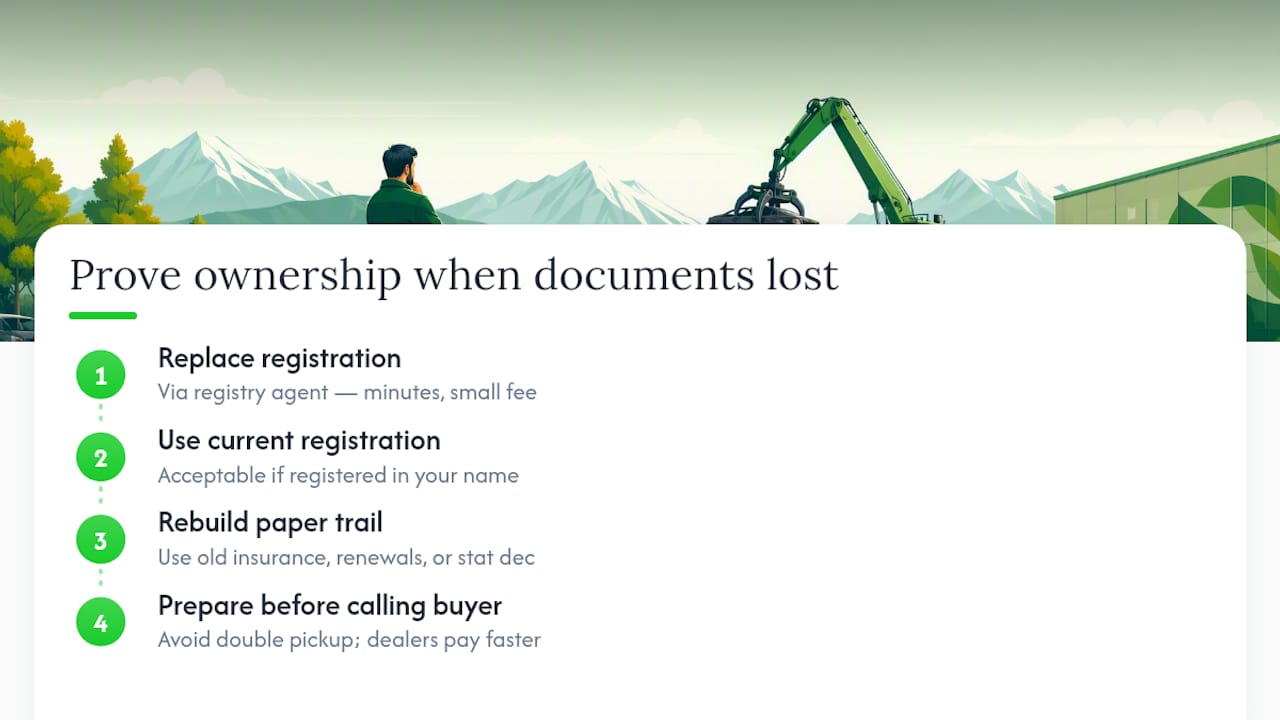
Losing your registration or bill of sale doesn't mean you're stuck with the car forever. Start by requesting a replacement registration through any Alberta registry agent. This usually takes a few minutes and a small fee, and it gives you a fresh document with your name and vehicle details that dealers will accept without question.
If you never had a bill of sale from your original purchase, and the vehicle is registered in your name, the current registration alone often satisfies a dealer's requirements since it already confirms your ownership. The bill of sale mostly matters when transferring ownership between two people at the point of the scrap sale itself, not as a standalone requirement for someone who's held the vehicle for years.
For vehicles where the registration lapsed and you can't easily prove a continuous ownership chain, a registry agent can advise on rebuilding that paper trail, sometimes through old insurance records, previous registration renewals, or a statutory declaration. Do this before you call a scrap buyer, not after. Dealers work faster and pay quicker when the paperwork is already sorted, and nobody wants to schedule a pickup twice because the first attempt stalled on missing documents.
Are There Alberta-Specific Forms for Vehicle Scrapping?
A few forms come up repeatedly in this process, and knowing their names ahead of time saves confusion. The Authorization for Vehicle Services form lets someone other than the registered owner complete a transaction, including a scrap sale, on the owner's behalf. The REG3106 form handles license plate returns after you've disposed of a vehicle, which triggers your plate refund.
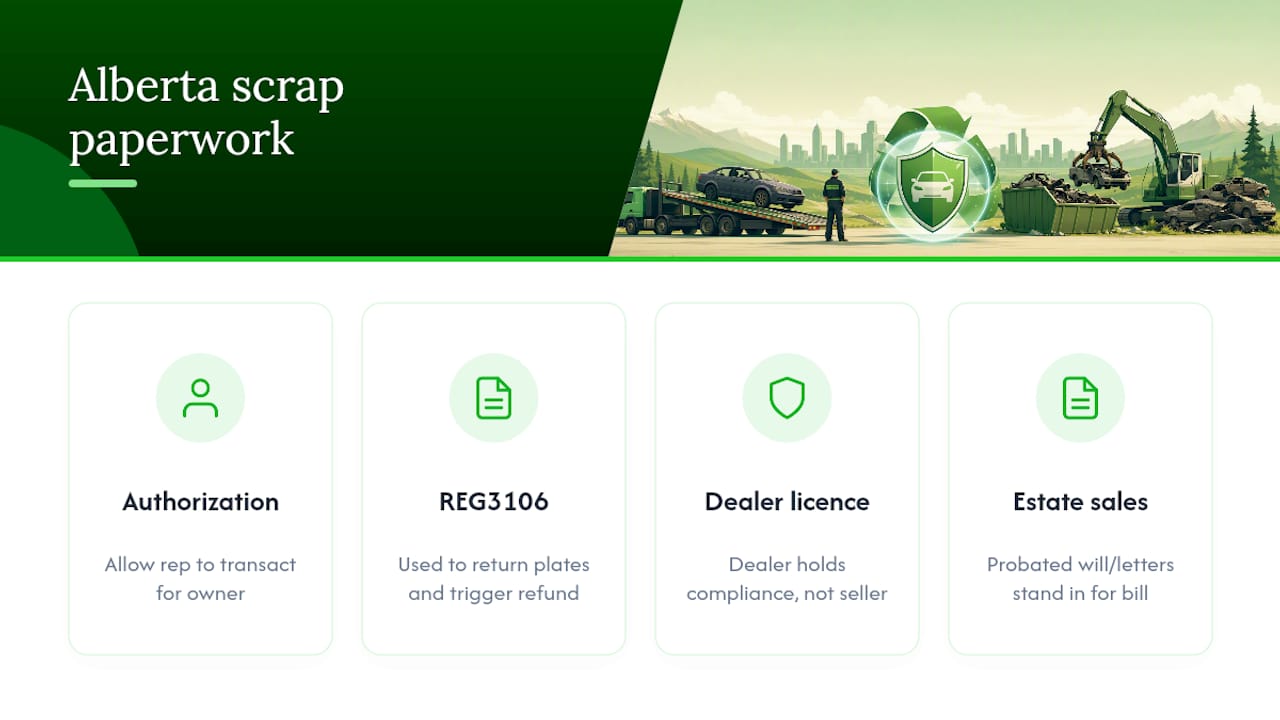
There's no separate government-issued "scrapping permit" in Alberta the way some people expect. Instead, the compliance burden sits with the scrap dealer, who operates under a licence issued according to the Scrap Metal Dealers and Recyclers Regulation. As the seller, your job is producing the ownership and identity documents already covered here, not obtaining a separate permit of your own.
Estate sales are the exception where paperwork multiplies: probated wills or letters of administration function as a required form in that specific circumstance, standing in for a bill of sale the deceased owner obviously can't sign.
Local Perspective: Why Alberta's Rules Matter
These rules exist because stolen vehicles and stripped catalytic converters have to go somewhere, and scrap yards are the obvious endpoint. Making dealers verify identity and ownership turns them into the front line against that trade, whether they like the paperwork or not.
Following the checklist here protects you too. A reputable buyer walks you through exactly what's needed before pickup day, which means no wasted trip and no awkward standoff over missing paperwork. Compliance isn't friction. It's what keeps the whole system honest.
— Franz
Ready to Scrap Your Car? Here's What Southsidecashforjunkcars Handles for You
Southsidecashforjunkcars offers services including same-day pickup, cash offers on the spot, and assistance confirming the necessary documents before the tow truck arrives.
Have your registration or bill of sale, your government-issued photo ID, and the vehicle's VIN ready when you reach out. If a catalytic converter is still installed, mention that upfront so the paperwork requirements can be clarified before pickup day. Assistance is available for estate vehicles, business-owned fleet vehicles, or cars with unclear paperwork, and every transaction includes a written receipt. Get a same-day cash offer or check out the full range of scrap and junk car removal services to get your vehicle picked up this week.
FAQ
Do I need my vehicle registration to scrap a car in Alberta?
Your registration is the simplest proof of ownership, though a dated, signed bill of sale with full vehicle details also works. Either document, paired with your government-issued photo ID, typically satisfies a dealer's requirements.
Can I scrap a car for someone else in Alberta?
Yes, with the right authorization. A signed bill of sale from the owner, a notarized power of attorney, or a completed Authorization for Vehicle Services form all work, and estate vehicles need probate documents or letters of administration instead.
Why do dealers ask for extra paperwork on catalytic converters?
Catalytic converters are frequent theft targets, so Alberta requires dealers to record the VIN and confirm ownership proof before accepting one, separate from the standard vehicle sale documentation.
What does Southsidecashforjunkcars need from me to scrap my car?
Have your ID, registration or bill of sale, and the vehicle's VIN ready when you contact them. Southsidecashforjunkcars offers same-day pickup and cash payment across Calgary and Okotoks, with a written receipt provided for every transaction.
What happens if I can't find my ownership documents?
Request a replacement registration through any Alberta registry agent, which usually takes just a few minutes. If the vehicle is currently registered in your name, that replacement document alone typically satisfies a dealer's ownership requirement.