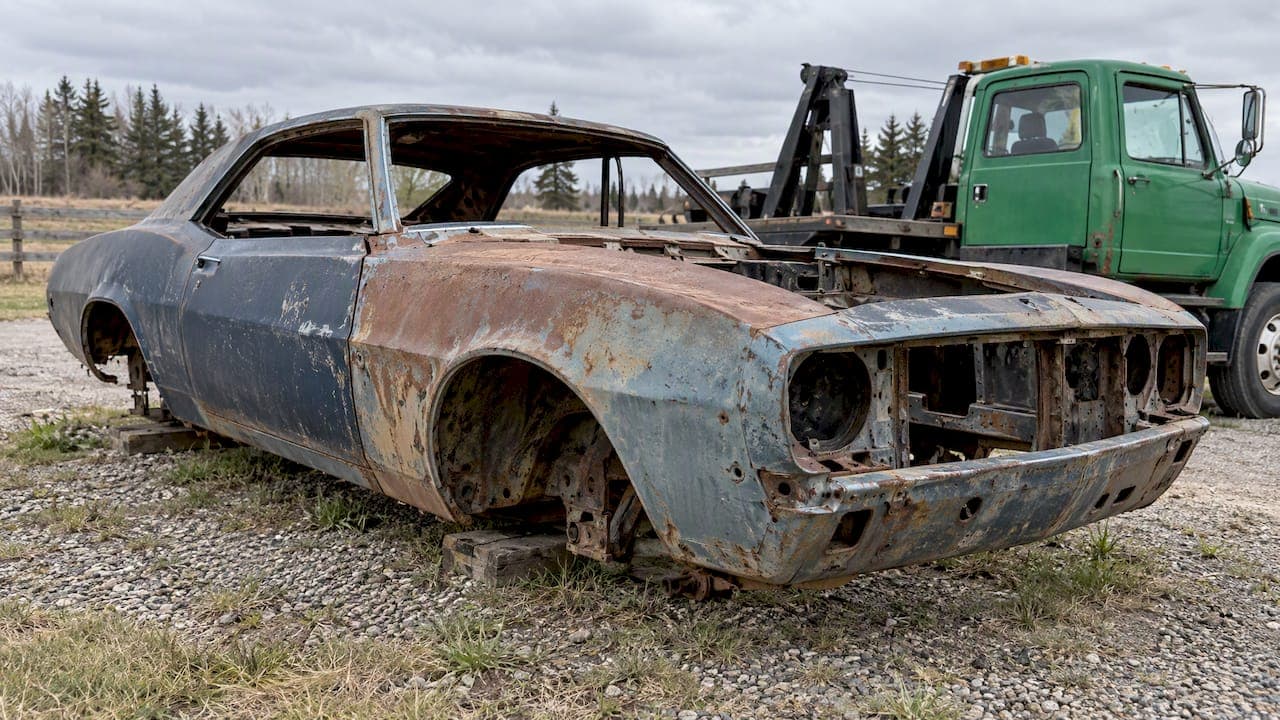
If you have a classic car shell sitting in a garage, a backyard or a farm shelterbelt in Alberta, you can get it removed, and often get paid for it. A shell is a body with the engine, transmission, interior or wheels gone. Most of the work is not the tow. It is proving the car is yours, deciding whether the body has value to a restorer or only as scrap, and closing out the registration and insurance afterward.
We buy and remove junk, non-running, damaged and scrap vehicles in Calgary and Okotoks, with same-day towing. This guide covers how shell removal works in practice, which paperwork matters, and how to avoid the mistakes that stall a pickup.
TL;DR
- A shell can be hauled away even with no wheels, no drivetrain and no key, as long as you can show it is yours.
- Prove ownership with your registration and a signed bill of sale. After pickup, cancel your insurance on that VIN and cancel the registration at an Alberta registry agent.
- Decide first whether the body is a restoration candidate or scrap. A rust-free, recognizable shell is a different conversation from a stripped hulk.
- Hazardous fluids and batteries must be handled by professionals, so choose a buyer that follows the Canadian Auto Recyclers' Environmental Code.
- We serve Calgary and Okotoks with same-day towing and cash on pickup. Call before you start tearing anything else off the car.
Table of Contents
- What counts as a classic car shell
- Restore, sell or scrap: a quick decision guide
- Paperwork: prove it is yours
- After the pickup: cancel the registration and the insurance
- Why shells cannot just go to any hauler
- What happens to the shell afterward
- Perspective: what we see with shells
- Getting your shell removed: how we do it
- Special cases
- Preparing the shell for pickup
- What to ask any buyer before you agree
- Get an offer for your shell
- FAQ
- Sources
What counts as a classic car shell
People use the word loosely. In practice, it covers a few situations:
- A project that stalled. The engine was pulled for a rebuild that never happened, and the body has sat for years.
- An inherited vehicle. A parent or relative left an old car in pieces, and you want the space back.
- A parted-out body. The valuable bits were sold, and what remains is a bare tub, cab or frame.
- A body from a failed restoration. Rust-through, bad bodywork or a missing title ended the project.
All of these are what we would call non-running vehicles, and that is the category we deal with every day. Our offer covers cars with blown engines or transmission failure, and the same logic applies when the engine and transmission are not in the car at all. We also take ATVs and side-by-sides.
One point separates a shell from an ordinary junker: whether anyone wants the body itself. Some shells are valued for their panels, trim, frames or rarity. Others are worth the weight of the metal. An honest buyer tells you which one you have.
Restore, sell or scrap: a quick decision guide
Before you call anyone, spend ten minutes with a flashlight and a magnet.
| Check | Points toward a restoration or parts buyer | Points toward scrap |
|---|---|---|
| Rust | Surface rust only, solid floors and rockers | Rot through floors, frame or pillars |
| Completeness | Original panels, glass and trim still present | Cut up, burned or heavily stripped |
| Identification | VIN plate or tag present and legible | No VIN, or plate removed |
| Model | Recognizable, sought-after model | Common model, no market for shells |
| Storage | Kept dry or indoors | Left in a field or under snow for years |
A rough rule: if three or more rows land in the left column, say so when you call, and send photos. If most land on the right, scrap value is the realistic expectation, and the fastest route is a same-day pickup rather than weeks of listing the shell and fielding offers from tire kickers.
We do not publish set prices, because shell value depends on weight, completeness and parts demand. The honest answer to "what is it worth" comes from photos and the VIN, not from a number pulled from a chart.
Paperwork: prove it is yours
This is where most shell removals get stuck. A body with no wheels still has a legal owner, and a responsible buyer will not remove one without ownership evidence.
Per the Alberta government's guidance on cancelling a vehicle registration, you need to prove ownership with your registration certificate and a signed bill of sale. A bill of sale should show the VIN, the date and the signatures of both parties. A step-by-step Alberta selling guide lists the same elements. If you are unsure which forms apply, our own breakdown of Alberta vehicle transfer forms walks through them.
What if the registration is long gone?
It happens often with inherited or decades-old shells. The registration lapsed, the paper is lost, or the car was bought years ago with a handshake. Do not guess or improvise. Call us, tell us what you have, and we will tell you what we can accept. A registry agent can also tell you what records exist under your name.
What a receipt protects
Get a receipt at pickup. It is your proof the vehicle left your hands on a certain date, which matters if the vehicle is later abandoned, ticketed or involved in anything. We cover this in our piece on scrap car receipts in Alberta and Ontario.
After the pickup: cancel the registration and the insurance
The steps after the truck leaves are yours, and they are easy to forget.
- Cancel your insurance on that VIN. Do this after the vehicle is gone, not before, so the car is never uncovered while it is still on your property.
- Visit an Alberta registry agent to cancel the registration so the vehicle is no longer tied to your name. The Alberta.ca page says you can receive a refund based on the time left on your registration.
- Keep your copies. File the bill of sale and receipt with your records.
If you never plated or insured the shell, there may be little to cancel. Check with your registry agent rather than assuming.
Why shells cannot just go to any hauler
A car body is not inert. Even with the engine out, there can be leftover motor oil, coolant, brake fluid, fuel, a battery or fluid-filled shocks. According to the City of Calgary's waste and recycling business guidance, businesses involved in this work must meet environmental standards for hazardous waste, and these fluids cannot be dumped or flushed down drains.

The industry standard is the Canadian Auto Recyclers' Environmental Code. The Automotive Recyclers of Canada describes it as the framework ensuring hazardous materials are removed and managed by professionals instead of contaminating soil or water. For Alberta specifics, the CAREC regulatory summary covers hazardous recyclables from automotive recycling facilities, including licensing and storage rules.
What this means for you:
- Do not drain fluids onto the ground to make the shell "cleaner" before pickup.
- Do not hand your shell to an informal operator who cannot tell you where it goes.
- Ask any buyer how fluids and batteries are handled. The answer should be specific.
What happens to the shell afterward
Our business runs on the resale value of parts and scrap metal from the vehicles we buy. That means a shell is not waste to us. Panels, frames, glass or trim that someone can use are sold on. What cannot be reused is recycled as metal.

Parts reuse is worth caring about. Industry coverage notes that locally available recycled OEM parts offer repairers shorter delivery times, competitive costs and environmental benefits. A restorer in Alberta hunting for an original door or fender is often better served by a shell that stayed local than by one shipped away.
Perspective: what we see with shells
We get calls about shells that people assume are worthless, and calls about shells people assume are gold. Both assumptions are usually wrong in the same way: nobody has looked at the VIN, the rust and the paperwork together.
Here is how we handle them. We ask for photos and the VIN first. We tell you plainly whether the body looks like a parts or restoration candidate or a scrap job. We quote with no hidden fees, so the number we give on the phone is the number you are paid when the truck arrives. And we do not ask you to clean, tow or move anything. The tow is free, and the payment is cash on pickup.
The mistake we see most often is delay. A shell parked outside through another Alberta winter rusts further and loses value. The second most common is stripping the last good parts off before calling. A complete shell with its trim and glass can be worth more than the same shell in a box of parts on the garage floor.
If you are unsure, call us and ask. A straight answer costs nothing.
— Franz
Getting your shell removed: how we do it
Our process has three steps.
- Contact us. Send the year, make, model, VIN if you can find it, and a few photos of the body, including the underside and any rust.
- We pick it up. We tow the shell the same day, at no charge, in Calgary and Okotoks. Wheels are not required.
- You get paid. Cash is paid on pickup, with ownership paperwork exchanged and a receipt provided.
If you are ready, our scrap car removal page explains what we take, or you can start from our main page and ask for an offer. If the shell is a blown-engine or transmission-failure car rather than a bare body, this page covers that situation.
Special cases
Shells on rural land
Farms and acreages near Calgary and Okotoks often have shells left in a corner of the property. Tell us exactly where the vehicle is and how we can get a truck in. Soft ground, snow and locked gates all affect access, and a short heads-up avoids a wasted trip.
Shells at an impound lot
If a vehicle is sitting in an impound lot, the fees keep growing. Our write-up on selling a car from a Calgary impound lot explains the order of steps.
Donation instead of sale
We buy vehicles for cash and do not run a donation program. If you are weighing a donation, our donate car archive has related posts. If you want the money and the space back quickly, selling is the simpler route.
Failed inspections and write-offs
Some bodies cannot return to the road. The Alberta Motor Vehicle Industry Council's simplified legislation guide notes that non-repairable vehicles cannot be registered and can be sold for scrap and dismantled for parts only. If your shell came from a write-off, say so on the first call.
Preparing the shell for pickup
A short checklist saves time on the day:
- Remove personal items from the cab, trunk and glovebox.
- Take the plates off, if any, and keep them for your registry visit.
- Clear a path wide enough for a flatbed or tow truck.
- Photograph the VIN and the vehicle's condition before it leaves.
- Have your ID, registration and bill of sale ready.
You do not need to wash it, repair it or fill it with fuel.
What to ask any buyer before you agree
Whether you sell to us or to someone else, ask these questions:
- Is the quote final, with no towing or admin fees deducted at pickup?
- Do you pay at pickup, and in what form?
- Will you give me a receipt with the VIN and date?
- How do you handle fluids and batteries?
- Do you remove the vehicle the day we agree, or "sometime this week"?
A buyer who dodges these is not worth your afternoon. For a wider look at what qualifies a vehicle as a junk car and the range you may see, read our guide to what qualifies as a junk car in Alberta, and for the recycling side, our Calgary vehicle recycling guide.
Get an offer for your shell
Send us the VIN and a few photos. We will tell you what the shell is worth to us, tow it away free the same day in Calgary or Okotoks, and pay cash on pickup. Start at our cash for junk cars page or read more about how we buy scrap vehicles.
FAQ
Can you remove a car shell with no wheels, engine or transmission?
Yes. Non-running and incomplete vehicles are what we collect, and our tow equipment handles bodies without wheels. Tell us when you call so we send the right truck.
Do I need a title or registration to sell a shell in Alberta?
You need to prove ownership. The Alberta government points to the registration certificate and a signed bill of sale. If your paperwork is missing, call us and explain, and ask a registry agent what records exist under your name.
What do I do after the shell is picked up?
Cancel the insurance on that VIN, then visit an Alberta registry agent to cancel the registration so the vehicle is no longer linked to you. Keep your bill of sale and receipt.
Is a classic shell worth more than scrap?
Sometimes. A rust-free, recognizable body with original panels and a legible VIN can have parts or restoration value. A rotted or heavily stripped one is usually priced as scrap. Photos and the VIN settle it quickly.
Do you serve all of Alberta?
Our same-day pickup covers Calgary and Okotoks. If you are elsewhere in Alberta, contact us and we will tell you honestly whether we can help.
Sources
- Cancel a vehicle registration | Alberta.ca
- Selling a Car in Alberta: Step-by-Step Guide + Documents (2026)
- Open a waste & recycling business | City of Calgary
- About ARC | Automotive Recyclers of Canada
- Hazardous Recyclables from Automotive Recycling Facilities | CAREC
- Cautious Optimism | Autosphere
- AMVIC simplified legislation guide