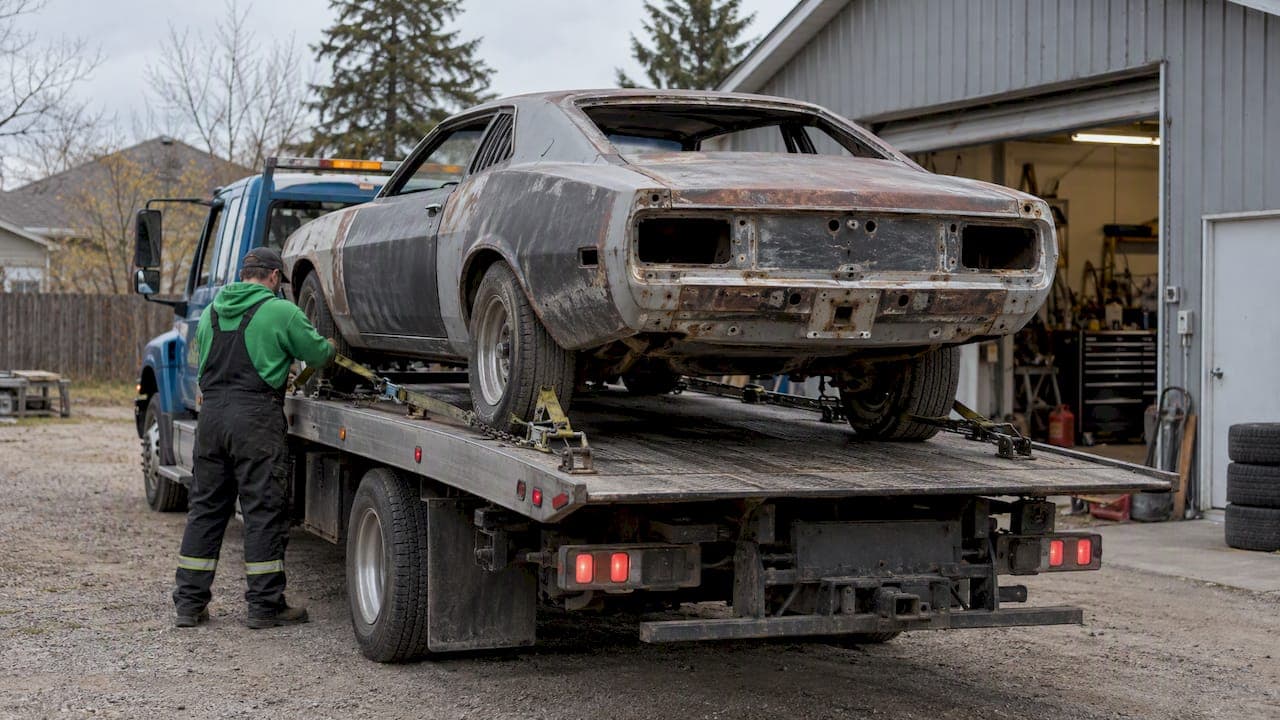
If a project car has been sitting in your garage, yard or acreage for years, you have three realistic exits: sell it to someone who wants to finish it, part it out, or sell it as scrap or for parts to a buyer who tows it away. In Calgary and Okotoks, we buy project cars that don't run, pay cash on pickup and tow them for free the same day. This guide helps you decide which exit fits your car, what to sort out first, and how to avoid the mistakes that cost sellers money.
TL;DR
- A project car that is half-built, seized or missing parts rarely returns what you put in. Decide early whether it is a build someone else will finish or a parts and scrap car.
- Don't force a seized engine to turn before selling. It can cause internal damage and lower the value.
- Paperwork comes first: ownership proof, a bill of sale and cancelling the registration.
- If you want it gone, not listed for months, a local buyer with a tow truck can quote, tow and pay on the same visit.
- Cars left on someone else's property, or in a shop, fall under different rules. Check them before you sell.
Table of Contents
- Why project cars get stuck
- Is it a project, a parts car or scrap?
- Don't restore it before you sell
- Leave the seized engine alone
- Sort out the paperwork first
- What if the car isn't yours to sell, or isn't on your property?
- Your options, compared
- How to sell a project car for cash in Calgary or Okotoks
- Our perspective: what we see in Calgary garages
- Ready to clear the space?
- Preparing for pickup day
- Common mistakes with stuck project cars
- FAQ
- Sources
Why project cars get stuck
Nobody buys a project car planning to leave it for a decade. The usual story is a job change, a new baby, a move, a divorce, or a build that turned out to need more money than expected. Alberta winters add to it. A car that can only be worked on in a heated garage for four months a year moves slowly.
Then the car turns into a cost. It takes up a garage bay or a corner of the yard. Parts boxes pile up. Rust creeps in, tires go flat, rodents move in. And the longer it sits, the harder it is to be honest about what it is worth.
The first step is to look at the car as a buyer would, not as the person who remembers what it was supposed to become.
Is it a project, a parts car or scrap?
These three categories get different money and different buyers. Be honest about where yours sits.
| Category | What it looks like | Who wants it | Typical best exit |
|---|---|---|---|
| Desirable project | Rare or sought-after model, solid frame, mostly complete, documents in order | Hobbyists and restorers | Private sale or specialist listing, if you have time |
| Parts car | Common model, incomplete or damaged, some good components | Wreckers, parts buyers | Sell for parts to a local buyer |
| Scrap | Heavy rust, missing major sections, stripped, failed inspection with no repair value | Scrap and recycling buyers | Cash for scrap with free towing |
A car can move down a column over time. Rust, theft of parts, moisture in the cabin and animal damage all push a project toward parts or scrap value. If you have been telling yourself you will get to it next summer, the car is probably already in the middle row.
Quick test
Ask yourself four questions:
- Could a stranger tell from photos what the finished car would be?
- Is the body structurally sound, with a frame that isn't rotted through?
- Are most of the parts still there, in the car or in labeled boxes?
- Do you have proof of ownership?
Four yes answers mean you might get a better price from an enthusiast, and it is worth giving that route a few weeks. Two or more no answers mean a parts or scrap buyer is the faster and more realistic route.
Don't restore it before you sell
It is tempting to put in a little more work so the car looks better. Industry guidance runs the other way. Restoring a project to a higher level of completion before selling is often a poor financial decision, because labor, paint and parts frequently cost more than the value they add, and buyers often prefer to finish a project to their own taste.
That guide is written for classic cars, but the logic holds for any build. A new paint job on a car with a doubtful frame is money spent to impress nobody. The same goes for fresh tires on a car that will be towed onto a flatbed.
What does help:
- Photograph the car from every angle, plus the VIN plate, odometer, engine bay and underside.
- Gather receipts, build notes and any parts you have bought.
- Gather the parts that belong to the car and keep them together.
- Be upfront about what doesn't work. Buyers who find surprises walk away or cut the offer.
Leave the seized engine alone
Many owners try to start a car that has been sitting for years, just to say that it runs. This often backfires. According to the same guide, a seized engine that is left alone keeps more value than one that has been forced to turn, since forcing it can cause internal damage.
If the car doesn't start, say so plainly. We buy cars with blown engines and transmission failures, so a non-running car is not a problem for a scrap or parts buyer. Don't tow it around town to a mechanic first just to learn what you already suspect.
Sort out the paperwork first
This is the part that slows most sales. A project car has often outlived its registration, its insurance and sometimes the memory of where the papers went.
Proof of ownership
Gather what you have: the registration, the bill of sale from when you bought it, and your photo ID. If the car was inherited, keep the paperwork that shows how it came to you. If you are unsure whether your documents are enough, ask a registry agent before you list the car. Do this before you have a buyer waiting.
A general Alberta guide to private sales says you should have your registration, government ID and a completed bill of sale with the price, VIN, date and signatures. The same applies when you sell a non-running car.

Cancel the registration
If the car is going for scrap and will not be driven again, you can cancel the vehicle registration with Alberta.ca and receive a refund based on the time left on the registration. Do it after the car has left, and keep your copy of the bill of sale as proof of when it went.
Remove your plates and your belongings
Take the plates off before the tow truck arrives. Check the glovebox, trunk and under the seats. Project cars collect strange things: spare keys, old receipts, tools and sometimes a stack of documents you were looking for.
What if the car isn't yours to sell, or isn't on your property?
Project cars end up in other people's spaces more often than owners like to admit. Two situations come up often.
The car is at a shop and the bill went unpaid
If a garage holds your car over an unpaid repair or storage bill, it can act. Under Alberta's Possessory Liens Act, a lienholder may apply to the court for permission to sell a motor vehicle if the debt remains unpaid after 3 months, and may sell directly, without the court, if the vehicle is believed to be worth less than $300. If your project is sitting in a shop with a bill attached, talk to the shop now, not after the three months have gone by. For anything involving a lien, speak to a lawyer or the Alberta Law Information resources before you sign or sell.
The car was abandoned by a tenant or former owner
Landlords in particular get stuck with a vehicle that is not theirs. According to one Alberta legal guide, a landlord must establish the vehicle's value and store it for 30 days if it is worth more than $2,000 before selling or disposing of it under the Residential Tenancies Act. Don't scrap it early. Get legal advice if you are unsure.
The province also has rules for vehicles seized, immobilized or abandoned and removed under the traffic laws, set out in the Vehicle Seizure and Removal Regulation. If your car was towed from a public road or lot, start there and contact the tow operator or impound lot named on the notice.
We have also written about getting a junk car picked up without the owner present and about what happens at an impound lot, if either of those is your situation.
Your options, compared
| Option | Speed | Effort | Best when |
|---|---|---|---|
| List it as a project for enthusiasts | Weeks to months | High: photos, messages, viewings, no-shows | The car is rare and documented |
| Part it out yourself | Months | Very high: removing, listing, shipping, storing the shell | You have the skills, space and time |
| Sell to a local junk or parts buyer | Same day to a few days | Low: one call, one pickup | You want it gone and paid |
| Donate it | Days to weeks | Low | You want a charitable receipt and aren't after cash |
We cover the broader set of choices in our guide to alternatives for selling a junk car in Alberta. If donating appeals, read our notes on donating a car first, so you know what you give up compared with a cash sale.
The pattern we see is simple. Owners who list a mediocre project for enthusiasts often spend months answering messages from people who only want to offer a fraction of the asking price. Some then call us after the third winter. If the car was never going to bring real money from a hobbyist, the listing only cost time.
How to sell a project car for cash in Calgary or Okotoks
The process we run has three steps.
- Contact us. Tell us the make, model, year, condition and where the car is. Mention whether it runs, whether it has all its parts, and whether it is blocked in a garage or behind a fence.
- We pick it up. We tow the car away for free, usually the same day. Tell us about access issues in advance, such as a narrow lane, deep snow or soft ground, so the right truck shows up.
- You get paid. Cash is paid on pickup. We state the offer up front and there are no hidden fees.
We buy cars in any condition: running or not, damaged, scrap, or failed inspection. That includes ATVs and side-by-sides, which tend to be forgotten in the same corner of the yard.
What to have ready when you call
- Year, make, model and VIN
- A clear description of what is missing or broken
- Photos if you can send them
- Your ID and ownership paperwork
- The location, with notes on access
Getting the most from a quote
A few things move an offer. Completeness helps: a car with its engine, transmission, interior and body panels is worth more than a shell. So does keeping bolt-on parts with the car rather than selling them separately. The business model is simple: we pay for what we can resell as parts and as scrap metal, so a car with more usable parts behind it is worth more to us. If you have good parts that you would rather sell on your own, say so up front so the quote matches what is actually on the car.
For more on how pricing logic works in the area, see who pays the most for junk cars and what qualifies as a junk car in Alberta.
Our perspective: what we see in Calgary garages
We handle project cars in Calgary and Okotoks week after week, and the same few things keep showing up.
First, the biggest cost is not the car, it is the space. A garage that holds a dead project for five years is a garage you can't use for the vehicle you drive, for storage, or for a workshop you actually use. Owners who count that cost usually decide faster.
Second, sentimental value is not market value, and we try to be gentle but straight about that. If a car has sat outside under a tarp, the frame and floors tell the story long before the paint does. We would sooner tell you an honest, simple offer than drag out a negotiation neither of us wins.

Third, a call costs nothing. You can ask what we would pay, hear the answer, and still list the car for enthusiasts if you want to try. What we don't want is someone waiting through another winter because they assumed the process would be complicated. It isn't: contact, pickup, cash.
And finally, local matters. We know the access problems in older Calgary neighbourhoods, the long gravel lanes outside Okotoks, and how fast a tow truck can get there. That is how we keep same-day pickup real, not a line on a website.
— Franz
Ready to clear the space?
If your project car is ready to go, contact us through our main page for a cash offer and free same-day towing in Calgary and Okotoks. For scrap-only vehicles, see our scrap car removal page. Okotoks owners can go straight to our Okotoks page.
Preparing for pickup day
A little preparation keeps the visit short.
- Clear access. Move parts boxes, ladders and stored items away from the car. If the car is blocked in, mention that when you call.
- Check for liens. If you financed the car at any point, confirm no loan remains against it.
- Keep your documents together. Bill of sale, ID and registration, if you have it.
- Take your plates and personal items.
- Plan for winter. Snow and ice can change the towing approach. Clear a path if you can, and tell us what the ground is like.
Our guide to how to get a junk car towed in Alberta walks through towing in more detail, and this post on getting paid fast in Calgary covers what to expect on payment day.
Common mistakes with stuck project cars
- Waiting for the market to improve. A rusting car does not appreciate. Each winter lowers what it can bring.
- Over-investing before selling. New paint or parts rarely pay back, as covered above.
- Splitting the car into piles. Selling the best parts on their own and leaving the shell often leaves you with a shell that is hard to move. If you part out, commit to the whole job.
- Ignoring the paperwork. An unresolved ownership problem stops a sale cold. Start early.
- Leaving it on a property that isn't yours. Dispute and disposal rules apply. Don't let a vehicle sit where it could end up towed at your expense.
FAQ
Can I sell a project car that doesn't run in Alberta?
Yes. Running condition is not a requirement for a cash sale to a junk or parts buyer. We buy non-running cars, including ones with blown engines or transmission failure, and we tow them for free in Calgary and Okotoks.
Should I finish the project before selling?
Usually not. Industry guidance says the cost of restoring a car to a higher level of completion often exceeds the added sale value, and buyers often prefer to finish projects their own way. Sell it as it sits, with all the parts you have for it.
What do I need to hand over a project car?
Have your ID, your ownership paperwork and a bill of sale with the price, VIN, date and signatures. After the car leaves, you can cancel the registration through Alberta.ca and get a refund for the time remaining. If you can't find your ownership documents, ask a registry agent before you book a pickup.
How fast can a project car be removed?
We aim for same-day pickup in Calgary and Okotoks once we have the car's details and location. Tell us about any access problems when you call, such as a blocked garage or soft ground, so the right truck arrives.
What if a garage is holding my car over an unpaid bill?
Talk to the shop right away. Under the Possessory Liens Act, a lienholder can apply to sell a vehicle after 3 months of unpaid debt. A lawyer can tell you where you stand before you sell or scrap anything.
Sources
- Possessory Liens Act, King's Printer Alberta
- Sell my classic car, including projects and barn finds
- Cancel a vehicle registration, Alberta.ca
- Vehicle Seizure and Removal Regulation, Open Government Alberta
- How an Alberta landlord must handle a tenant's abandoned vehicle
- Selling a car in Alberta: step-by-step guide and documents