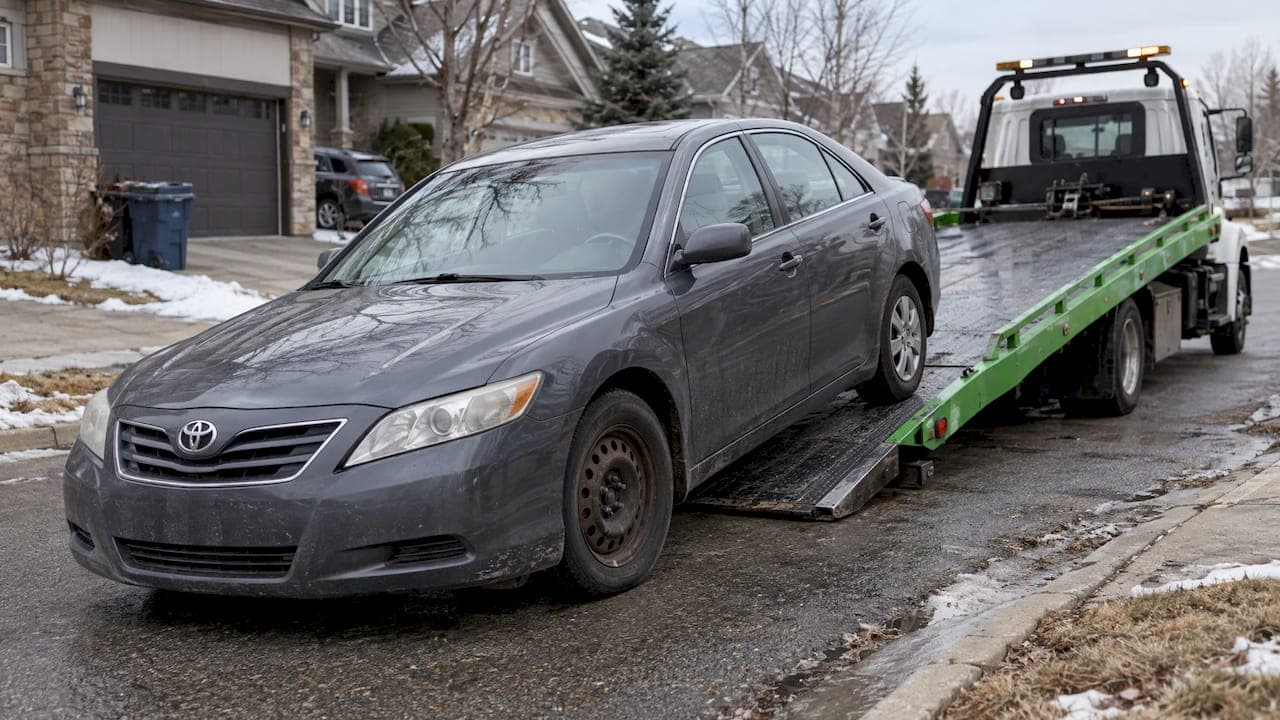
You can sell a car with seized brakes in Alberta, and you don't need to fix it first. Be honest about the fault, put it in writing, and never drive the car to the buyer. The simplest route is a buyer who tows the car away and pays on pickup. A private buyer or a repair shop can also work, but they take longer and cost you more effort.
This guide covers how to confirm the brakes are really seized, what Alberta rules mean for your sale, how to compare your options, and how to handle the paperwork.
TL;DR
- Seized brakes are usually a stuck caliper, slide pins or a collapsed brake hose. Confirm which before you describe the fault to a buyer.
- Don't drive the car to a buyer. Have it flat-decked or winched. Hot, dragging brakes can damage the wheel and hub and can start a fire.
- Disclose the fault in writing on the bill of sale. Alberta's rules for licensed dealers rule out selling "as is", and honest wording protects a private seller too.
- A buyer that offers same-day towing and pays on pickup removes the most stressful parts of the sale. That is how we work in Calgary and Okotoks.
- Bring your ID, registration and a completed bill of sale, and check for liens before you agree on a time.
Table of Contents
- What "seized brakes" usually means
- Check the safety risk before you do anything else
- Your options for selling a car with seized brakes in Calgary
- Moving a car with no working brakes
- What Alberta expects you to disclose
- Paperwork and checks before you agree on a pickup
- Our perspective: why seized brakes shouldn't slow your sale
- How we buy cars with seized brakes
- Mistakes to avoid
- FAQ
- Sources
What "seized brakes" usually means
People use the phrase for a few different faults. One wheel may be locked or dragging, the car may refuse to roll, or the brakes may smell of burning after a short drive. Most of the time the cause is one corner of the braking system, and it is often cheaper to diagnose than owners fear.
A sticking caliper leaves the pad clamped against the rotor when you aren't braking. Firestone explains that this creates constant friction, fast pad wear, heat and weaker braking at that wheel. The same page lists the usual signs:
- the car pulls to one side
- one rotor is noticeably hotter than the others
- a sharp burning smell
- longer stopping distances
- grinding from one wheel
- a spongy or less responsive pedal
Haynes adds that the car can feel as if the brakes are partly on, feel down on power, and give off extreme heat, an acrid smell or smoke.
Why the cause matters when you sell
A buyer will ask what is wrong, and "the brakes are seized" is a vague answer. Wagner Brake's inspection checklist points out that uneven pad wear is a clue, not a verdict. Heavy wear on the outside pad with a nearly new inside pad can mean seized slide pins. Heavy inside wear with a like-new outside pad can point to a dragging piston. Technicians should rule out stuck slide pins, pads binding in the bracket and a restricted brake hose before they condemn the caliper.
The same checklist describes a simple test: loosen the bleeder. If the piston then moves, the hose may be restricted. If it still binds, the problem is inside the caliper. Brake & Frontend's diagnostic guide agrees that if the wheel turns freely once the bleeder is open, hydraulic pressure is being trapped upstream and the caliper itself may be fine. It also says a healthy piston should push fully and easily into its bore with the bleeder open.

You don't have to do this work. But knowing whether you have a stuck pin, a bad hose or a dead caliper lets you describe the car accurately, and it helps you judge whether a repair is worth it.
Check the safety risk before you do anything else
Don't test the brakes by driving the car around the block. AutoZone warns that an acrid burning smell deserves serious attention, because overheated brakes can damage the wheel, hub and braking system and, in the worst case, start a fire. If you smell it, park the car, let it cool and leave it parked.
There is also a legal side. Alberta's Traffic Safety Act prohibits operating a vehicle on a highway unless it meets the prescribed vehicle and equipment standards and is maintained in good working order. Brakes fall within that regulated equipment. So a car with a seized brake should not be on a public road under its own power. Selling it is a separate matter from driving it, and the sale can still go ahead if the car moves by tow.
Should you repair first?
Sometimes yes. A seized slide pin or a collapsed hose can be a modest repair, and a car that then drives properly sells for more on the private market. A caliper, rotor and pad job on one axle can also be reasonable on a newer car in good shape.
On an older car it often isn't. If the car also has rust, a failing transmission, a blown engine or a failed inspection, the repair bill can pass the car's value. Seized brakes then become one more item on a list, and the car is worth more to a buyer that wants it for parts and scrap metal. If your brakes are a repair candidate, it is worth understanding when to inspect and replace brake discs, because rotors that have run hot against a stuck caliper are often the first thing to go.
Your options for selling a car with seized brakes in Calgary
There are four realistic routes. They differ most in who moves the car, how fast you are paid, and how much explaining you do.
| Option | Who moves the car | Speed | What you deal with |
|---|---|---|---|
| Private sale to a stranger | You arrange a tow, or the buyer does | Days to weeks | Listing, messages, no-shows, haggling over the fault |
| Repair, then sell | You pay for the repair and the tow to the shop | Slowest | Repair cost, risk it exceeds the car's value |
| Trade-in at a dealership | Usually you must deliver it | Varies | Dealers often refuse cars that can't be driven in |
| Junk car or wrecker buyer | The buyer tows it | Often same day | One phone call, paperwork, cash on pickup |
The junk car route fits best when the car is old, the repair doesn't pay, or you simply want it gone. A buyer that sells parts and recycles the metal doesn't need the car to roll, so the brake fault barely changes the offer. A private buyer sees the same fault as a risk and a bill, and will often walk away or push the price down.
Selling privately: what changes
A private sale can bring the highest price when the fault is minor. But you must be upfront. Say the brakes are seized, say which wheel if you know, and say the car must be towed. The description in the ad should match what you later write on the bill of sale. Expect most enquiries to come from people who want to fix it themselves or strip it, so price it for them.
Moving a car with no working brakes
A seized or failed brake changes how the car must be moved. Don't drive it, and don't tow it in a way that depends on its own brakes. The practical answer is a flatbed or a winch-loading tow truck. Before you book anyone, confirm the operator can load and secure a car that won't roll freely or won't hold itself on a slope.
This is also why a private sale can get messy. A buyer who shows up with a car trailer needs to be sure the trailer and tow vehicle are legal. Alberta's Recreational Vehicle Towing Guide says trailer brakes are required when the trailer's gross laden weight is more than 910 kg or at least 50% of the tow vehicle's weight, and that the combination must still be capable of safe stopping. It also calls for two separate attachment means between vehicle and trailer. A professional operator already works to these standards. A friend with a borrowed trailer may not.
If your car is parked on a slope, in a tight underground stall or behind other cars, tell the tow operator when you book. A car with one locked wheel can need dollies or extra winching, and surprises at pickup cause delays.

What Alberta expects you to disclose
The rules differ depending on whether you are a private seller or a licensed business. Here is what the checked sources say.
For licensed dealers, AMVIC requires a Mechanical Fitness Assessment before a used-vehicle sales contract, valid for 120 days. AMVIC also says there is no provision for a licensed business to sell a vehicle to the public "as is". If it doesn't comply with the Vehicle Equipment Regulation, it can be sold only with full disclosure and a description of the missing or non-compliant items.
Alberta's written disclosure rules for businesses also cover vehicle history: salvage, non-repairable or unsafe status, major collision repairs, fire, flooding, former rental or emergency use, and results from earlier registration or inspection in another jurisdiction.
Those rules bind licensed businesses, not you as a private owner. But they show what a fair sale looks like, and the same logic helps you. If you say plainly that the car has seized brakes, is not safe to drive and will be towed, the buyer can't later claim you hid it. Whoever buys it can price the fault in.
Practical wording for the bill of sale
Alberta's standard bill of sale includes optional space for special sale conditions. Use it. A short line such as "Vehicle sold with seized rear left brake, not roadworthy, to be removed by tow" is clear and costs you nothing. The form asks for both parties' full names and addresses, the VIN, the make, model or series, style, colour and year, the price and both signatures. It can also record phone numbers and identification, liens or encumbrances, whether payment is complete, and the payment method and terms.
Take a photo of the signed document, and keep a copy. Our guides to Alberta vehicle transfer forms and how to transfer car registration walk through the steps in more detail.
Paperwork and checks before you agree on a pickup
A buyer who wants a quick sale will still need proof that the car is yours. Have this ready:
- Government photo ID that matches the name on the registration.
- Your registration, or other proof of ownership. If it is missing, read our guide on proving ownership to scrap a car in Alberta.
- The VIN, from the dash or driver's door jamb, to fill in the bill of sale.
- Lien information. If you still owe money on the car, the lender has a claim on it. Alberta tells buyers to run a VIN-based personal-property lien search, verify the seller's identity and ownership, and complete a standard bill of sale. Expect a careful buyer to do exactly that, and sort out any loan balance before pickup.
- Your plates. Remove them if the plates stay with you. Our guides on scrapping a car without plates and returning plates for a refund explain what to do next.
- A receipt. Ask for a written record of the sale. See scrap car receipts in Canada for what it should show.
On the buyer's side, Alberta says registering a vehicle takes proof of ownership such as a bill of sale, valid insurance, acceptable identification and any required inspection, completed through a registry agent. A wrecker that dismantles the car doesn't register it, but private buyers who plan to repair and drive it will.
Take out your own belongings first: documents in the glovebox, toll tags, garage openers and anything in the trunk. Cancel or transfer insurance only once the car has left and the paperwork is signed.
Our perspective: why seized brakes shouldn't slow your sale
Most people who call us about seized brakes expect the fault to cost them. They assume nobody will want a car that can't roll. In our experience that is the wrong way round. We buy running and non-running vehicles, including cars with blown engines or transmission failure, so a locked wheel is one more condition we already deal with. Our business is reselling parts and the scrap metal value of the vehicles we buy, which means a car doesn't have to be drivable to have value to us.
What matters to us is that the owner describes the car honestly and that the paperwork is clean. If you tell us the brakes are seized, we plan the tow around it. If the car has other problems, such as a failed inspection or a broken odometer, tell us too. We have written about failed Alberta out-of-province inspections, cars with a blown engine or transmission failure and selling with a broken odometer because the same principle applies each time: disclose it, and the sale goes smoothly.
Our advice is not to sink money into a car just to sell it unless the repair is small and the car is worth keeping. Get a quote for the repair if you aren't sure, then compare it with a cash offer. If the cash offer is close, take it and stop worrying about the car.
— Franz
How we buy cars with seized brakes
We buy junk, non-running, damaged, scrap and failed-inspection cars, plus ATVs and side-by-sides, in Calgary and Okotoks. The process has three steps:
- Contact us. Tell us the make, model, year and location, and mention the seized brakes and any other faults.
- We pick up the car. We offer same-day towing, and the towing is free. Our crew brings the right equipment for a car that won't roll.
- You get paid. Cash is paid on pickup, with no hidden fees.
If you're ready, start with our cash for junk cars page or read about our scrap car removal service. You can also reach us from the Southside Cash For Junk Cars homepage. We don't publish a fixed price, because the offer depends on the car.
We are a buyer, not a repair shop or a donation service. If you want the car fixed, or a tax receipt for donating it, we aren't the right fit.
Mistakes to avoid
- Driving it to the buyer. A dragging brake overheats quickly, and it is unsafe and not permitted on the road in this condition.
- Hiding the fault. Even if a private buyer doesn't ask, put the seized brake on the bill of sale.
- Paying for a repair that doesn't pay back. Compare the repair quote with the car's market value before you spend anything.
- Handing over the car before the money. Agree on payment terms in advance, and release the keys at pickup, not before.
- Skipping the lien check. A loan balance can stop a sale, so sort it out before the tow truck arrives.
- Forgetting the plates. Remove them and handle them properly so you don't lose a refund.
FAQ
Can I sell a car with seized brakes in Alberta?
Yes. Nothing in Alberta's rules stops you selling a car because the brakes are seized, but the car shouldn't be driven on a public road in that state. Disclose the fault in writing and arrange a tow. Licensed dealers face stricter rules, including no "as is" sales under AMVIC's guidance.
How do I know if my brake caliper is seized?
Common signs are pulling to one side, a hot rotor at one wheel, a burning smell, grinding and longer stopping distances. A technician can confirm it by checking slide pins, the brake hose and the piston. If you can't tell, say "suspected seized brake" rather than guessing at the cause.
How do I move a car with no brakes?
Don't drive it. Use a flatbed or winch-loading tow service that can secure a car that doesn't roll freely, and tell the operator about the fault when you book. Towing it behind another vehicle in a way that relies on its brakes is unsafe.
What paperwork do I need to sell a non-running car?
You need photo ID, proof of ownership and a completed bill of sale with the VIN, vehicle details, price and both signatures. If there is a loan on the car, settle it or tell the buyer before pickup. Keep a signed copy for your records.
Will a junk car buyer pay me even if the car won't roll?
It depends on the buyer, but a buyer that tows vehicles and resells parts and scrap metal can usually make an offer on a car that won't roll. We do. Contact us with the car's details and any other faults, and we will tell you what we can offer.
Sources
- Brake Inspection Checklist, Wagner Brake
- Finding the Cause of Brake Pulls, Brake & Frontend
- How To Diagnose and Fix a Seized Brake Caliper, Haynes
- What Causes Brake Calipers to Stick, Firestone Complete Auto Care
- Brake Caliper Sticking: Causes, Signs, and What to Do, AutoZone
- Traffic Safety Act, RSA 2000, c T-6, CanLII
- Recreational Vehicle Towing Guide, Alberta Transportation
- Mechanical Fitness Assessment, AMVIC
- Researching the vehicle, AMVIC
- Standard bill of sale, Alberta.ca
- Register a vehicle in Alberta, Alberta.ca
- Buying a vehicle from a private seller, Alberta.ca