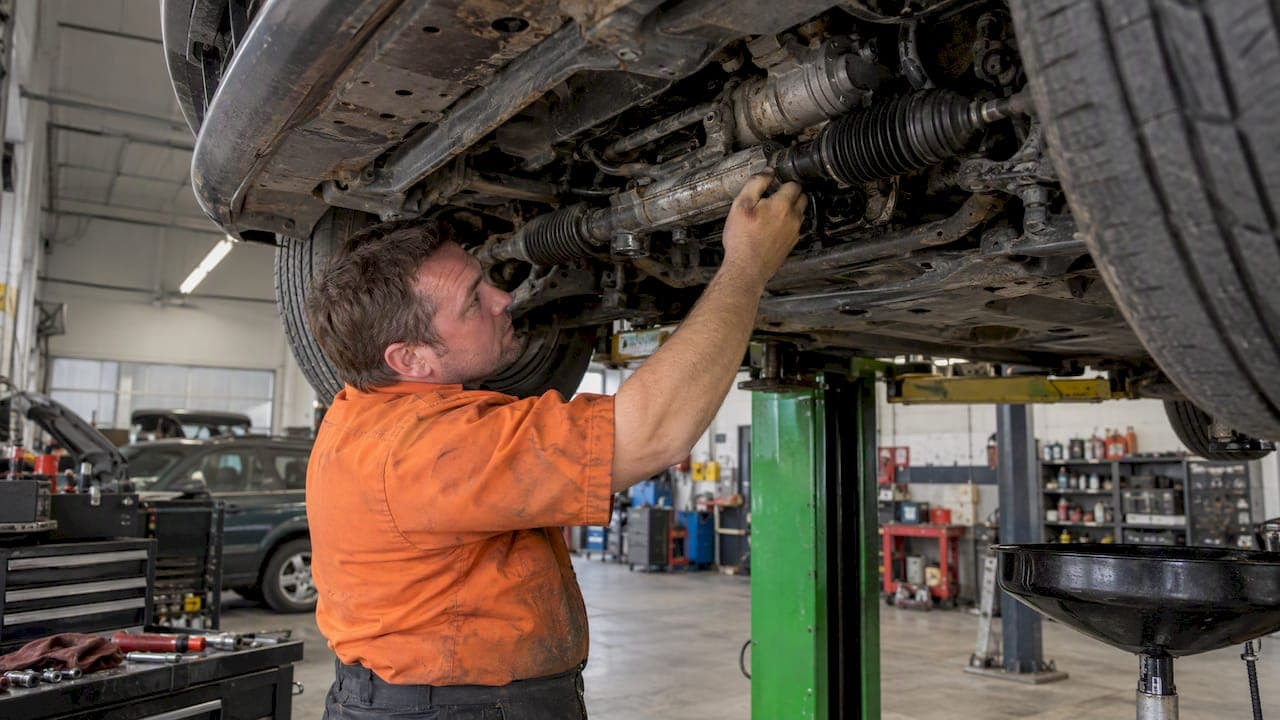
A steering rack failure is safety-critical: if you lose steering assist or notice severe play in the wheel, stop driving and arrange a tow. For milder symptoms like stiffness or a small leak, a cautious, short drive to a nearby shop may be reasonable. Either way, check your VIN for open recalls before you decide anything else.
TL;DR:
- Fluid pooling often signals a seal or hose leak; whining points to the pump, while clunks or steering play suggest rack or tie rod wear.
- Technicians distinguish rack leaks from pump problems by checking leak locations and test driving; pressure tests, boot inspections, and electrical diagnostics help pinpoint the cause.
- Seal repairs may take one visit, while full replacements can span days and need alignment; weigh the quote against the vehicle’s age and resale value.
- Check your VIN for open recalls before paying, since dealers repair covered defects at no charge, including some corroded steering motor bolts.
Table of Contents
- Signs and Symptoms Owners Can Check For
- Common Causes That Lead to Rack Failure
- Safety Guidance: When to Stop and When You Can Keep Driving
- How Technicians Diagnose Steering Rack Problems
- Repair Options, Timelines, and Cost Factors
- Recalls and How to Check Your VIN Recall Status
- When Repair Isn't Practical: Weighing Disposal Instead
- Southside Cash For Junk Cars: A Same-Day Option for Steering Failures We Don't Repair
- FAQ
- Sources
Signs and Symptoms Owners Can Check For
Your steering system usually warns you before it fails outright. The most reliable early sign is fluid pooling under the front of the vehicle, often reddish or clear and oily, which points to a seal or hose leak rather than internal wear.
Other symptoms tell a different story. Whining or groaning when turning usually traces back to the power steering pump, while clunking, knocking, or a loose dead spot in the wheel often points to the rack itself or worn tie-rod ends. Increased steering effort, a wheel that will not return to center, or a pull to one side can all stem from fluid loss, internal rack wear, or component damage. Uneven tire wear is a slower-moving clue that steering geometry has been off for a while.
- Fluid leaking under the front of the vehicle, often near the front wheels or firewall
- Whining, groaning, creaking, or knocking noises when turning
- Increased effort required to turn the wheel, especially at low speed
- Steering wheel play, a dead spot, or slow return to center
- Vibration, pulling to one side, or uneven tire wear over time
A quick owner check takes a few minutes: look at the power steering fluid level and color, check under the front of the car for drips, turn the wheel lock to lock in a parking lot to feel for resistance or noise, and note any dashboard message. Typical rack-and-pinion failure signs include leaking fluid, unusual noise, and steering play, and catching these early often means a cheaper fix.
Common Causes That Lead to Rack Failure
Most steering rack problems trace back to one of four root causes, and knowing which one applies helps you understand what a shop is about to tell you.
- Hydraulic issues: worn seals, cracked hoses, or contaminated fluid that eventually damages internal rack components
- Corrosion: mounting bolts and intermediate shafts that rust over time, a problem that accelerates sharply with heavy road salt exposure
- Mechanical damage: pothole impacts, minor collisions, worn tie-rod ends, or broken bushings that put uneven stress on the rack
- Electric power steering (EPS) causes: heat or connector damage near the motor, and corroded motor-mount fasteners that can cause a gradual or sudden loss of assist
On hydraulic systems, a worn seal lets fluid escape slowly at first, then faster as pressure drops and internal components start running dry. On EPS-equipped vehicles, the failure mode is different: corrosion can affect the bolts that hold the assist motor to the gear housing, and in some documented cases this has led to a loss of power assist entirely, which is the exact issue addressed in Transport Canada recall 2018724.
Safety Guidance: When to Stop and When You Can Keep Driving
A few clear signals mean you should not continue driving under any circumstances.
- Sudden loss of power steering assist, where the wheel suddenly becomes heavy
- The steering wheel locks or will not turn in one direction
- A loud bang, pop, or separation noise from the front end while turning
- A strong, uncontrollable pull to one side that fights your correction
If what you are dealing with is milder, such as general stiffness or a small, slow leak with steering that still responds normally, a short, cautious drive to the nearest shop is usually acceptable — especially if you use Canadian fleet warning lights that hold up to alert others to your vehicle's condition. Stay off the highway, avoid sharp or repeated turns, and keep speeds low.
If you need a tow, put the transmission in neutral if the tow operator asks, secure the steering wheel so it cannot spin freely, tell the driver exactly what symptoms you noticed, and remove valuables before it is loaded.
Pro Tip: Take a short video of the noise or the wheel's play on your phone before the tow truck arrives. It helps the shop diagnose faster and saves you a round of guessing.
How Technicians Diagnose Steering Rack Problems
A shop's first move is usually visual: checking the rack boots, the pinion area, and the hose and pump fittings for leaks, since where the fluid shows up narrows down the failing part fast.
- Leak location at the boots or pinion usually points to the rack itself, while leaks near the pump or reservoir point elsewhere
- A test drive separates pump whine from rack clunk, play, or a dead spot in the wheel
- Pressure testing checks whether the hydraulic system is building and holding pressure correctly
- Removing the boots lets a technician inspect internal rack components directly
- Checking mounting bolts and the intermediate shaft for corrosion rules in or out the failure mode described in several Transport Canada recalls
- On EPS vehicles, electrical diagnostics check the motor, connectors, and torque sensor for faults
These findings determine the path forward. A clean leak with otherwise sound internals often points to a reseal. Internal wear or scoring usually means a rebuild or full replacement, and corrosion at the mounting bolts, as flagged in Transport Canada recall 2017415 for Ford vehicles, may call for a dealer-level fastener replacement rather than a standard repair order.
Repair Options, Timelines, and Cost Factors
Three realistic paths exist once a rack problem is confirmed: a minor seal repair, a reconditioned or rebuilt rack, or a remanufactured or new replacement unit. Which one makes sense depends on how far the damage has progressed and what the vehicle is worth.
- Seal repair addresses leaks without touching internal components, usually the fastest and cheapest option
- Reconditioning or rebuilding replaces worn internal parts while reusing the housing, often with a warranty attached
- A remanufactured or new rack replaces the whole unit and is typically required after significant internal wear or physical damage
Cost depends heavily on the vehicle's make and model, how many labor hours the job takes, whether the shop uses a new or remanufactured part, and whether a wheel alignment is needed afterward. Replacement jobs typically require a wheel alignment and several hours of labor, according to a guide to steering rack replacement costs, which adds real time and expense on top of the part itself.
A minor seal repair can sometimes be done same day. A full replacement usually spans multiple days once you factor in parts availability, the labor involved, a post-repair alignment, and a test drive to confirm the fix holds. When weighing your options, consider the vehicle's age and resale value against the repair bill, whether a reconditioned rack comes with a warranty, and whether a reman part is even available for your model. For an older vehicle, a repair that costs more than the car is worth rarely makes financial sense, which is where evaluating whether a car is still worth fixing becomes the more useful question.
Recalls and How to Check Your VIN Recall Status
Before paying for any steering repair, check your VIN against the recall database, since a defect covered by a recall is fixed by the dealer at no charge. Steering-related recalls commonly involve corroded EPS motor-mount bolts, degraded heat-shield fasteners that expose the steering gear to excess heat, and corroded intermediate shafts.
- Corroded EPS motor-mount bolts, addressed in Transport Canada recall 2018724
- Heat-shield fastener corrosion that can trigger a 'SERVICE POWER STEERING NOW' message, covered in Transport Canada recall 2017415
- Intermediate shaft and mounting bolt corrosion patterns seen across several manufacturer recalls
If your VIN shows an open recall, a dealer inspection and repair generally take priority over an independent shop visit, and it can change your urgency and your cost calculation entirely.
When Repair Isn't Practical: Weighing Disposal Instead

Some owners face a simple math problem: the repair quote exceeds what the car is worth, especially on an older vehicle with a safety-critical steering failure. A non-running car, or one that is not safe to drive, is a different situation than a car with a cheap, isolated leak.
Specialized buyers who purchase non-running or damaged vehicles typically give a quote based on parts and scrap value, then handle same-day pickup and payment, which avoids sinking more money into a repair you will not recoup when you sell.
— Franz
Southside Cash For Junk Cars: A Same-Day Option for Steering Failures We Don't Repair
When a steering rack failure makes a car too expensive or too risky to fix, we offer a faster way out. We buy junk, damaged, and non-running cars, including vehicles with steering, engine, or transmission failures, with no hidden fees.

- We give you a cash offer based on your vehicle's condition and value
- We provide same-day pickup.
- We pay on pickup, no waiting on a check or e-transfer.
If your steering rack has failed and the repair bill is not worth it, get a same-day quote for your car and skip the repair shop entirely.
FAQ
Is It Expensive to Fix a Steering Rack?
Cost varies widely by vehicle and the extent of damage. A minor seal repair is relatively inexpensive, while a full replacement that includes parts, labor, and a wheel alignment runs considerably higher.
How Much Does It Cost to Fix a Steering Rack?
The total depends on your vehicle's make and model, whether the shop uses a new or remanufactured rack, and local labor rates. A shop quote after diagnosis is the only reliable way to know your actual cost, since the range is too wide to generalize.
Can I Drive with a Steering Rack Problem?
It depends on the symptom. Mild stiffness or a small leak with normal steering response may allow a short, cautious drive to a nearby shop, but sudden loss of assist, wheel locking, or loud separation noises mean you should stop and arrange a tow instead.
Is Replacing a Steering Rack a Big Job?
Yes, a full replacement is a significant job that typically requires several hours of labor plus a post-repair wheel alignment. A minor seal repair, by contrast, can often be done in a single visit.
Sources
- Transport Canada recall 2018724
- Transport Canada recall 2017415 — Ford
- Signs Of a Failing Rack and Pinion — AutoZone
- Guide to steering rack replacements — RAC