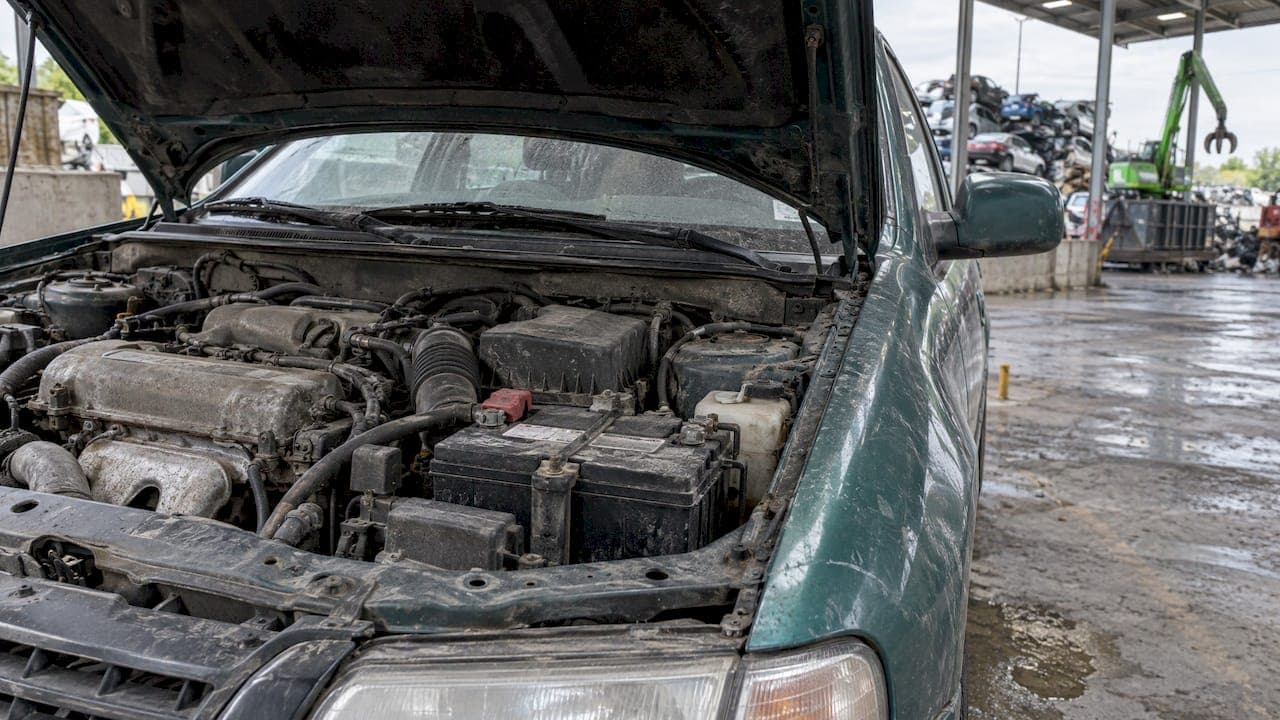
You don't have to remove the battery to scrap a car, but you can, and doing it right takes about 15 minutes. A used vehicle battery has modest recycling value and a strict disposal rule: in Calgary it never goes in your household cart. If the battery is cracked, leaking or stuck, leave it where it is and tell whoever is picking up the car.
This guide covers when pulling the battery makes sense, how to disconnect it safely, what to do with it afterward, and which Calgary drop-off points take it for free.
TL;DR
- Removing the battery is optional, and it only makes sense if the battery is intact and you can reach it safely.
- Disconnect the negative (black) cable first, then the positive (red), and keep your wrench from touching both terminals.
- Never put a car battery in a blue, black or green cart. The City of Calgary takes lead-acid car batteries for free at Eco Centres and fire hall depots.
- If the battery is swollen, cracked, leaking or frozen, don't disconnect it. Mention it when you book the pickup.
- Take your plates, personal items and any other parts you want to keep out of the car before the tow truck arrives.
Table of Contents
- Is it worth removing the battery before you scrap the car?
- Check the battery before you touch it
- How to disconnect and remove a car battery safely
- Batteries aren't all the same
- Where to take an old car battery in Calgary
- What happens to the battery after you drop it off
- What else to take out of the car
- Our perspective
- Ready to sell the car?
- FAQ
- Sources
Is it worth removing the battery before you scrap the car?
For many owners it's a small, sensible job. It isn't a requirement, and it isn't a big payday.
Lead-acid batteries get recycled mostly because the lead inside is worth money. The Canadian Battery Association reported that the average vehicle battery had a commodity value of $5 to $15 in 2012, depending on size and the cost of shipping it to a smelter. That figure is more than a decade old, so treat it as a ballpark rather than a quote. It does show why a battery is worth recycling properly and why it shouldn't be left to rot in a yard.
There are three good reasons to take it out yourself:
- The battery is relatively new. If you replaced it in the last year or two, it may still hold a charge. A good battery can go into another vehicle, a lawn tractor or a backup setup. The federal National Code of Practice for the automotive recycling industry says reusable lead-acid batteries should be resold and reused where possible.
- You want the core refund. Some retailers refund a core charge when you return an old battery, so the one you pull out may offset the cost of its replacement in another vehicle.
- You want the car completely empty. Once the car is cleared of belongings, plates and loose parts, pickup is simpler.
There are also times to leave it alone. If the car has been sitting for years with a corroded, swollen or leaking battery, or if the terminals are fused with corrosion, the risk isn't worth a few dollars. We cover those cases below.
Check the battery before you touch it
Look before you loosen anything. Open the hood, find the battery (some cars put it under the rear seat or in the trunk) and inspect it in good light.
Stop and leave the battery in place if you see any of the following:
- A cracked or bulging case
- Wet residue, white or blue crusty corrosion spreading over the tray, or a strong rotten-egg smell
- Ice on the case, which means the battery is frozen
- Burn marks on the case or cables
BatteriesStore.ca advises not to attempt a swap when the battery is frozen, leaking or visibly damaged. The federal guidance for the automobile recycling industry is blunt about why: used lead-acid batteries pose pollution risks, and cracked batteries can contaminate the environment, especially if they sit outdoors. That same document says cracked or leaking batteries belong in a closed, leak-proof container, and that an absorbent like baking soda or lime helps with spilled acid.
If a battery is already damaged, a pickup crew that handles vehicles every day is better equipped to deal with it than you are in a driveway. Tell us when you call, and we'll plan for it.
How to disconnect and remove a car battery safely
A car battery holds sulphuric acid and can throw sparks if you short it. You need a wrench (usually 10 mm, sometimes 8 mm or larger), safety glasses, gloves and a few minutes. A visual walkthrough can help if you haven't done it before, and this guide shows how to remove a car battery safely step by step.
Prepare the workspace
Canadian Tire's how-to recommends working in a well-ventilated area, wearing hand and eye protection, keeping sparks and flames away from the battery, turning the vehicle off and setting the parking brake. NAPA Auto Parts Canada adds that you shouldn't smoke anywhere near a battery and should use only work lights with protected bulbs.

Take off rings, bracelets and watches too. Interstate Batteries lists removing jewelry and making sure the ignition is off among its first steps, because metal across a terminal can cause burns.
Step by step
- Turn everything off. Ignition off, key out, lights and accessories off. Never disconnect a battery while the engine is running.
- Find the negative terminal. It's marked with a minus sign and usually has a black cable.
- Loosen the negative clamp and lift it off. AutoZone is clear that you should always disconnect the negative cable first, and Continental Battery explains why: the negative side is grounded, so removing it first won't produce a short or sparks. Tuck the cable aside so it can't spring back and touch the post.
- Loosen the positive clamp. Keep the wrench from touching any other metal. NAPA warns that taking the positive off first risks short-circuiting the battery and damaging electrical components. Wrap the loose clamp in a rag to keep it clear of metal.
- Remove the hold-down. That's the bar across the top or the clip at the base of the battery.
- Lift the battery straight up and keep it level. Don't tip it. A flooded battery can spill electrolyte, and batteries can weigh 40 lbs or more. Continental Battery says some reach up to 60 pounds, so bend your knees and use both hands.
- Set it upright on a flat, stable surface away from the driveway slope, children and pets.
AutoZone's guide adds the one mistake to avoid above all others: touching the positive and negative posts with a wrench at once can produce a shower of sparks, a fire, blown fuses or fried modules.
What about the car's computer?
If you were keeping the car, disconnecting the battery would matter. Without backup power it can erase adaptive settings from the car's computers, which may lead to rough idling, odd shifting or warning lights until the systems relearn. Canadian Tire suggests a memory saver to hold those settings. For a car headed to the scrapper, none of that matters, and a locked-out radio isn't a worry either.
Batteries aren't all the same
Most older cars carry a conventional flooded lead-acid battery. Newer vehicles, especially those with start-stop systems, often use AGM batteries. Both are lead-acid and both get recycled the same way, but they can differ in weight, price and how they're treated. If you're curious which type is under your hood, this comparison of AGM versus flooded batteries will help you identify it. The label on top normally says which one you have.
The City of Calgary's household hazardous waste program accepts lead-acid automotive batteries, but EV batteries are not included. If your car is a hybrid or electric, don't try to remove the traction battery yourself. Leave it with the vehicle and let the pickup crew know.

Where to take an old car battery in Calgary
The short answer: the City takes it free. According to the City of Calgary, you can drop off lead-acid vehicle batteries at a designated fire hall HHW location or a City Eco Centre at no cost. Charges apply at an Eco Centre only if you bring the battery with other garbage, so keep it separate from a trailer load of junk.
The household hazardous waste program lists three Eco Centres and eight fire station depots that accept car, motorcycle, golf cart, lawn mower and wheelchair batteries. Check the City's Eco Centres page for current hours and locations before you drive over. Hours change, and a seasonal schedule can differ from last year's.
Two more options:
- Battery retailers. Canadian Tire says municipal garbage won't collect lead-acid batteries and suggests returning the old battery to a store for a core charge refund and safe recycling. That works best if you're buying a replacement for another vehicle.
- Damaged batteries. The City's HHW program says swollen, corroded, leaking or burnt household batteries go only to Eco Centres and should be handed to a staff member. Don't leave them at an unattended depot.
What never to do
The City is firm: automotive batteries must never go into blue, black or green carts. They're a major safety hazard for collection drivers and processing staff. Alberta's Waste Control Regulation also prohibits sending hazardous waste to landfill in most cases, and the Alberta guide for waste managers puts the responsibility on whoever generates the waste to classify it correctly. Dumping, burying or abandoning a battery isn't just bad for the ground; it's the wrong move legally.
Moving it from your garage to the drop-off
The federal guidance for the industry recommends storing batteries upright, and not stacking them more than five high, on a non-reactive surface. At home, that boils down to a few habits:
- Keep the battery upright in a sturdy plastic tub or a battery box, which catches any drips.
- Put it in the trunk or truck bed and wedge it so it can't tip. Never carry it loose on the back seat.
- Don't hold on to it for months. The City's automotive guidance says long-term storage of used batteries should be avoided, and used batteries should be checked regularly for leaks and cracks.
- Wash your hands after handling it.
What happens to the battery after you drop it off
Lead-acid batteries are among the most recycled products in Canada. The Canadian Battery Association's stewardship report for British Columbia says about 99% of the lead is recovered at the smelter and sold to make new batteries. The sulphuric acid and plastic casings are also recovered and reused. The federal code of practice notes that lead-acid batteries, tire weights and lead cable connectors are the main sources of lead in end-of-life vehicles, so getting the battery into the right stream matters.
What else to take out of the car
The battery is only one item. Before the car leaves, clear out:
- Licence plates, and make sure you've handled your registration and insurance
- Papers in the glovebox, garage door openers, toll or parking passes, and anything in the trunk or under the seats
- Child seats, aftermarket stereos or tools you want to keep
- Personal data from the infotainment system, such as saved addresses and paired phones
Our full checklist, what to take out of your car before scrapping it in Calgary, goes through each item. If you want the bigger picture of how the process works, read how to scrap a car in Calgary and what happens to a scrapped car in Canada.
Our perspective
We pick up junk, non-running, damaged and failed-inspection cars in Calgary and Okotoks every week, and the battery question comes up on almost every call.
Our view is simple: don't turn a straightforward sale into a project. If the battery is in good shape and you're comfortable with a wrench, pulling it is a fine 15-minute job, and you can recycle it for free at a City depot. If the car hasn't started in years, the terminals are crusty, or you aren't sure, leave the battery in place. Don't risk acid on your skin or a spark near the hood to save a few dollars.
What we want is a clear, honest process: you contact us, we come to the car, and you're paid in cash on pickup. We tow free of charge on the same day, and the car doesn't need to run. We aim for no hidden fees, so the conversation about what's in the vehicle shouldn't change the deal in a way you don't expect. Tell us what you've removed and what's still there, and we'll work from the facts.
Franz
Ready to sell the car?
Whether the battery is out or still in the car, we'll tow it for free. We buy cars, ATVs and side-by-sides in Calgary and Okotoks, including vehicles with blown engines, transmission failure, collision damage or a failed inspection. It works in three steps: you contact us, we pick up the vehicle, and you get paid in cash.

Start on our scrap car removal page or get an offer through our main site. If you're curious about what the metal is worth, our scrap value guide for Calgary explains how it's worked out.
FAQ
Do I have to remove the battery before I scrap my car?
No. Removing it is optional, and it makes sense mainly if the battery is intact and you can reach it safely. If it's damaged, leaking or frozen, leave it in the car and mention it when you book the pickup.
Which cable do I disconnect first?
The negative (black, minus-marked) cable first, then the positive (red, plus-marked). The negative side is grounded, so taking it off first lowers the risk of a short or sparks. Never let a wrench touch both terminals at once.
Can I put an old car battery in the garbage or recycling cart?
No. The City of Calgary says automotive batteries must never go in blue, black or green carts, because they're a safety hazard for collection and processing staff. Take it to an Eco Centre or a fire hall HHW depot instead.
How much does it cost to recycle a car battery in Calgary?
It's free at City Eco Centres and designated fire hall drop-off locations. Charges apply at an Eco Centre only if you bring the battery along with other garbage. Retailers may also refund a core charge if you're buying a replacement.
Is a scrap car battery worth any money?
A little. The Canadian Battery Association put the commodity value of an average vehicle battery at $5 to $15 in 2012, so expect a modest amount, and the figure depends on size and shipping costs to a smelter.
Sources
- National Code of Practice for the Automotive Recycling Industry (Government of Canada, 2010)
- Canadian Battery Association report 2012 (Manitoba)
- Environmental Protection for the Automobile Recycling Industry (Government of Canada, 1996)
- BatteriesStore.ca: safe car battery replacement
- How to remove a car battery safely
- Canadian Tire: how to install a car battery
- NAPA Auto Parts Canada: how to replace a dead car battery
- Interstate Batteries Canada: how to disconnect car battery terminals safely
- AutoZone: how to disconnect a car battery
- Continental Battery: how to replace an automotive battery
- AGM vs flooded battery
- City of Calgary: how to safely dispose of automotive batteries
- City of Calgary: HHW accepted materials
- City of Calgary: Eco Centres
- City of Calgary: automotive wastewater compliance information
- Alberta user guide for waste managers