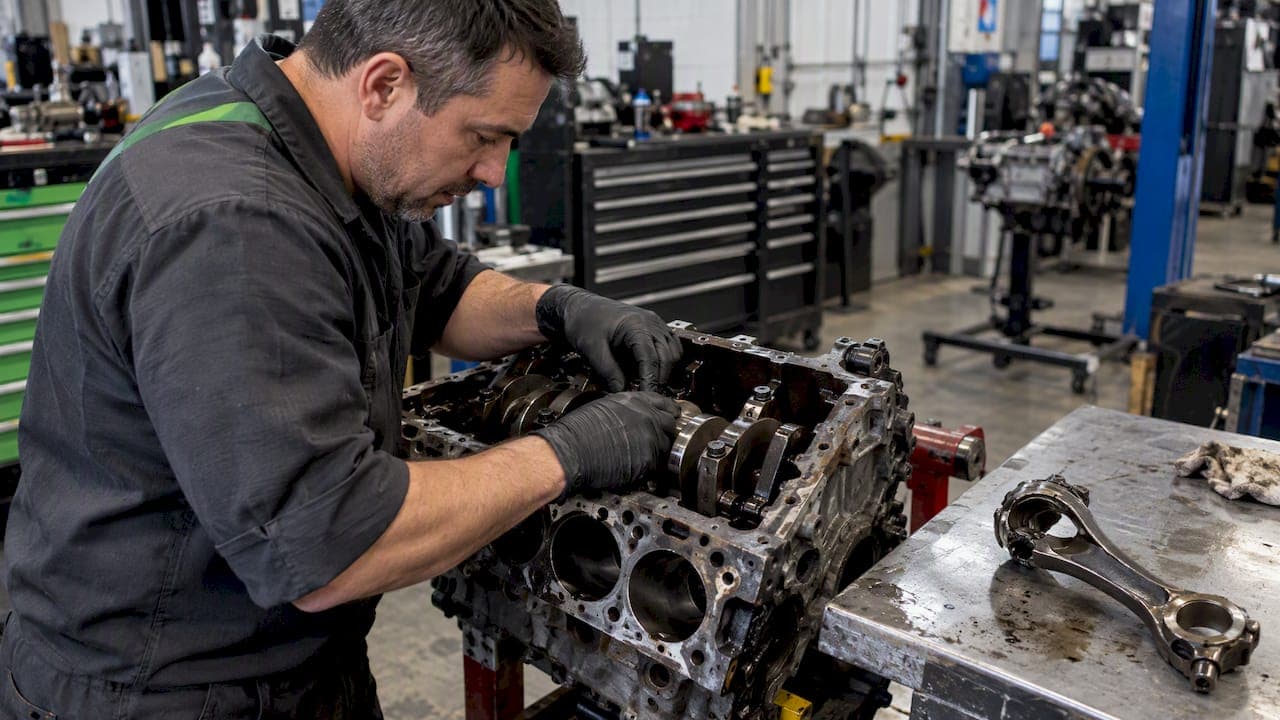
A hydrolocked engine has taken in liquid, usually water, that its pistons cannot compress, so the engine seizes or bends internal parts. If your car has one, stop trying to start it. Then work out whether a repair makes financial sense. If it doesn't, a car with a hydrolocked engine can still be sold for cash in Calgary and Okotoks, running or not.
This guide explains what happens inside the engine, how to tell if yours is hydrolocked, what the repair can cost, and how to decide between fixing it and selling it. It also covers a related question we hear often: what to do with a car that has a blown radiator or other coolant failure.
TL;DR
- Hydrolock happens when liquid fills a cylinder. Air compresses, liquid does not, so something has to give: usually a connecting rod, piston or the block.
- Never crank or restart the engine if you suspect water ingestion. Even a brief crank can turn a fluid-removal job into a full engine replacement.
- A mild case caught early can cost a few hundred dollars. A bent rod often means a replacement engine, and that can cost more than an older car is worth.
- If the repair bill is close to the car's value, selling it as is can be the cleaner financial choice. We buy non-running cars in Calgary and Okotoks and tow them for free.
- Check your insurance first. Comprehensive coverage generally covers flood damage, liability-only does not.
Table of Contents
- What actually happens inside a hydrolocked engine
- Common causes
- Signs your engine may be hydrolocked
- What to do right after it happens
- Can a hydrolocked engine be fixed?
- Is a hydrolocked car totaled?
- Repair or sell: a decision framework
- Perspective: how we look at hydrolocked cars
- What about a blown radiator?
- Selling a hydrolocked car in Calgary
- How to avoid hydrolock in the first place
- FAQ
- Sources
What actually happens inside a hydrolocked engine
An engine works by compressing a mix of air and fuel in each cylinder. Compression is possible because gas squeezes into a smaller space. A liquid does not. Hydrolock is the condition where a liquid enters a device designed to compress gas and stops it mechanically.
When the piston rises into a cylinder holding water, the crankshaft keeps pushing with the momentum of the whole engine, or with the starter motor. The weakest part gives way. That is typically a connecting rod, which bends. Other outcomes include damaged pistons or, in severe cases, a cracked block, as one engine-repair explainer describes.
The damage depends on speed. A car that stalls at low speed in a puddle may only have water in the intake and cylinders, with nothing bent. A car that was driving hard when it swallowed water usually has structural damage.
Common causes
Water is the usual culprit, but not the only one.
- Driving through deep water. If the water level reaches the air intake, the engine sucks it in. Underpasses and flooded roads are the classic traps.
- Floodwater or standing water. A car parked where water rises can take water in through the intake or exhaust.
- Internal coolant leaks. A failed head gasket or cracked head can let coolant seep into a cylinder overnight. The next start can then hydrolock the engine.
- Too much fuel. A stuck injector or a flooded carburetted engine can put liquid fuel in a cylinder.
This is also where the "blown radiator" searches connect. A blown radiator on its own does not hydrolock an engine. It makes the engine overheat, and overheating can then blow a head gasket, which is one of the ways coolant gets into the cylinders. If your car lost coolant, overheated and now won't turn over, treat it with the same caution as a water-ingestion case.
Signs your engine may be hydrolocked
Look for this pattern, especially after driving through water or an overheating event:
- The engine stalls suddenly, often with a bang or a heavy shudder.
- The starter clicks or the engine will not turn over at all, or it stops after a partial turn.
- You hear knocking or clunking if it does run. Automotive guidance says this typically points to severe internal damage such as a bent connecting rod.
- Water or milky fluid appears on the dipstick or in the oil fill area.
- White smoke or a sweet coolant smell from the exhaust after an overheat.
No single sign proves it. A mechanic confirms by pulling the spark plugs or injectors and checking the cylinders for liquid, then turning the engine by hand.
What to do right after it happens
The order matters more than speed.
- Do not restart it. This is the single most important rule, and technicians agree on it. Turning the starter even briefly can bend rods against the liquid.
- Get out of the water and turn the ignition off. If you are stalled in a flooded road, leave the vehicle when it is safe. Your safety comes before the car.
- Disconnect the battery if you can reach it safely and the car is not sitting in water.
- Have it towed. Do not drive it, push-start it or try again "just to see".
- Photograph everything before anyone touches it: water lines, the dash, the engine bay, the odometer. You may need these for an insurance claim or a sale.
- Call your insurer before authorizing repairs.
If you want a plain-language checklist for the first moments after an engine starts to fail, this guide to immediate steps when an engine overheats covers what to do to avoid making the damage worse. The same principle applies here: stop, shut it down, and let it cool or drain before anyone tries anything.
Can a hydrolocked engine be fixed?
Sometimes, yes. It comes down to whether anything bent.
Best case: no mechanical damage. The car stalled before the pistons were forced against the water. A mechanic removes the spark plugs, turns the engine over by hand to expel the liquid, changes the oil and filter, and checks for further contamination. One cost overview puts this range at a few hundred dollars for water removal and an oil change, in US dollars, so expect Canadian quotes to differ.
Worst case: bent rods, damaged pistons or a cracked block. The same source puts a bent connecting rod roughly between US$2,500 and US$4,000, and replacement at US$4,000 or more. Labour rates and vehicle type move these figures a lot. In Calgary, get a written local quote rather than relying on any online range.

There is a harder truth about partial survivors. Once a rod has bent, the engine may still run, but it will knock and lose balance, and eventually fail. When teardown, rod replacement and machining approach the price of a replacement engine, the sensible choice is usually to replace or walk away rather than rebuild.
Would a hydrolocked engine still run?
Sometimes for a short while. If water got in only partly, the engine may start and run roughly. That does not mean it is fine. Knocking or clunking is the warning that something inside is damaged, and running it risks turning a damaged engine into a destroyed one.
How long does a repair take?
A simple fluid purge can be a day. A replacement or rebuild depends on parts supply and shop schedules, so ask for a written timeline with the quote.
Is a hydrolocked car totaled?
That is an insurance decision, not an engineering one. A car is typically written off when repair costs exceed a share of its value, and the exact threshold is the insurer's call. Flood damage affects more than the engine: electrical systems, interior, fluids and transmissions can all be contaminated, as this guide to engine water ingestion explains.
On coverage, comprehensive insurance generally covers flood and water damage, engine included, while liability-only policies do not cover damage to your own vehicle. That source is written for the US, so read your own Alberta policy or ask your broker. Questions to put to your insurer:
- Does my policy include comprehensive coverage?
- What is my deductible?
- If you declare it a total loss, do I keep the car, and what is the payout?
The last question matters. If you keep a written-off car, selling it as is for cash can be a practical way to recover some value.
Repair or sell: a decision framework
Run these numbers before you spend anything.
| Situation | Usually makes sense |
|---|---|
| Newer, well-kept car, simple fluid purge confirmed by a mechanic | Repair |
| Valuable car, insurer covers the damage | Claim, then repair or take the payout |
| Older car, bent rod confirmed, quote close to the car's value | Sell as is |
| Car with other problems too (rust, transmission, failed inspection) | Sell as is |
| Unknown damage, no budget for diagnosis | Sell as is or get a diagnosis first |
A simple rule: if the repair quote plus the other repairs the car will soon need is near or above what the car would be worth running, repairing it is rarely a good deal. Our guide on five signs your car is officially a junker walks through the same logic for any major failure.
Perspective: how we look at hydrolocked cars
We buy cars in Calgary and Okotoks that other buyers won't touch: blown engines, transmission failures, failed inspections, flood damage. A hydrolocked engine is one of the more common reasons people call us, and most callers have the same two worries: "Is it worth anything?" and "Will anyone take it?"
Our answer is that the engine's condition changes the price, not whether we will buy. We buy running and non-running vehicles, and a car with a seized engine still has value in its parts and its scrap metal. That is how our business works: we make money by reselling parts and recovering scrap value, so a non-running car is not a problem for us the way it is for a private buyer who wants to drive it home.

The advice we give most often is simple. Do not sink money into a diagnosis on a car that is already old and worth little. If a mechanic has told you the engine needs replacing, you now have the information you need. Compare the quote with the car's value, and if it doesn't add up, call us before you pay for more work. We would rather you keep your cash than spend it on a repair that never pays back.
We also tell people not to start the engine "one more time" to see if it works. That single attempt can turn a repairable car into an unrepairable one and lower what any buyer, including us, can offer.
— Franz
What about a blown radiator?
Many owners searching for a blown radiator are really asking whether the car is still sellable. It is. A burst radiator, a coolant leak or an overheated engine does not make a car unsellable. It makes it a non-running or damaged vehicle, which is exactly the kind we buy.
What matters for the price is what the overheating did next. A radiator replacement on its own is a modest repair. If the engine overheated badly enough to warp the head, blow the gasket or damage the pistons, the repair cost climbs quickly. In that case the car's value drops and selling as is becomes the better option.
Be honest about the condition when you call. Tell us:
- Year, make and model
- Whether it starts, turns over or is seized
- What happened (flood, overheating, coolant loss)
- Whether a mechanic has given a diagnosis
- Where the car is parked and whether we can reach it
Honest details lead to a firm offer instead of one that changes at your driveway.
Selling a hydrolocked car in Calgary
A car with a hydrolocked engine is a normal job for us. Our process has three steps:
- Contact us with the details above.
- We pick up the vehicle, same day where possible, with free towing.
- You get paid in cash on pickup.
There are no hidden fees, and you do not have to get the car to us or to a mechanic. We also take ATVs and side-by-sides, and cars with blown engines or transmission failure. Our page on selling a car with a blown engine or transmission failure covers that situation in more depth.
Before the tow truck arrives:
- Remove personal items, including anything in the glovebox, trunk and under the seats.
- Take photos of the car as it sits.
- If the car was flooded, tell us honestly. It will not surprise us, and it avoids a revised offer later.
- Ask us what paperwork to have on hand and whether your insurance or registration needs attention after the sale. Rules for transferring and cancelling vehicles in Alberta are set by the province, so confirm the details with your registry agent as well.
If your car is at an impound lot, see our page on selling your car from a Calgary impound lot.
Ready to sell?
If your car won't start and you would rather not pay for a repair that doesn't add up, contact Southside Cash For Junk Cars for a cash offer and free same-day towing in Calgary and Okotoks. You can also read about our scrap car removal service.
How to avoid hydrolock in the first place
- Never drive into water you cannot see the bottom of. Even shallow-looking flooded roads can be deeper than the air intake.
- If the engine stalls in water, do not restart it. Get the car out and towed.
- Fix coolant leaks and overheating early. A small leak into a cylinder is a quiet route to hydrolock.
- Know where your air intake sits. On many cars it is low behind the bumper or wheel arch, and on some trucks and SUVs it is higher.
- Slow down in standing water. A bow wave pushed ahead of the car can raise the water level at the intake.
FAQ
Can a hydrolocked engine be fixed?
Yes, if nothing inside has bent or cracked. A mechanic can clear the water, change the oil and check for damage. If a connecting rod, piston or block is damaged, the realistic fix is a replacement engine, and on an older car that often costs more than the car is worth.
Would a hydrolocked engine still run?
It might, briefly, if only a small amount of liquid got in. If it runs with knocking or clunking, that points to internal damage, and continuing to run it risks complete failure. The safest course is to shut it off and have it towed.
Is a hydrolocked engine totaled?
Not automatically. Your insurer decides based on repair cost against the car's value, and flood damage elsewhere in the car counts too. If the car is declared a total loss, ask whether you can keep it and sell it as is.
Can I sell a car with a hydrolocked engine or blown radiator?
Yes. We buy running and non-running cars in Calgary and Okotoks, including ones with blown engines, seized engines and cooling-system failures. Call with the car's details and we will give you an offer and arrange free towing.
Sources
- Hydrolock, Wikipedia
- Signs of Engine Hydrolock & How to Fix It, CBAC
- Flash Flood Soaked Your Car? Here's How to Save It, Auto30
- Hydrolocked Engine: Symptoms, Repair Cost, and What to Do, Car Oracle
- To-Do Steps if Your Car Engine Takes in Water, Plant Machinery Vehicles