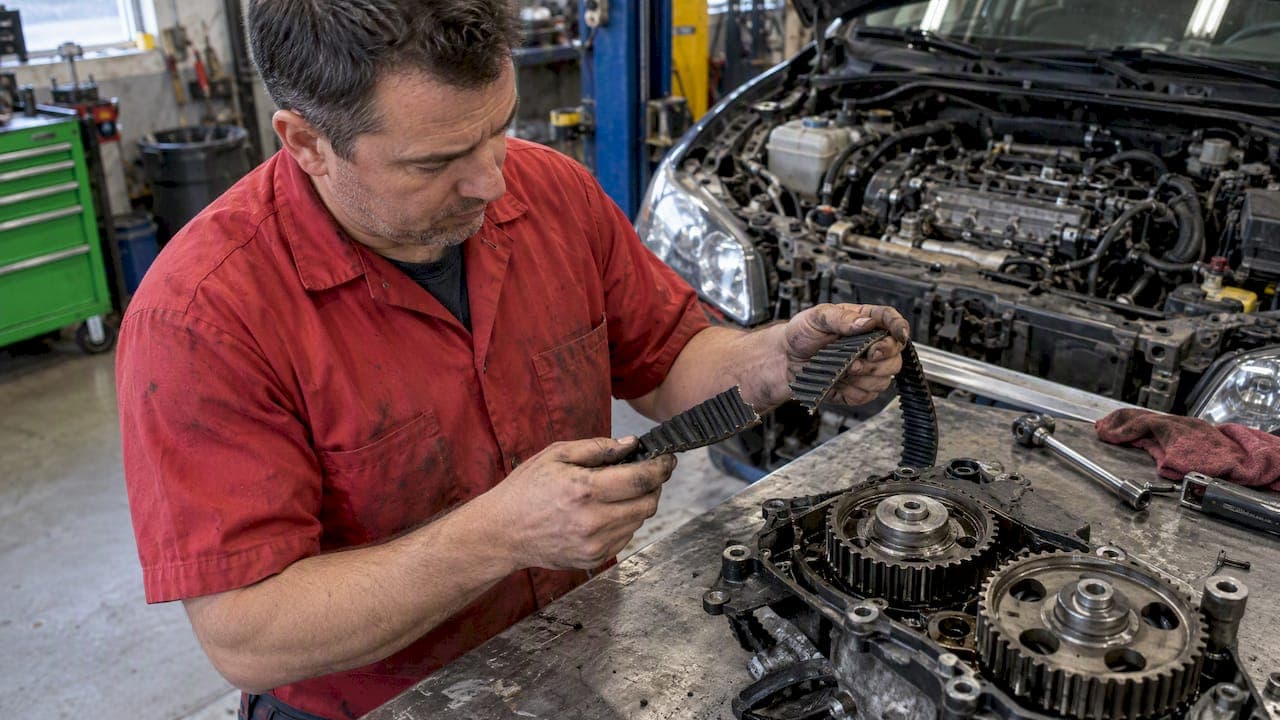
If your timing belt snapped, your engine stopped running immediately and lost its internal timing, and if it's an interference engine, the valves and pistons may have collided. Do not try to restart it. Pull over safely, shut the engine off, and arrange a tow for a professional inspection before you spend another dollar on the car.
TL;DR:
- Interference engines can bend valves, damage pistons, or crack the cylinder head after the belt breaks; noninterference designs may stop without internal contact.
- Ask the shop to verify the belt, run compression or leak down tests, and document findings with photos and an itemized report before authorizing teardown.
- Compare repair estimates, including valve or head work, with the car’s market value; selling as is makes sense when costs approach or exceed it.
- Follow the manufacturer’s mileage and age replacement schedule because belts can fail without warning; ask whether to replace the tensioner, idlers, and water pump too.
Table of Contents
- What happens inside the engine when a timing belt snaps
- What to do right after the belt breaks
- How mechanics figure out how bad the damage is
- Repair options and what they typically cost
- How long the inspection and repairs usually take
- Preventing a timing belt failure before it happens
- When selling for cash makes more sense than repairing
- A straight answer on repair versus sale
- Get a same-day cash offer for your car
- FAQ
- Sources
What happens inside the engine when a timing belt snaps
The timing belt keeps the crankshaft and camshaft turning in perfect sync, which controls when each valve opens and closes relative to the pistons below it. When the belt breaks, that coordination disappears instantly, and the engine stalls because it can no longer complete a combustion cycle.
What happens next depends entirely on engine design:
- Interference engines have valves and pistons that occupy the same space at different points in the rotation, so a snapped belt often means bent valves, damaged pistons, or a cracked cylinder head.
- Non-interference engines leave enough clearance that the valves and pistons rarely touch, so the car simply stops without further internal damage.
- Either way, the failure is typically sudden. A belt can look fine on the outside and snap with no warning noise or vibration beforehand, according to Driving.
You usually will not know which category your car falls into just by how it feels from the driver's seat. That's why the next step matters so much: get it looked at before assuming the worst, or assuming you got lucky.
What to do right after the belt breaks
The actions you take in the first few minutes can determine whether the damage stays contained or gets worse.
- Steer to the shoulder or a safe parking spot using momentum, since power steering and braking assist will be gone.
- Turn the key off completely and do not attempt to restart the engine, even to "see if it still runs."
- Note the time, what you heard or felt, and any dashboard warnings, then take a few photos of the engine bay if it's safe to do so.
- Call a tow truck or roadside assistance and tell the dispatcher the timing belt may have failed.
- Warn the tow operator and the receiving shop that the engine should not be started or cranked during loading or diagnosis.
A Car Talk write-up describes a case where an engine survived a broken timing belt, but the bigger risk came from further cranking attempts after the initial failure, which can turn a survivable situation into a costly one.
Pro Tip: Keep your keys out of the ignition entirely once you suspect the belt failed. Even a reflexive turn of the key can crank the engine and cause damage that wasn't there a moment earlier.
How mechanics figure out how bad the damage is
A shop can't tell you what's wrong just by listening to your description. Diagnosing a snapped timing belt is a step-by-step process, and understanding it helps you judge whether an estimate is thorough or rushed.
- A technician starts with a visual check of the belt, pulleys, tensioner, and water pump to confirm the belt is the actual cause of the stall.
- A compression or leak-down test follows, which reveals whether cylinders are holding pressure the way they should.
- Low or uneven readings usually mean the valves made contact with the pistons, which points toward bent valves or worse.
- When the tests suggest internal damage, the shop removes the cylinder head to directly inspect the valves, valve seats, and piston tops.
- A reputable shop documents this process with photos and an itemized report, so you can see exactly what's bent, cracked, or fine.
This is also where repair-versus-scrap decisions start to take shape. If the compression test comes back clean, you may be looking at a belt-only repair. If the head has to come off, the cost conversation changes fast, and that's worth knowing before you authorize any teardown labor.
Repair options and what they typically cost
Once you know the extent of the damage, three realistic paths open up, and a fourth one that's worth considering honestly.
- Belt-only replacement is possible when the engine is non-interference or when an interference engine got lucky, and the job mainly involves parts (belt, tensioner, idlers) plus the labor to access them, which varies by how deeply the belt is buried in the engine bay.
- Valve and head repair costs climb quickly once machining or valve replacement enters the picture, since the head often has to be removed, inspected, resurfaced, and reassembled with new valves or seats.
- Engine replacement, using a used or rebuilt short-block, becomes the fallback when the damage is too extensive to repair piece by piece, and it carries its own labor and compatibility tradeoffs.
- Selling the car as-is is the rational move when repair costs start approaching or exceeding what the car is worth on the market.
Mechanics and automotive writers generally agree that repair-versus-scrap decisions come down to comparing repair costs to the vehicle's market value, comparing the repair bill to the vehicle's market value, according to Driving.ca's breakdown of timing belt repair economics. That same coverage notes owners often keep repairing out of attachment to the car rather than because the numbers support it, which is worth remembering before you say yes to a big estimate. If you're trying to figure out where your car falls on that scale, these signs a car is officially a junker can help you think it through.
How long the inspection and repairs usually take
Expect the inspection and estimate to take a few hours to a full day, depending on how quickly the shop can run compression tests and, if needed, pull the head.
A belt-only replacement is typically a same-day or next-day job once parts are on hand, since the labor is mostly access and reassembly. Head or valve repairs stretch into multiple days because machining, parts ordering, and reassembly all add time. Engine replacements can take even longer, especially if the shop is sourcing a used short-block for an uncommon model, since lead times on parts vary widely by make and availability.
Preventing a timing belt failure before it happens
The most reliable protection is following your manufacturer's replacement interval, measured in mileage and time, since belts degrade with age even on a car that's driven lightly.
- Replace the timing belt according to your owner's manual schedule rather than waiting for symptoms.
- Have the tensioner, idlers, and water pump replaced at the same time if your mechanic recommends it, since they wear on a similar timeline.
- Don't rely on noise or vibration as a warning system. Mechanics note that belts frequently fail with no advance signs, which is why scheduled replacement, not symptom-watching, is the real safeguard, per Driving.ca.
A shop like Richardson Kwik Kar can walk you through the specific interval and signs worth watching for your model.
When selling for cash makes more sense than repairing
If the repair estimate is high relative to your car's value, or you simply don't have the time to wait on a multi-day teardown, selling as-is is often the more practical route. A buyer will typically want to know the vehicle's condition, whether you have the title, if you still have the keys, and some basic photos of the car.
The process usually moves fast: you describe the car, get a quote, and arrange same-day pickup with payment handed over on the spot. Before accepting any offer, ask how the price was calculated and whether pickup and paperwork are included, since getting an instant quote should be straightforward, not a negotiation marathon.

A straight answer on repair versus sale
Safety comes first: don't crank the engine, get it inspected, and let the compression test tell you what you're actually dealing with. After that, it's just math. Compare the real repair number to what the car is worth, get the number in writing, and don't let attachment to the car cloud a decision that's really about dollars.
— Franz
Get a same-day cash offer for your car
We buy cars with engine problems exactly as they sit, running or not, so you skip the teardown estimates entirely if that's the route you'd rather take. 
- We give instant quotes based on your car's condition, year, and location.
- Pickup is typically same-day, with cash paid on-site once the paperwork is done.
- Have your title and keys ready, since that's what speeds up the handoff.
If your engine damage turns a repair bill into a losing bet, you can get a quote for your junk car and have it picked up without ever setting foot in another repair shop.
FAQ
Can you drive with a snapped timing belt?
No. Once the belt breaks, the engine loses timing and typically stalls immediately, and in interference engines, continuing to try to run it risks further valve and piston damage. Have the car towed rather than attempting to restart or drive it.
How much does it cost to fix a snapped timing belt?
Costs depend heavily on whether the engine suffered internal damage: a belt-only replacement is far cheaper than a repair that requires valve work or a new engine. Shops typically recommend getting a written estimate after a compression test, since that result determines which repair category you're in.
How much does it cost to fix a timing belt?
A routine, preventive timing belt replacement, done before it fails, generally costs less than a post-failure repair because there's no internal engine damage to address. Asking your shop for the belt, tensioner, idler, and water pump as a bundled job is the standard approach.
Is it worth fixing a timing belt on a car?
It's worth fixing when the repair cost, including any valve or head work, stays well below the car's market value. When the estimate approaches or exceeds that value, selling the car as-is is often the more rational choice, according to Driving.ca's cost-versus-value guidance.