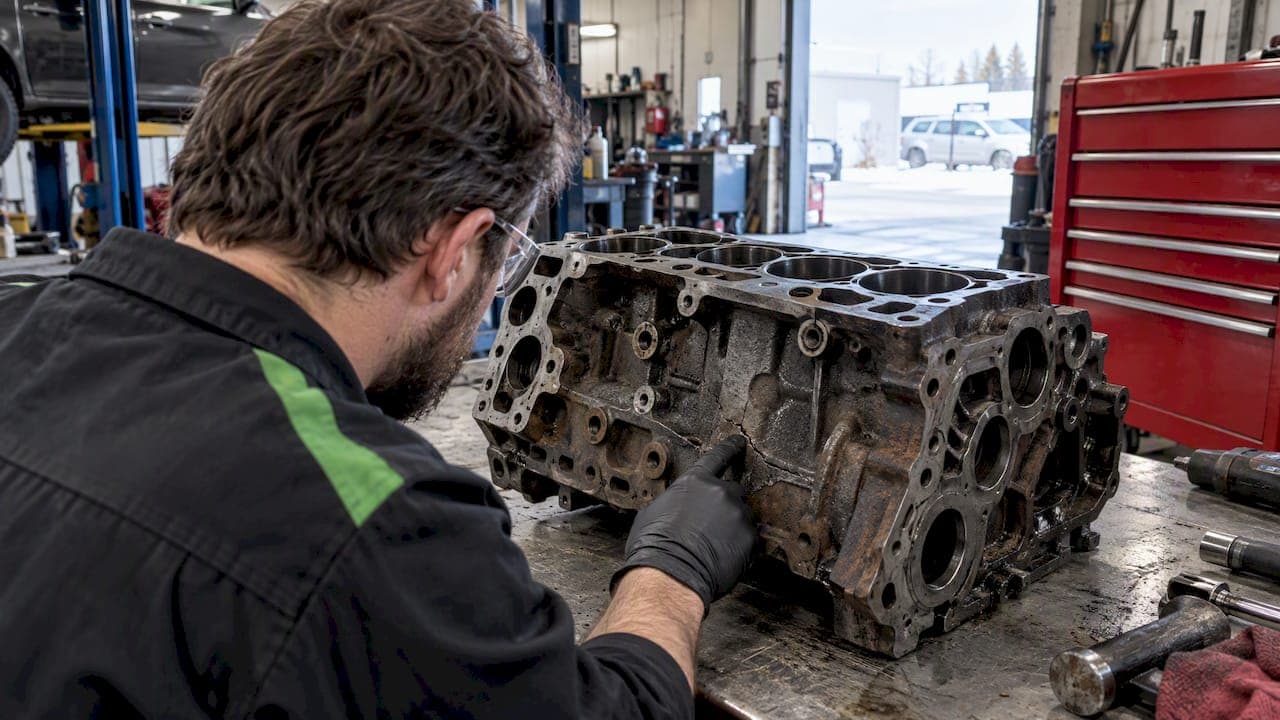
Some cracked engine blocks can be repaired, but many are more economical to replace, and the right call depends on where the crack sits, how big it is, and whether the block is cast iron or aluminum. If you suspect a crack, stop driving as soon as it's safe, especially with overheating, coolant loss, low oil pressure, or heavy white smoke, and arrange a tow. The next step is a proper diagnostic sequence to confirm the block, not the head gasket, is the actual problem.
TL;DR:
- Repairability depends heavily on the crack's location and whether the engine block is cast iron or aluminum, with structural cracks being poor repair candidates.
- Diagnostic steps include visual inspection, cooling system pressure testing, combustion gas testing, and possibly borescope or machine-shop analysis, with pressure and MPI tests confirming leaks.
- Cold repair methods like pinning or composite fills suit small, external cracks, while welding requires precise preheating and slow cooling, especially for cast iron; larger or structural cracks often lead to replacement.
- Continuing to drive with a suspected cracked block risks engine hydrolock, bearing damage, and secondary failures, often turning minor repairs into full engine replacements.
- Cost considerations favor replacement over repair for common engines, especially if repair quotes approach or exceed vehicle value or if remanufactured engines are readily available.
Table of Contents
- Symptoms that point to a cracked block versus a lookalike problem
- How shops diagnose a cracked block and what each test tells you
- Repair methods, material limits, and how long they tend to last
- Repair versus replace: a decision checklist
- What to do right now: safety, towing, and talking to the shop
- What happens if you keep driving on a cracked block
- Preventing a cracked block before it happens
- Why engine blocks actually crack
- Comparing repair methods on durability and reliability
- How long diagnosis and repair usually take
- A shop and salvage perspective on repair versus replacement
- If repair doesn't make sense, here's a straightforward way to sell
- FAQ
- Sources
Symptoms that point to a cracked block versus a lookalike problem
A cracked block and a blown head gasket often look identical from the driver's seat, which is why so many owners misjudge the problem before a shop ever opens the hood. Persistent overheating paired with white steam or a sweet smell from the exhaust usually means coolant is burning inside a cylinder, a hallmark of both failures. Milky, discolored oil tells a similar story: coolant and oil have mixed, either from a cracked water jacket near an oil gallery or from a failed gasket.
Watch for these combinations:
- White or gray steam from the tailpipe with a faint sweet odor, often worse under load
- Oil that looks like a milkshake on the dipstick or filler cap
- Rough running, misfires, or a sudden loss of power tied to a specific cylinder
- Bubbles rising in the coolant reservoir or radiator with the engine idling
- External coolant or oil weeping from the block itself, not from hoses or the radiator
A single symptom, like a slow coolant loss with no other signs, can sometimes be monitored for a day or two while you book a diagnostic appointment. Overheating combined with white smoke and bubbling coolant is a different situation entirely: that combination overlaps with cracked cylinder heads or failed head gaskets just as often as it points to the block, which is exactly why testing matters more than guesswork.
How shops diagnose a cracked block and what each test tells you
Diagnosis follows a logical order, and skipping steps usually means paying twice. Shops start cheap and noninvasive, then escalate only as needed.
- Visual inspection and fluid checks, plus an OBD scan for misfire or temperature codes
- Cooling-system pressure test to find external leaks and confirm the system holds pressure
- Combustion-gas-in-coolant test to detect exhaust gases leaking into the cooling system
- Compression test and cylinder leak-down test to isolate which cylinder is losing pressure and why
- Borescope inspection through the spark-plug hole to look for visible cracking or carbon streaking
- Head removal and direct inspection, followed by machine-shop pressure testing or magnetic particle inspection (MPI) of the bare block when earlier tests are inconclusive
A sensible diagnostic sequence moves from visual and fluid checks through pressure and combustion-gas testing before compression and leak-down narrow things down, with head removal reserved for confirmation. The catch is that leak-down bubbles in the coolant confirm a combustion-to-coolant path, but they don't by themselves tell you whether the culprit is the head gasket or the block itself. Machine-shop testing closes that gap: a bare block gets immersed and pressurized, commonly with roughly 20 psi of air, to reveal leaks in the water jacket, and MPI finds surface cracks in cast iron that pressure testing alone can miss, as outlined in manufacturer service procedures for pressure-testing cylinder blocks.
Pro Tip: Ask the shop for written pressure-test results and any MPI or dye-penetrant report before authorizing repair work, not just a verbal "it's cracked."

Repair methods, material limits, and how long they tend to last
Repair technique depends heavily on whether you're working with cast iron or aluminum, and on how much stress the cracked area carries in normal operation.
Cold repair methods carry the least risk of warping the casting. Tapered pins, threaded inserts, and metal stitching work by mechanically locking the crack closed rather than melting the metal, and they're a reasonable option for many external or low-stress cracks. Hot methods go further but demand more skill: cast-iron welding requires careful preheating and slow, controlled cooling to avoid seeding new cracks nearby, while aluminum blocks are more commonly repaired with TIG welding because of how the alloy behaves under heat.
- Cold pinning and tapered plugs: low distortion risk, suited to many external or low-stress cast-iron cracks
- Cast-iron welding: effective in skilled hands but requires preheat control and slow cooling to prevent rec racking
- Aluminum TIG welding: the standard approach for aluminum blocks, though it demands more precision than cast-iron work
- Epoxy or Belzona-style composite repairs: useful for small, external, low-pressure leaks, often a situational or temporary fix rather than a permanent one
- Resleeving or machining at a machine shop: restores cylinder walls but adds cost and only works for certain crack locations
A crack's location often matters more than its size. A hairline crack in a lightly stressed exterior wall is a reasonable repair candidate, while a crack running through the main bearing webs or deep into a cylinder wall is a poor one, because those areas carry combustion and bearing loads that a repaired casting may not hold over time. Repair outcomes vary by approach: cold pinning handles many cast-iron cracks well, aluminum more often goes to TIG welding, and large cracks in structurally critical areas tend to be poor repair candidates regardless of method. Trade reports on cast-iron weld repairs note that machine shops often drill out the ends of a crack to stop it from spreading further, cut a V-groove to prepare the area for welding or pin insertion. Keep individual weld passes short to limit residual stress, and cool the block slowly under sand or thermal blankets afterward.
Repair versus replace: a decision checklist
Repairing a cracked block is as much a financial decision as a mechanical one, and the math rarely favors welding a common engine back together.
- Get a fully installed repair quote that includes machine-shop pressure testing and any confirmatory teardown, not just the welding labor
- Get a comparable quote for a replacement engine, whether used, remanufactured, or new
- Weigh both numbers against the vehicle's current value, mileage, and the condition of the body and transmission
- Check core availability and warranty terms; a remanufactured engine with a warranty often removes the uncertainty that comes with welding a marginal casting
- Get at least two independent shop quotes along with a written machine-shop pressure-test report before committing to either path
In practice, repairability is as much an economic question as a technical one: specialist welding tends to make sense for rare, numbers-matching, or hard-to-source blocks, while replacement usually wins for common mass-produced engines where a reman unit is readily available. If your car is an everyday commuter with 150,000 miles on the odometer, a $1,500 repair bill on a block that might crack again competes poorly against a warrantied reman engine, especially once you add the machine-shop testing fees that a responsible repair requires either way.
What to do right now: safety, towing, and talking to the shop
If you're seeing overheating, low oil pressure, a severe misfire, or persistent white smoke, stop driving and shut the engine off. Repeated restarts after overheating are one of the fastest ways to turn a repairable crack into a scrapped engine.
- Pull over safely and switch off the engine rather than trying to "limp it home"
- Arrange a flatbed tow instead of driving, even a short distance
- Write down when the overheating started, your last coolant top-up, the antifreeze mix ratio, and any recent repair work
- If you decide to sell rather than repair, keep your title, keys, and a photo record of visible damage, and note the symptoms honestly for the buyer
A flashing temperature warning or a rapidly climbing gauge should be treated as a stop-now condition, since continuing to drive risks bearing damage, hydrolock, or total engine failure on top of the original crack.
What happens if you keep driving on a cracked block
Continuing to drive a vehicle with a confirmed or suspected cracked block rarely ends well, because the problem compounds instead of staying static. Coolant leaking into a cylinder can hydrolock the engine on startup, bending a connecting rod almost instantly. Coolant mixing into the oil strips away lubrication at the bearings, and bearing damage from running low or contaminated oil is expensive to fix on its own, separate from the crack.
Repeated overheating cycles also stress the head gasket, the cylinder head, and the block itself, so a crack that started small and localized can spread or trigger secondary failures elsewhere in the cooling and lubrication systems. What might have been a $600 to $1,500 cold-pinning repair can turn into a full engine replacement if you keep driving through the symptoms. Overheating is also the most common event that starts the cracking process in the first place, which means driving on a hot engine doesn't just risk the existing crack, it can create new ones.
There's a resale angle too. A vehicle with a documented cracked block and no repair history is a harder sell at a dealership or to a private buyer, since most will assume the worst about the rest of the drivetrain. Owners who let the problem run its course often end up with a car that's only worth something for parts or scrap value, which is a very different conversation than a vehicle sold promptly with an honest description of the issue.
Preventing a cracked block before it happens
Most engine block cracks trace back to a handful of preventable habits, and routine maintenance closes off nearly all of them.
Keep the cooling system in good shape: check coolant level and condition regularly, flush and replace coolant on the schedule your manufacturer specifies, and never run straight water in a climate where temperatures drop below freezing. Freezing coolant expands inside the block's water jacket with enough force to crack the casting, and it's one of the most preventable causes of block failure.
Address overheating the moment it shows up rather than hoping it resolves itself. A failing thermostat, a weak radiator fan, a slipping belt, or a slow coolant leak can all push engine temperatures into the danger zone, and overheating is the most common event that initiates a crack. If your temperature gauge creeps up, pull over and have the cooling system checked before the next drive, not after.
Watch for early warning signs during routine oil changes and inspections, since a technician doing a digital vehicle inspection can often catch a failing thermostat or weak coolant mixture before it becomes an overheating event. Keeping the engine bay clean also makes small leaks easier to spot early; regular engine-bay cleaning makes a fresh coolant or oil weep visible before it becomes a bigger problem.
Why engine blocks actually crack
Three mechanisms account for the overwhelming majority of cracked blocks, and none of them are mysterious once you understand how the casting behaves under stress.
Thermal stress from overheating is the leading cause. When an engine runs too hot for too long, the metal expands unevenly, and repeated heating and cooling cycles fatigue the casting at its weakest points, typically thin sections near the cylinder walls or the main bearing webs. Freezing is the second major cause: coolant that's too weak or plain water left in the block during cold weather expands as it freezes, and that expansion can split the casting outward. Manufacturing defects, while less common, account for a portion of cracks that show up early in an engine's life, often from porosity or thin spots introduced during the original casting process.

Overheating stands out as the most common initiating event, with freezing from improper antifreeze concentration and long-term thermal fatigue following close behind, alongside casting defects that surface over years of thermal cycling. Knowing which of these applies to your situation matters for the repair decision: a block that cracked once from a one-time freeze event is a different risk profile than one that's been chronically overheating for months, even if the visible crack looks the same.
Comparing repair methods on durability and reliability
Not all repairs are built to last the same way, and the right method depends on matching the technique to the crack rather than picking whichever shop quotes the lowest price.
Cold pinning and tapered plugs are mechanically reliable for cracks in low-stress, non-structural areas, and they avoid the heat distortion that comes with welding, but they're not meant for cracks running through main bearing webs or deep cylinder walls. Cast-iron welding, done with proper preheat and slow cooling, can produce a durable repair, though case studies of successful welds consistently emphasize that skipping the controlled heating and cooling steps is how repairs fail and new cracks form. Aluminum TIG welding follows a similar logic: it's the standard approach for aluminum castings, but it demands more precision than cast iron because the alloy is more sensitive to heat distortion.
Epoxy and composite repairs like Belzona sit at a different durability tier. Industrial case studies show these cold-applied repairs holding up well on hairline, low-pressure cracks and cutting downtime compared to a full replacement, but suitability depends heavily on crack size, location, and the loads the area carries in service. Treat epoxy as a strong option for small external leaks, not a universal fix. Across all methods, the deciding factor is less about which technique is "best" and more about whether the crack's location and the block's material match what that technique is actually good at.
How long diagnosis and repair usually take
Diagnosis itself is usually the fast part. Visual inspection, fluid checks, an OBD scan, and a cooling-system pressure test can often be done in a single shop visit lasting a few hours. Combustion-gas testing and a compression or leak-down test add more time but are still typically same-day work. The slower step is anything requiring head removal or a bare-block pressure test at a machine shop, since pulling the head, cleaning the block, and getting a machine shop to run pressure or MPI testing can stretch diagnosis out to several days depending on shop backlog.
Repair timelines vary more widely. Cold pinning or tapered-plug work on an accessible crack might be a one- to two-day job once the block is out and prepped. Welding repairs, especially on cast iron, take longer because of to preheat and slow-cool requirements. Add machine-shop scheduling, parts sourcing for gaskets and seals, and reassembly, and a welding repair can realistically run a week or more from teardown to a running engine. Replacement with a used or remanufactured engine often moves faster once the unit is sourced, since the labor is swap-focused rather than repair-focused, but sourcing the right reman core itself can add days if it's not a common application.
A shop and salvage perspective on repair versus replacement
In practice, welding tends to succeed on rare or valuable cores where sourcing a replacement is hard, while common engines usually get replaced on cost and reliability grounds. Machine-shop pressure testing and MPI are the evidence that actually settles the question, not guesswork. For owners who decide repair isn't worth it, selling the vehicle for cash through a transparent, honest sale preserves some value and skips the months of storage and uncertainty that a marginal repair often brings.
— Franz
If repair doesn't make sense, here's a straightforward way to sell
When a repair quote comes in close to or above what the vehicle is worth, or when reman engine availability means weeks of waiting, selling the car as-is is often the more practical move. We buy damaged and non-running vehicles, including ones with blown engines or cracked blocks, with same-day pickup and no hidden fees across Calgary and Okotoks.

Our process stays simple: you contact us with the vehicle's condition, we give you a cash offer, and we arrange prompt pickup with payment on the spot. If you're weighing this option, our guide on selling a car with a blown engine or transmission failure walks through what to expect, and our non-running car guide covers the paperwork worth having ready.
- Have your title or ownership documents and keys on hand before pickup
- Note the basic condition and symptoms honestly, including when the overheating or smoke started
- Reach out through our scrap car buyer page for a straightforward offer on your vehicle
FAQ
Can you still drive with a cracked engine block?
Driving with a cracked engine block is risky and generally not advisable once overheating, coolant loss, or white smoke appears. Continued driving can lead to hydrolock, bearing damage from oil contamination, or complete engine failure, so the safer move is to stop and arrange a tow.
Can a cracked engine block be fixed?
Some cracked blocks can be repaired using cold pinning, welding, or epoxy-based methods, depending on the crack's location and whether the block is cast iron or aluminum. Cracks in structural areas like the main bearing webs are poor repair candidates, and replacement is often more practical for common engines.
How much would it cost to fix a cracked engine block?
Repair costs vary widely based on the method, the crack's severity, and whether machine-shop pressure testing and teardown are needed to confirm the diagnosis. There's no single published figure that applies across cases, so getting a fully installed quote that includes testing, compared against a replacement engine quote, is the only reliable way to know your actual cost.
What are the symptoms of a cracked engine block?
Common symptoms include white or sweet-smelling exhaust steam, persistent overheating, milky oil from coolant mixing in, and bubbles in the coolant reservoir. These signs can overlap with a failed head gasket or cracked cylinder head, which is why pressure testing and compression testing are needed to confirm the block itself is at fault.
Sources
- What causes an engine block to crack? Know the signs and prevention
- Crack engine block: what is it, causes, how to fix it
- Cracked engine block on luxury cars & semi trucks — J W Welding
- Series 50 - Cylinder block and cylinder liner (Detroit Diesel)
- Engine block repair (Hot Rod)