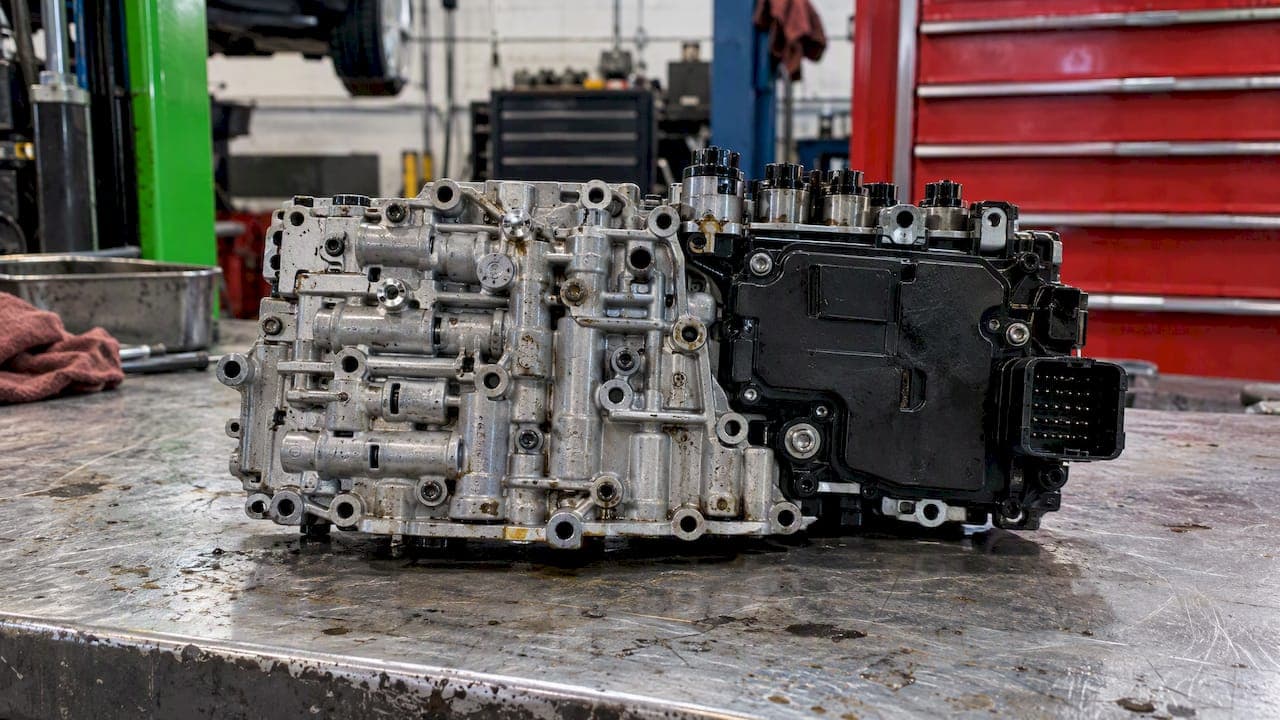
A failing transmission control module (TCM) usually shows up as harsh, delayed or random shifting, a transmission or check-engine light, or a car that locks itself into one gear (limp mode). The module is not always the culprit, though. Wiring, low voltage, sensors and worn internal parts can mimic it, so test before you buy anything. If the car is old and the repair bill is climbing past what the car is worth, selling it as-is for cash can be the smarter move.
TL;DR
- A bad TCM typically causes hard or delayed shifts, slipping, a gear that will not change, warning lights or limp mode.
- Many "TCM problems" are actually bad grounds, low battery voltage, corroded connectors, a faulty sensor or worn clutches. Scan for codes and check the basics first.
- Driving in limp mode is meant only to get you to a safe place or a shop, not to keep commuting.
- In Canada, expect roughly $120 to $250 for a full diagnostic with a road test, and a full transmission replacement can reach $3,500 to $8,000.
- If the repair would exceed about half the car's market value, selling or scrapping is worth a serious look. We buy non-running cars in Calgary and Okotoks with free same-day towing.
Table of Contents
- What the transmission control module does
- Common signs of TCM failure
- What causes a TCM to fail
- Problems that look like a bad TCM
- How a suspected TCM failure is diagnosed
- Can you still drive with a bad TCM or transmission?
- Repair or replace: can a TCM be fixed?
- What TCM failure costs in Canada
- When the car is not worth fixing
- Our perspective
- Selling a car with TCM or transmission failure in Calgary
- FAQ
- Sources
What the transmission control module does
In a modern automatic, the TCM is the transmission's computer. It takes data from sensors and the engine controller, calculates when to shift, and signals actuators such as the solenoids that control valves and gears. Some vehicles house it inside the transmission, some mount it on the valve body, and some fold it into the engine computer.
Because it depends on so many inputs, a fault anywhere in the chain can look like a dead module. Speed sensors, throttle-position data, temperature sensors, mode switches, wiring harnesses and the vehicle's communication network all feed it, and Allison's troubleshooting manual notes that a failure in any of those inputs or in the solenoids and valves it commands can produce TCM-like symptoms.

Common signs of TCM failure
No single symptom proves the module is bad, but this cluster should get your attention:
- Erratic shifting. Slipping or unpredictable shifts, delayed shifting, or getting stuck in one gear are the classic complaints.
- Harsh engagement. The car bangs into gear, or shifts too early or too late for your speed.
- Warning lights. A check-engine or transmission light, sometimes with a missing gear indicator on the dash.
- Limp mode. The car stays in second or third gear and will not accelerate normally. Kelley Blue Book describes limp mode as a protective state that limits acceleration and top speed.
- Stored codes. Incorrect gear ratio codes, solenoid codes and communication codes all point toward the transmission control system, but they require testing rather than automatic replacement.
A real-world example: a Transmission Digest case logged a temperature-sensor code (P0711), a pressure-control-solenoid code (P0776), an incorrect-gear-ratio code (P0731) and a communication code (U1024). In that case a replacement TCM did resolve the shifting problem, but the point of the story is that the technician confirmed the cause first.
What causes a TCM to fail
The usual suspects, according to a service-provider guide to testing the module, are:
- Damaged wiring or short circuits.
- Excess heat, especially for modules mounted on or in the transmission.
- Water getting into the housing. This matters in Alberta, where road salt and slush in winter are hard on connectors and electronics.
- Age and wear.
- Outdated or corrupted programming.
- Rough driving conditions.
Some failures are design-wide rather than random. Transport Canada's closed-investigation summary says that affected Ford Fiesta and Focus DPS6 transmissions could slip, buck, kick or jerk, causing harsh acceleration or hesitation. If your vehicle is a popular model with a shifting complaint, check the recall and defect databases and ask a shop about technical service bulletins before paying for parts.
Problems that look like a bad TCM
This is the section that can save you a few thousand dollars. Low or burnt fluid, worn clutch packs, failing solenoids, damaged wiring, a bad speed sensor or a faulty valve body can all cause symptoms similar to TCM failure. One transmission specialist's view is that the module is often blamed for problems caused by low voltage, bad grounds, corroded connectors or faulty sensor data, and that replacing it without checking those items can be an expensive mistake.
Voltage is a good example. Transmission Digest notes that a failing battery, weak alternator output, or power and ground problems can prevent a GM transmission's fast-learn process, and that misfires and fuel or air problems can interfere too. Even a single code can have several parents: PartsAvatar lists blocked fluid passages, internal mechanical failure, low or contaminated fluid, solenoid wiring faults and a faulty TCM as possible causes of P0744.
| Symptom | Could be the TCM | Could also be |
|---|---|---|
| Harsh or delayed shifts | Corrupted programming, failed internal circuits | Low or burnt fluid, worn clutches, bad solenoid |
| Stuck in one gear | Module fault, limp mode triggered | Speed sensor, wiring, valve body |
| Warning light, no gear indicator | Internal fault, communication loss | Corroded connector, network fault |
| Shifts feel wrong after a battery change | Rarely a failed module | Lost adaptive values that need relearning |
How a suspected TCM failure is diagnosed
A sensible diagnostic order goes from cheap to expensive:
- Check the basics. Battery health, terminals and grounds. Weak voltage causes odd behaviour across the whole car.
- Scan for codes. An OBD-II scan, inspection of wiring and connections, and a check of fluid level and condition are the standard starting points.
- Inspect the fluid. Dark, burnt-smelling or low fluid points to mechanical wear, not electronics.
- Road test with live data. A technician watches commanded versus actual gear, solenoid duty and line pressure.
- Check for updates. Software updates or bulletins may already exist for your model.
Can you reset a TCM? Sometimes. The same source says that disconnecting the battery for a few minutes can reset minor issues, as long as you follow safety precautions and know your car's electronics will lose stored settings. Do not expect it to fix a hardware fault.
If you do replace a module, set expectations. A new unit starts without learned values, so shift quality may feel off until it relearns, and many vehicles need a deliberate relearn procedure. Shifting complaints after a battery disconnection or a part swap are often adaptive-value issues rather than a failed module.
Can you still drive with a bad TCM or transmission?
Short answer: only as far as you must. Limp mode exists to protect the transmission and engine, and Kelley Blue Book's blunt answer is that driving in it is not okay as a habit, though a minor trigger may allow a short trip of a few miles to a shop or home without harm.
Here is how we would think about it on the road:
- Gear will not change, or the car lurches into gear: you can lose power at an intersection or on a highway on-ramp. Pull over safely and arrange a tow rather than gambling on Deerfoot or Highway 2 traffic.
- Slipping with a burning smell: stop. Heat is the enemy of both fluid and electronics, and continued driving turns a repair into a replacement.
- Occasional harsh shift, no lights: you can usually drive carefully to a shop, but book the scan this week.
- Limp mode after a restart clears it: the fault is still stored. It will likely return, often at a bad time.
If you are unsure, a tow costs far less than a wrecked transmission, and an unsafe vehicle is not worth the risk.
Repair or replace: can a TCM be fixed?
Often yes, and that is where the savings are. Allison's 2021 procedure for U.S. and Canadian distributors says many returned TCMs tested "No Trouble Found", and directs technicians to complete the active-code troubleshooting steps, reflash the original TCM with current calibration and software, and try to duplicate the complaint before replacing it. That is a commercial-transmission procedure, but the principle carries over: confirm, update, retest, then replace.
Options you will be quoted, from cheapest to most expensive:
- Software reflash or update where the manufacturer offers one.
- Wiring or connector repair if the diagnosis finds corrosion or a damaged harness.
- Module repair or a rebuilt unit, which specialist electronics shops offer for some models.
- New or used module, which usually needs programming to your VIN.
- Full transmission replacement if the damage is mechanical.
What TCM failure costs in Canada
Prices vary by vehicle, shop and city, so treat these as ranges from published guides and get written quotes:
| Item | Typical range | Source |
|---|---|---|
| Basic scan | $0 to $80 | Canadian repair cost guide |
| Full diagnostic with road test | $120 to $250 | same guide |
| Electrical or driveability diagnostics | $180 to $400 | same guide |
| Mercedes-Benz 722.9 transmission, parts, labour and programming | $2,000 to $4,000, depending on TCM type | circuit board repair blog |
| Full transmission replacement | $3,500 to $8,000 | parts guide |
The same Canadian guide says dealership rates run 30 to 50 percent above independent shops, though dealers can be the right call for warranty work, complex electronics or programming. One practical approach is to pay a dealer for diagnostics and bulletin checks, then take the documented findings to an independent shop for the hardware work.
If you have an extended warranty, read it first. Many require prior authorization, and unauthorized repairs or the wrong shop can void coverage or reduce reimbursement.

When the car is not worth fixing
An older car with a failed transmission system is a classic repair-versus-sell decision. The rule of thumb from the Canadian cost guide: consider walking away if the repair exceeds half the vehicle's market value, or if it follows a second major repair within a year. With transmission replacement quoted anywhere from $3,500 to $8,000, a ten- or fifteen-year-old sedan can cross that line quickly.
A quick way to decide:
- Get a written diagnosis, so you know whether it is a $300 wiring fix or a $5,000 rebuild.
- Look up what a comparable running car sells for in Alberta.
- Compare the quote to half of that figure.
- Compare the repaired-car value with what you can get today as-is, with no repair spending.
Selling a car with a bad transmission is common and legal. Be honest about the condition. If the odometer is also unreliable, our guide on selling a car with a broken odometer in Alberta explains how to disclose it. For other drivetrain failures, see our notes on what shops check before you repair or sell with a transfer case failure, and if you are weighing a rebuild, salvage versus rebuilt title matters for resale. Our page on selling a car with a blown engine or transmission failure in Calgary covers the process in more detail.
Our perspective
We see these cars every week. The pattern is predictable: an owner spends on a scan, then a module, then a second opinion, and ends up with a car that still does not shift right and a bill larger than the car's value. Our advice is not to skip diagnosis. Pay for a proper one, because it tells you whether you are looking at a cheap wiring fix or a real transmission problem. But decide your ceiling before the shop calls with the quote, and stick to it.
If the number is above that ceiling, you do not have to fix the car to get something for it. A non-running car still has value in parts and scrap metal, and that is how we pay for it. We do not charge for the tow, and we do not care whether the car starts, moves or shifts. What we ask for is honesty about the condition so the offer we give you is the offer you get on pickup.
— Franz
Selling a car with TCM or transmission failure in Calgary
We buy cars with transmission and module problems, including those with blown engines, in Calgary and Okotoks, and we offer same-day free towing. The process has three steps: contact us with the vehicle details, we pick it up, and you are paid in cash. There are no hidden fees. Start at our cash for cars page, or see scrap car removal if the vehicle is well past repair. Note that we purchase vehicles for cash. We are not a donation program, and you can compare the two in our car donation versus cash guide.
FAQ
What happens when a TCM goes bad?
The transmission loses the instructions that tell it when and how to shift. You may get harsh, delayed or random shifts, slipping, a stuck gear, warning lights or limp mode. Because other faults produce the same signs, a code scan and wiring check should come before any part is replaced.
Can I still drive if my transmission is bad?
Only briefly and carefully, for example a short trip to a shop if the car shifts mostly normally. If it slips, smells burnt, will not change gear or lurches, stop and have it towed, since losing power in traffic is a safety risk and driving on can destroy the transmission.
How much does a TCM cost to replace?
It depends on the vehicle and whether the module needs programming. Canadian diagnostics run roughly $120 to $250 for a full road-test diagnosis, and one specialist estimates $2,000 to $4,000 all-in for a Mercedes-Benz 722.9 repair. Get a written quote that separates the part, labour and programming.
Can you reset a TCM?
Sometimes. Disconnecting the battery for a few minutes can clear minor faults on some vehicles, but it will not repair failed hardware, and it resets learned shift values. If the problem returns, have the codes read.
Is a car with a bad transmission worth selling?
Yes. Junk and non-running cars have parts and scrap value, and if the repair would cost more than half the car's market value, selling as-is is often the better financial choice.
Sources
- Clemson Vehicular Electronics Laboratory: transmission control
- Transmission Digest: TCM trouble and being certain about parts
- AutoZone: Understanding the transmission control module
- Kelley Blue Book: Limp mode in a car
- Allison troubleshooting manual
- Allison service procedure (NHTSA)
- Transport Canada: closed defect investigations
- Transmission Digest: GM transmission fast learn
- PartsAvatar: P0744 code
- Live Auto Parts: used TCM guide
- Transmission control module faults
- How to test a transmission control module
- How much should car repair cost in Canada
- Dealership transmission repair cost
- Mercedes-Benz 722.9 TCM failure overview