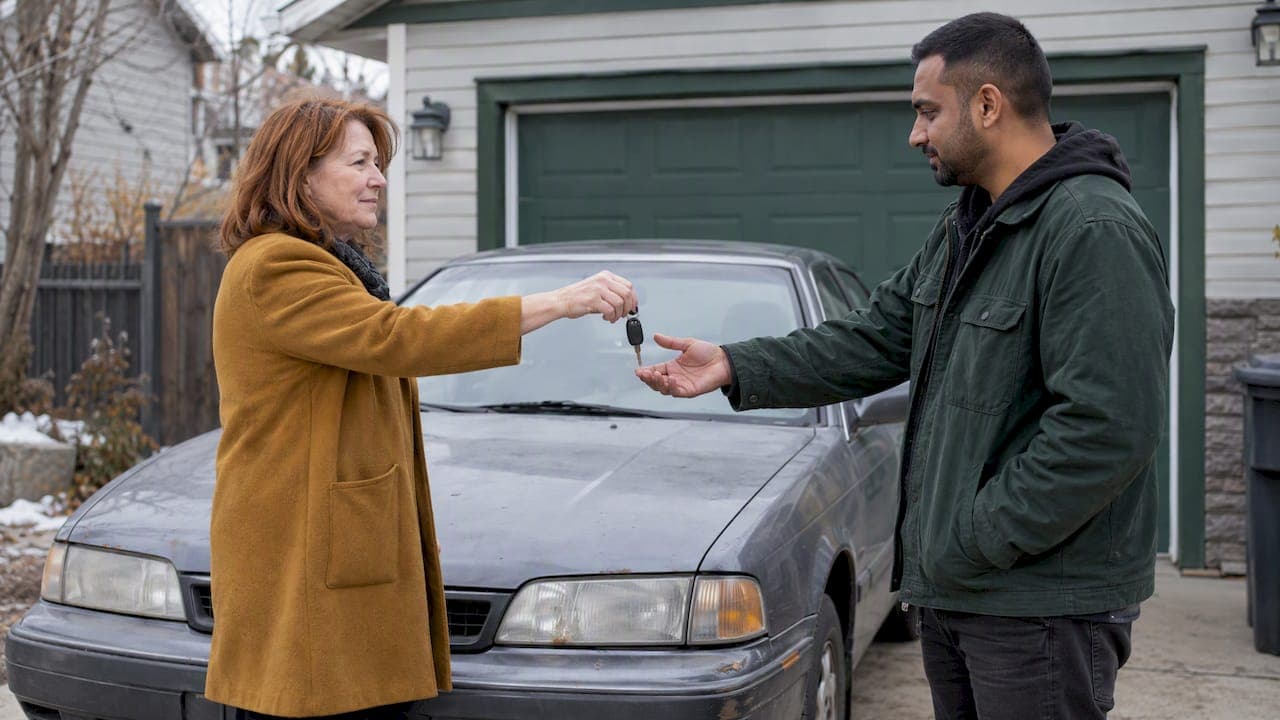
Yes, you can sell a car with a bad ECU, even if it won't start. The engine control unit is one expensive part of a vehicle that still has a body, wheels, a drivetrain and parts other people need. Your real choice is between spending money to confirm and fix the fault, or selling the car as it sits. In Calgary, that second route can mean a buyer who tows the car away the same day and pays you on the spot.
TL;DR
- A bad ECU can leave a car running poorly or not running at all, but the same symptoms often come from cheap problems such as wiring, grounds or sensors, so get it tested before you decide.
- If a new unit costs $1,000 or more and the car is old, repair rarely beats selling. Compare repair cost with what the car would fetch.
- Non-running cars still sell: to private buyers, dealers, scrapyards or cash buyers who tow.
- In Alberta, a signed bill of sale with the VIN and both parties' details is what transfers ownership, so keep a copy.
- Describe the fault honestly and in writing. It protects you and speeds up the deal.
Table of Contents
- What a bad ECU actually does to a car
- Before you write the car off: rule out the cheap causes
- Repair or sell: the math
- How a bad ECU changes what the car is worth
- Where you can sell a car with a bad ECU
- Disclosure: say what you know, and put it in writing
- The Alberta paperwork
- Perspective: why we say sell it, not sink money into it
- Selling your car to us
- Arranging safe removal and payment in Calgary
- FAQ
- Sources
What a bad ECU actually does to a car
The ECU (also called the ECM, or engine control module) is the computer that manages fuel, spark and many related functions. When it fails, the result isn't always the same. Some failures let the car keep driving with performance problems, while others cause stalling, limp mode or a no-start.
Symptoms owners typically report:
- A check-engine light that stays on, sometimes with several codes that seem unrelated
- Misfires, rough idle or stalling
- Poor fuel economy, hesitation or surging
- Harsh, delayed or erratic shifting, and a scan tool that can't communicate with the module
- Intermittent electrical problems, random warning lights or erratic gauges
- Loss of power or limp mode
The multiple-codes point matters. A failing ECU may log faults for several unrelated systems because it can no longer communicate properly with components. If your dash looks like a Christmas tree and the codes don't agree with each other, the computer is a suspect.
Is it safe to keep driving?
If you suspect the ECU, we'd advise against it. A suspected bad ECU can cause sudden stalling, loss of power-assisted steering and braking, and damage to other systems. Stalling in traffic on Deerfoot Trail or Macleod Trail is not how you want to find out. If the car is borderline, having it towed is the safer way to move it, whether to a shop or to a buyer.
Before you write the car off: rule out the cheap causes
A car with ECU symptoms isn't always a car with a dead ECU. Faulty sensors, damaged wiring and poor ground connections can mimic ECU problems, which is why testing comes first.
A proper diagnosis usually works through this order:
- Battery voltage. A weak battery or bad charging can make the electronics misbehave.
- Grounds, fuses and wiring. Corroded grounds and loose harness connectors are common culprits.
- A full scan of all modules, not just the engine code reader at the parts store.
- Service bulletins and software updates for your make and model.
- Live data analysis, to see whether the ECU is reading and commanding things sensibly.
That list follows the diagnostic steps described by a Canadian auto-parts blog, which also advises checking power, grounds and connectors before condemning the module. You can do the battery and visual checks yourself. The rest needs a shop with a proper scan tool.
Why bother if you plan to sell? Two reasons. First, if the fix turns out to be a $60 ground strap, you may not want to sell at all. Second, a documented diagnosis makes the sale cleaner, because a buyer can see exactly what is wrong instead of guessing and discounting for the unknown.
Repair or sell: the math
If the ECU is truly the problem, you have two broad paths.
Repair the unit. Specialized electronics shops can sometimes repair circuit-board damage, failed capacitors or corroded traces. The same source gives a cost of $200 to $500 for a repair, against $1,000 or more for a new unit. Those are one company's figures, so treat them as a ballpark and get a local quote. Replacement modules also often need programming to the vehicle, which adds labour.

Sell as is. You skip the repair bill, the shop time and the risk that the diagnosis was wrong.
AutoTrader.ca suggests comparing repair costs with the vehicle's potential sale price. Here is how that plays out in practice:
| Situation | Likely better move |
|---|---|
| Newer car, good body, fault confirmed as a repairable ECU | Repair, then sell or keep |
| Mid-age car, ECU repair quote is a small share of the car's running value | Repair if you plan to keep driving it |
| Older car with rust, high mileage or other problems, and a replacement unit would cost more than the car is worth | Sell as is |
| Car also failed inspection, or has engine or transmission trouble on top | Sell as is |
| Diagnosis uncertain and the quote for testing is high | Get a second opinion, or sell as is if the car is old |
If the repair would cost more than the car is worth running, our guide on when repair costs exceed market value walks through the sell-or-scrap decision in more detail.
How a bad ECU changes what the car is worth
A bad ECU knocks down the price of a running-car sale sharply, because a private buyer sees an unknown repair bill and a car they can't test drive. But a non-running car is not worthless. AutoTrader.ca notes that an end-of-life vehicle may still hold value for a purchaser, dealership, scrapyard or charity, including value in its parts, and that even a vehicle with a blown engine can keep some value.
What tends to set the offer on a non-running car:
- Make, model and year. Popular models have parts in demand.
- Body and interior condition. Panels, glass, seats and wheels can all be reused.
- Completeness. A car missing a catalytic converter, battery or major components is worth less.
- Scrap metal weight and market. When the car is only worth scrap, metal prices drive the number.
- Whether it can be moved easily. Free towing matters here, because a buyer who must pay for a flatbed will deduct it.
No honest buyer can quote you a firm number without the details, so be wary of anyone who promises a price sight unseen with no questions about the car.
Where you can sell a car with a bad ECU
| Route | Speed | Effort | Best for |
|---|---|---|---|
| Private sale (online listing) | Slow, depends on buyers | High: photos, messages, viewings, test-drive questions | Newer cars where the ECU fault is a known, quotable repair |
| Trade-in at a dealer | Same day if you're buying another car | Low | When you're replacing the car and the dealer will take it |
| Scrapyard or wrecker | Fast | Medium: you may need to arrange the tow | Older cars with little value beyond parts and metal |
| Donation to charity | Varies | Low | When you want a tax receipt rather than cash (not what we do) |
| Local cash-for-cars buyer with towing | Often same day | Low | Non-running, damaged or failed-inspection cars you want gone |
The private route carries a particular hazard with an ECU fault: buyers will ask whether it runs, and an intermittent fault is hard to describe. Many sellers end up either hiding the problem, which is risky, or discounting heavily to close. The trade-in route works, but a dealer will price in the repair and the resale risk too.
For a car you can't drive, a buyer who comes to you removes the biggest practical headache: moving a vehicle that may not start, steer under power or brake normally.
Disclosure: say what you know, and put it in writing
Selling "as is" doesn't mean you can say anything. If you know the ECU is faulty, say so. If a defect involves misrepresentation at the point of sale, the federal Office of Consumer Affairs directs people to their provincial or territorial consumer affairs office for advice. In Alberta, that means contacting Service Alberta and Red Tape Reduction if a dispute arises, and it's far easier to avoid one in the first place.
A simple routine keeps you covered:
- Write down the symptoms you've seen (stalling, no-start, codes, lights).
- Keep any scan printout, shop invoice or diagnosis.
- State the condition in the listing or in your conversation with the buyer.
- Put a line in the bill of sale saying the buyer accepts the vehicle in its current condition. Sellers commonly add this wording to say there are no warranties or guarantees.
Don't clear stored codes or disconnect the battery to hide a problem before a buyer sees the car. It's dishonest, and a buyer who finds out will have grounds to come back at you.
The Alberta paperwork
Paperwork is simple, but skipping it is how sellers end up with a car still registered in their name.
Bill of sale. Alberta's standard bill of sale includes the buyer's and seller's full names and addresses, the VIN, make, model/series, style, colour and year, the cost, and both signatures. It's what proves the transfer of ownership. Make two copies and keep one.
Registration transfer. The new owner visits a registry agent with acceptable identification, proof of ownership (the bill of sale) and proof of valid insurance. When you sell to a business, they handle their side. For your own record, you can find more in our guides on Alberta vehicle transfer forms and how to transfer car registration in Alberta.
Also remove your licence plates if the plates stay with you, cancel your insurance only after the car has left and the sale is documented, and take your personal belongings out of the glovebox and trunk.
Perspective: why we say sell it, not sink money into it
We buy cars that don't run, every week, in Calgary and Okotoks. Blown engines, failed transmissions, cars that failed inspection and cars with electrical gremlins. A bad ECU is one of the most misunderstood faults we see, because owners are told two opposite things: "it's a $3,000 computer, the car is dead," or "it's probably just a wire." Both can be true.
Our advice is plain. If the car is newer and worth real money running, pay for a proper diagnosis first. If the car is older, has other problems, or the repair quote is close to what the car is worth, stop spending. Every dollar you put into a diagnosis, a tow to a shop and a part is a dollar you won't get back at sale, because buyers of non-running cars price the car as it sits.
We also think sellers deserve to know what they're getting before they say yes: who is coming, when, whether the tow is free, and when the money changes hands. That's the standard we hold ourselves to, and the one we'd tell a friend to demand from anyone.
— Franz
Selling your car to us
If the car is past the point of repair, we make the sale simple. We buy junk, non-running, damaged, scrap and failed-inspection cars, plus ATVs and side-by-sides, in Calgary and Okotoks, including cars with blown engines or transmission failure. Same-day free towing is part of the service, and we don't charge hidden fees.
It works in three steps: you contact us, we pick up the vehicle, and you're paid in cash. You can start on our Cash for cars page or read about scrap car removal.
Have the make, model, year, location and a short description of the ECU symptoms ready when you call. That's enough for us to talk through your car. If you'd like to see how the process runs online, see our guide to selling a junk car online with free pickup.
Arranging safe removal and payment in Calgary
When a car won't run, the handover is where problems happen. Use this checklist with any buyer, ours included.
- Confirm who is towing and that it's free. Ask for the cost of towing before you agree. A good buyer tells you it's included.
- Get the timing. Same-day pickup is common for local buyers, but ask for a window rather than a vague "today."
- Make the car accessible. If it's in a garage, underground parkade or tight alley, tell the buyer. A car with electrical faults may have a locked steering column or an electronic parking brake that won't release, so mention that too.
- Have your ID and ownership documents ready. Photo ID, the registration, and any lien information if you still owe money.
- Agree the price before the truck is loaded, and confirm in writing what the number covers.
- Get paid at pickup. Don't let the car leave on a promise of a payment later or a cheque you can't verify.
- Sign the bill of sale and keep a copy with the VIN and both names on it.
- Clean it out. Remove plates if applicable, personal items, toll tags and garage remotes.
If a buyer's first quote shows up lower once the truck arrives, you're entitled to say no. That's why asking for details up front matters.
FAQ
Can a car run with a bad ECU?
Sometimes. Some ECM failures allow driving with performance issues, while others cause stalling, limp mode or a no-start. Because stalling can also affect power steering and braking assistance, don't rely on a car with a suspected ECU fault for regular driving.
Do I have to tell a buyer the ECU is bad?
Yes, if you know about it, say so. Misrepresenting a defect at the point of sale can create a dispute, and Canada's Office of Consumer Affairs points to provincial consumer affairs offices for advice on those cases. Writing the condition into the bill of sale protects both sides.
Is it worth fixing the ECU before selling?
Only if the car is worth enough running to justify the bill. A repair can run in the hundreds, and a new unit $1,000 or more, according to one Canadian source. For an older car with other issues, selling as is usually leaves you better off than repairing it.
Will anyone pay cash for a car that won't start?
Yes. Non-running cars keep value through parts and scrap metal. In Calgary and Okotoks, we buy them for cash and tow them the same day for free.
What do I need to sell a car in Alberta?
A signed bill of sale with the VIN, vehicle details, price and both parties' names and addresses, plus your ID and ownership documents. The buyer then registers the car at a registry agent with ID, the bill of sale and insurance.
Sources
- Electronic Control Module (ECM/ECU) Guide, Autrex
- Engine Control Units (ECUs): a complete guide, RAC Drive
- What happens when ECU goes bad?
- What to Do With Your Vehicle at the End of Its Life, AutoTrader.ca
- Recourse for vehicle defects, Office of Consumer Affairs
- Standard bill of sale, Alberta.ca
- Transfer a vehicle registration, Alberta.ca