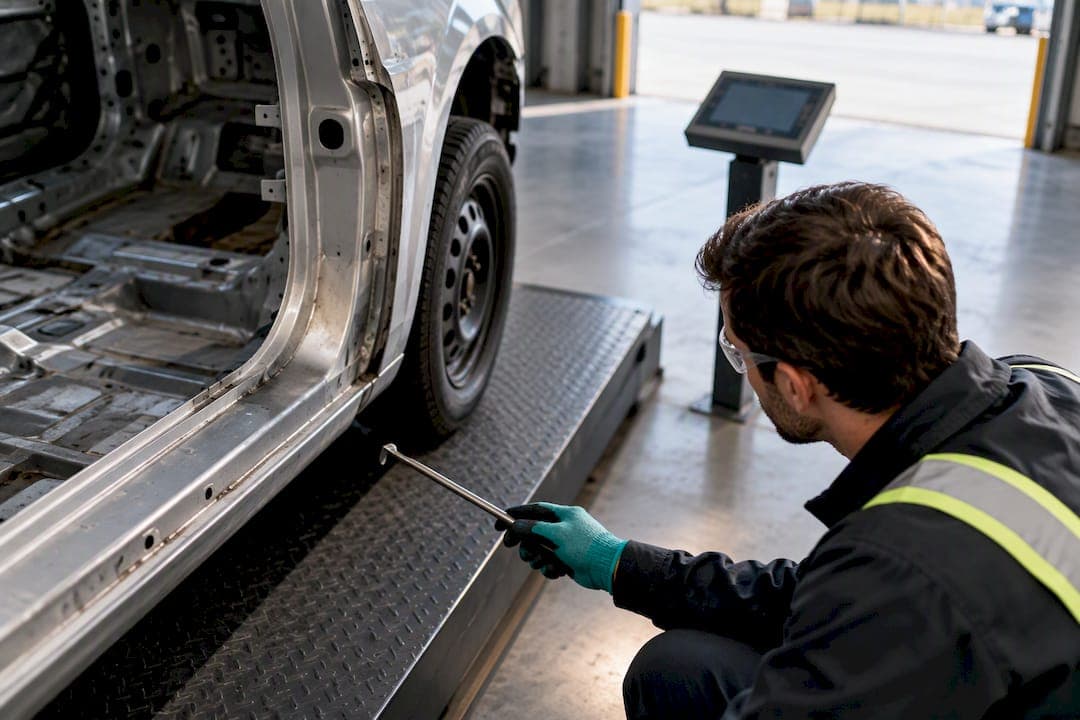
Your scrap car weight estimate starts with one formula: curb weight in pounds divided by 2,000 gives you tons, and tons multiplied by the current steel price per ton gives you a raw metal value. Buyers then apply a shell percentage and adjust for parts. A compact sedan near 2,800 pounds might land in a modest cash range, while a half-ton pickup near 5,000 pounds can be worth significantly more before add-backs.
TL;DR:
- The typical steel scrap price ranges from $170 to $250 per ton, impacting the vehicle's metal value calculation, which varies with current market conditions.
- Scrap yard offers are adjusted by shell percentages between 60% and 85%, depending on vehicle completeness and condition, with higher values for intact cars.
- Valuable parts such as catalytic converters, aluminum wheels, and working batteries are priced separately and can significantly increase the final payout.
- Curb weight, not gross vehicle weight, is essential for an accurate estimate, obtainable from the door sticker or owner’s manual, and influences the initial metal valuation.
- Expect offers to be reduced by costs for towing, fluid handling, and processing, which vary by yard and vehicle condition, so get a written breakdown before agreeing.
Table of Contents
- How to estimate a scrap car's value in one minute
- What metals and parts determine value
- How scrap yards calculate offers
- How to find your car's curb weight and check for valuable parts
- Worked examples: compact sedan and half-ton pickup
- How to get accurate offers and questions to ask the buyer
- Publisher perspective: how a transparent, local buyer approaches pricing
- How Southside Cash For Junk Cars can help
- Sources
- FAQ
How to estimate a scrap car's value in one minute
You don't need a spreadsheet to get a workable number. Follow this sequence and you'll have a defensible estimate before you make a single phone call.
- Find your car's curb weight from the door jamb sticker or owner's manual.
- Divide that weight in pounds by 2,000 to get tons.
- Multiply tons by the current scrap steel price per ton within the typical range tracked by Statistics Canada in its industrial product and raw materials price data.
- Apply a shell factor of roughly 60% to 85% of that raw metal figure, since buyers rarely pay full raw value for a stripped shell, according to practical calculation guidance.
- Add value back for a catalytic converter, aluminum wheels, or a working battery, and subtract for towing or hazardous fluid handling.
Use the lower end of the shell range when the vehicle is missing parts, has fluid leaks, or needs a long tow. Use the higher end when it's complete, drivable, and close to the buyer's yard. Steel prices shift monthly, so plug in a current local quote rather than relying on last year's number. The formula gives you a floor, not a guaranteed offer, but it puts you in a strong position before you talk to anyone.
What metals and parts determine value
A vehicle's scrap worth comes down to what's actually recoverable once fluids, plastics, and foam are stripped away. Ferrous steel makes up the bulk of the frame, body panels, and engine block, while aluminum shows up in wheels, some engine components, and increasingly in body panels on newer models. Copper hides in wiring harnesses and electric motors. Everything else, the "auto fluff" of foam, glass, rubber, and plastic trim, adds processing cost without adding recoverable weight, a point explained in detail in NRC's review of vehicle recycling economics.
| Component or material | Typical role in scrap value |
|---|---|
| Steel body and frame | Largest share of recoverable ferrous weight |
| Aluminum wheels and parts | Non-ferrous premium above base steel price |
| Catalytic converter | High per-unit value driven by precious metals |
| Battery | Separate add-back, priced independently of steel |
| Auto fluff (foam, plastic, glass) | Non-metal waste that raises processing cost |
A typical car's metal content runs roughly 1,100 to 1,400 kilograms, or about 65% to 70% of total curb weight, according to Schmidt's Auto Recycling. The remaining weight is fluid, fabric, plastic, and other material that doesn't count toward your metal-based estimate.
How scrap yards calculate offers
Every offer you receive starts with the same raw metal calculation you just ran, then gets adjusted for the yard's own costs and margin. Understanding that structure helps you see why two buyers can quote different numbers for the same vehicle.
- Raw metal value comes first: curb weight in tons times the current steel price per ton.
- A shell percentage, commonly 60% to 85% of raw value, covers the buyer's processing, labor, and margin, per practical scrap-value guidance.
- Deductions apply for towing distance, fluid draining, and hazardous material handling, a cost driver detailed in the NRC vehicle recycling review.
- Add-backs apply for a catalytic converter, aluminum wheels, and a functioning battery, since these are priced separately from base steel.
Yards generally pay more for a complete, intact vehicle because dismantling it themselves is part of their margin calculation. Pull the converter or swap the wheels before calling, and you may see the offer drop by more than those parts were worth to you.
Pro Tip: Ask for a certified scale weight and a written, line-item breakdown before you agree to a price, so you can see exactly what shell percentage and add-backs were applied.
How to find your car's curb weight and check for valuable parts
Curb weight, not gross vehicle weight rating (GVWR), is the number that matters here. GVWR includes passengers and cargo capacity, so using it will inflate your estimate and set expectations no buyer will meet.
- Check the driver's side door jamb sticker, which usually lists curb weight directly.
- Look in the owner's manual under vehicle specifications if the sticker is worn or missing.
- Search the manufacturer's official spec page for your exact trim and model year.
- Look underneath for the catalytic converter and check whether your wheels are aluminum or steel, since both affect the add-back.
- Gather your VIN, title, and a few clear photos of the exterior, interior, and undercarriage before you request a quote.
Having this information ready lets a buyer give you a firm number on the first call instead of a rough guess that changes at pickup.
Worked examples: compact sedan and half-ton pickup
Here's how the math plays out using a plausible scrap-steel price band of roughly $170 to $250 per ton, a range cited in practical junk-car value guides for 2026 planning purposes.
| Vehicle | Curb weight | Raw metal value (low to high price) | Shell-adjusted range (60% to 85%) | With converter and wheels added back |
|---|---|---|---|---|
| Compact sedan (2,800 lb) | 1.3 tons | $170 to $250 | $170 to $250 | Higher, depending on converter grade |
| Half-ton pickup (5,000 lb) | 2.8 tons | a range of typical raw metal values | a typical shell-adjusted range | Higher, depending on converter grade |
Start with your own vehicle's curb weight from the sticker or manual, divide by 2,000, and multiply by whatever steel price your local buyer quotes today. Apply the shell percentage that matches your car's condition and completeness, then layer on the converter, battery, and wheel add-backs your buyer names separately. The converter figure varies widely by model and precious metal content, so ask your buyer to price it on its own rather than folding it into a vague lump sum.
How to get accurate offers and questions to ask the buyer
A transparent buyer will answer every question below without hesitation. A vague or evasive answer on any of these is worth treating as a warning sign.
- Ask what steel price per ton they're using today and whether it's a certified or estimated figure.
- Ask whether the final weight will be confirmed on a certified scale at pickup.
- Ask about towing fees, processing fees, and whether hazardous fluid handling is deducted separately.
- Ask how the catalytic converter, battery, and wheels are priced, and whether that's itemized.
- Ask what paperwork they need for title transfer and whether missing documents cause delays.
Pro Tip: Get two or three offers and ask each buyer for a written breakdown, not just a total figure, so you can compare shell percentages and add-backs side by side.
Reliable buyers won't flinch at these questions, and a clear paper trail protects both sides if a dispute comes up after pickup.
Publisher perspective: how a transparent, local buyer approaches pricing
A straightforward three-step process, contact, pickup, cash, works best when the seller shows up with accurate weight and parts information already in hand. That's the practical benefit of running the math yourself first: it turns a vague inquiry into a specific conversation about steel price, shell percentage, and add-backs. Service differences still matter. Response speed, how paperwork is handled, and whether pickup happens the same day all factor into the final number a seller actually receives.
— Franz
How Southside Cash For Junk Cars can help
A local junk car removal company buys junk, non-running, damaged, and scrap vehicles, along with ATVs and side-by-sides, for cash with same-day pickup and no hidden fees. Vehicles are accepted regardless of condition, including cars with blown engines or transmission failure, through a straightforward process involving contact, pickup, and cash payment.
Send clear photos of the exterior, interior, and undercarriage, along with your VIN and curb weight from the door sticker, and you'll get a quote that reflects the actual math rather than a guess. Use the estimate ranges above as your benchmark before you commit. You can request a quote directly through the scrap car removal page or start the process at Southsidecashforjunkcars.
If your yard's quote involves draining fluids or handling other workshop tasks, a resource like GarageMap's oil change service directory explains the basic procedures involved, which helps you understand why hazardous material handling shows up as a deduction on some offers.

Sources
This article's calculations draw on Statistics Canada's raw materials price data, Natural Resources Canada's automotive scrap guide, and practical junk car value guidance.
This article is general information, not a substitute for advice from a qualified financial advisor. Consult a qualified financial professional about your own circumstances before acting on anything here.
- Junk Car Value by Weight: The Math Behind Every Offer — CashForJunkCars guide
- NRC publication on vehicle recycling and processing costs
- The Daily — Industrial product and raw materials price indexes, August 2026 — Statistics Canada
FAQ
How do you calculate the scrap value of a car?
Divide the car's curb weight in pounds by 2,000 to get tons, then multiply by the current steel price per ton for a raw metal value. Apply a shell percentage, commonly 60% to 85% as noted in practical scrap-value guidance, then add back value for the converter, battery, and wheels.
How much is a scrap car worth?
It depends on curb weight, current local steel prices, and which parts a buyer adds back separately. A compact sedan and a half-ton pickup can land in very different ranges simply because of the weight difference, as shown in the worked examples above.
How much scrap metal do you get for a car?
A typical car contains roughly 1,100 to 1,400 kilograms of metal, about 65% to 70% of its total curb weight, according to Schmidt's Auto Recycling. The rest of the vehicle's weight is fluid, plastic, glass, and other non-metal material that doesn't factor into the metal-based estimate.
How much is scrap metal worth per kilogram?
Scrap steel pricing is typically quoted per ton rather than per kilogram, and the rate shifts month to month, as tracked in Statistics Canada's price index data. Ask your buyer for their current per-ton rate and convert it yourself if you need a per-kilogram comparison.