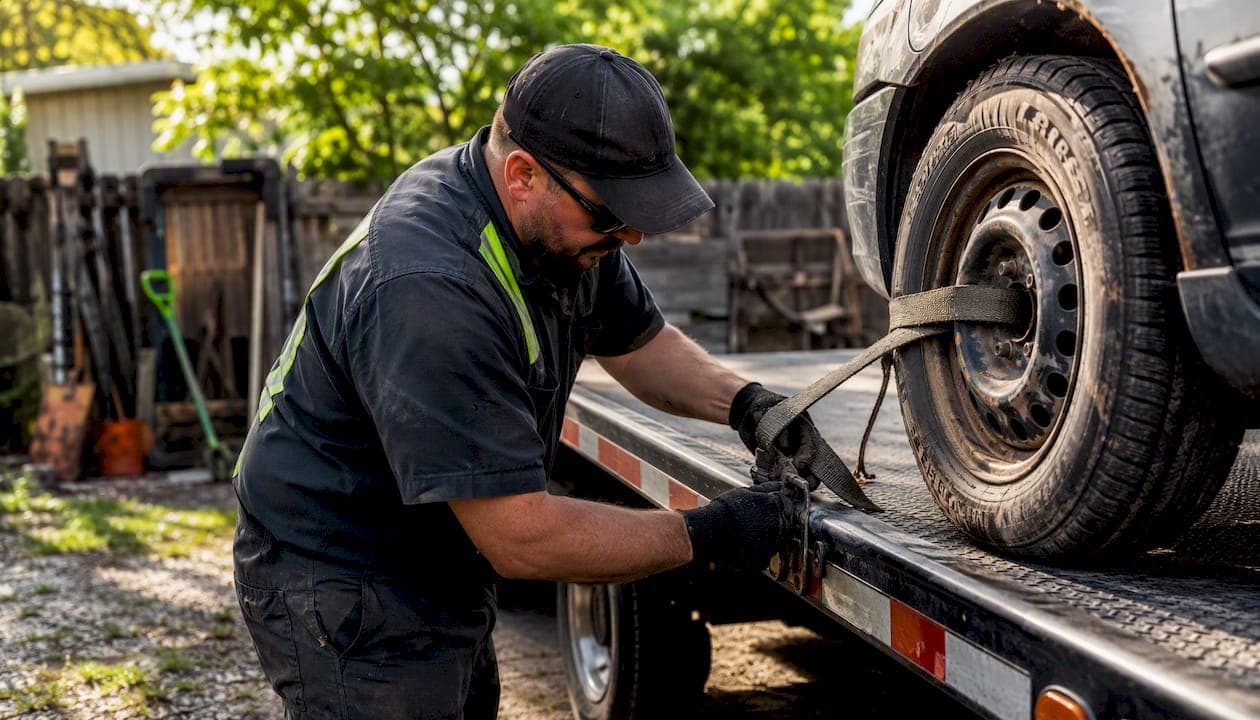
The fastest, lowest-effort way to clear a junk car from your backyard is to call a cash-for-junk-cars removal service that offers free towing and pays you on pickup. No hauling fees, no waiting weeks for a buyer, no negotiating with strangers in your driveway. That said, the right option depends on your priorities: speed, maximum cash, or minimum hassle.
Here are the six practical routes homeowners use:
- Cash-for-junk removal service — fastest, lowest effort, paid on pickup
- Private sale — highest potential cash, more time and effort
- Donation or giveaway — low effort, possible tax receipt, little to no cash
- Scrapyard or licensed auto recycler — cash based on weight and scrap value
- Part-out or fix-and-sell — highest possible return, most work
- Tow-only service — moves the car but does not buy it
Recommended pick for most homeowners: If the car doesn't run, you need it gone quickly, and you have no interest in spending weekends parting it out, a cash-for-junk removal service is the right call. You get paid the same day the car leaves your property, and you pay nothing for the tow.
Key Takeaways
The fastest and lowest-effort way to remove a backyard junk car is a cash-for-removal service that pays on pickup and handles towing at no cost to you.
| Point | Details |
|---|---|
| Best for speed | Cash-for-junk removal services offer same-day pickup and pay you on the spot. |
| Best for maximum cash | A private sale or part-out returns more money but requires days to weeks of effort. |
| Best for low effort | Donation or a junk-car service both require minimal work; only the service pays you. |
| Prepare before you call | Have your title, photo ID, and plates removed; clear access and note any obstacles. |
| Southsidecashforjunkcars | Serves Calgary and Okotoks with same-day pickup, instant cash, and free towing. |
Table of Contents
- 1. Sell to a junk-car or cash-for-cars removal service
- 2. Sell privately through classifieds or online marketplaces
- 3. Donate or give the car away
- 4. Sell to a scrapyard or licensed auto recycler
- 5. Part the car out or fix it and sell
- 6. Hire a tow company (tow-only vs. full removal)
- How to prepare your vehicle and property for pickup
- The single biggest reason pickups go wrong
- Typical costs and how payment is handled
- Environmental rules and legal requirements for car disposal
- Municipal and government programs for junk car removal
- Environmental impact: how each option compares
- What homeowners consistently get wrong (and how to fix it)
- Same-day cash for your backyard car in Calgary and Okotoks
- Sources
- FAQ
1. Sell to a junk-car or cash-for-cars removal service
This is the option that eliminates the most friction. A reputable junk-car buyer will quote you, schedule a pickup, send a driver with a tow truck, hand you cash, and take the car. Reputable removal services include free towing because the vehicle's scrap and parts value covers hauling costs — which means you should never pay out of pocket to have a whole car removed when you're selling it.
How the process works:
- Contact the buyer (phone or online form) and describe the vehicle — year, make, model, condition, and location.
- Receive a written quote. A trustworthy buyer gives you a number before anyone shows up.
- Accept the offer and schedule pickup. Many services offer same-day or next-day arrival.
- Sign a bill of sale at pickup, hand over the title and keys, and collect payment on the spot.
What to look for in a buyer:
- Written quote before pickup (no surprise lowballs at the door)
- Same-day or next-day availability
- Cash or certified payment on pickup, not "we'll mail you a check"
- Licensed and environmentally compliant disposal
- Proof of ownership required (they ask for your title — that's a good sign, not a red flag)
This option suits you best when the car doesn't run, you can't easily move it, and you want it gone without coordinating multiple parties. Southsidecashforjunkcars runs exactly this model in Calgary and Okotoks: instant quote, same-day removal, cash at pickup.
Pro Tip: Get the quote in writing before the driver arrives. A verbal offer that drops $200 at the curb is a common complaint — a written quote locks the number.
2. Sell privately through classifieds or online marketplaces
A private sale takes more effort but can return more money, especially if the car runs or has desirable parts. Platforms like Facebook Marketplace and Kijiji reach local buyers quickly, and a "For Sale" sign in the windshield still works in residential neighborhoods.
Listing checklist:
- Write an honest condition description — note what works and what doesn't. Buyers who show up to a surprise will walk or lowball.
- Take clear photos in daylight: all four sides, interior, engine bay, and any damage.
- Price it realistically. Check comparable listings in your area rather than guessing.
- Remove personal items and valuables before anyone comes to look.
- Meet buyers in a public place or have someone with you if they come to your property.
- Accept cash or e-transfer only. Never accept a personal check for a vehicle.
Paperwork you'll need:
- Signed title (or registration if the title is unavailable)
- Bill of sale with both parties' names, date, and sale price
- License plates stay with you in most Canadian provinces — remove them before the buyer drives away
- Check your province's specific transfer steps; Alberta has its own registration transfer process through a registry agent
Pro Tip: Post your listing on both Facebook Marketplace and Kijiji at the same time. The overlap in audiences is minimal, and doubling your exposure cuts the time to a serious inquiry roughly in half.
3. Donate or give the car away
Donation works well when the car has sentimental complications, you want a tax receipt, or you simply don't want to deal with buyers. Charities that accept vehicles typically arrange their own towing, so your effort is minimal.
Who takes donated vehicles:
- Registered charities with vehicle donation programs (they sell the car or its parts and keep the proceeds)
- Car enthusiast clubs or hobbyist groups looking for project vehicles
- Individuals willing to take the car in exchange for hauling it away themselves
Pros and cons:
- Low effort: the charity or recipient usually handles pickup
- Tax receipt: in Canada, you may receive a receipt for the fair market value of the vehicle, but the amount varies by charity and your province's tax rules — confirm with the charity before assuming a specific deduction
- Little to no cash: you're trading money for convenience and a potential tax benefit
- Not every charity accepts every vehicle; condition and age matter
Donation checklist:
- Confirm the charity is a registered organization (CRA-registered in Canada)
- Get the tax receipt in writing before the car leaves
- Sign over the title and complete any provincial transfer paperwork
- Remove your plates and cancel your insurance once the transfer is confirmed
For a direct comparison of donation versus a cash sale, the math usually favors cash unless your marginal tax rate makes the receipt genuinely valuable.
4. Sell to a scrapyard or licensed auto recycler
A scrapyard pays you based on what your car is worth as raw material and salvageable parts. It's a straightforward transaction, though the offer will almost always be lower than what a private buyer or junk-car service might pay for a vehicle with usable components.
What affects your scrap offer:
- Vehicle weight: heavier vehicles (trucks, SUVs, full-size sedans) bring more money per ton
- Catalytic converter: present and intact converters add meaningful value because of the precious metals inside; catalytic converter scrap value varies by vehicle and current metal prices
- Completeness: a stripped car with missing doors, engine, or transmission is worth less than a complete one
- Local scrap market: metal prices fluctuate, so the same car can fetch different amounts month to month
Before you go:
- Call ahead to confirm the yard is licensed and environmentally compliant
- Ask whether towing is included or whether you need to arrange delivery
- Get the offer in writing before you commit
Most junk cars sell for amounts typically ranging from a few hundred to over a thousand dollars, depending on weight, completeness, and local scrap prices — with trucks, SUVs, and vehicles with intact catalytic converters generally bringing higher offers.
Check local recyclers and cash-for-car providers to compare current offers before settling on the first yard that calls back.
5. Part the car out or fix it and sell
This route takes the most time and skill, but it can return significantly more than a scrap sale if the car has valuable components. A working engine, a clean transmission, low-mileage wheels, or a sought-after body panel can each sell for more than the whole car's scrap value.
When parting out makes sense:
- The car has one or two high-value parts (engine, transmission, catalytic converter, infotainment system)
- You have storage space to keep the car while you sell parts over weeks or months
- You're comfortable listing on platforms like Facebook Marketplace, eBay Motors, or local classifieds
When fix-and-sell beats parting out:
- The car needs only a common, low-cost repair (battery, alternator, minor brake work) that restores its ability to drive
- A running car in rough cosmetic shape can sell privately for two to three times its scrap value
- You have a mechanic you trust and a realistic repair estimate before you commit
Practical considerations:
- Parting out requires tools, time, and a place to store the shell afterward (which still needs disposal)
- Unsold parts become clutter; be realistic about how many you'll actually move
- Check local bylaws about storing a partially disassembled vehicle on residential property — some municipalities have restrictions
6. Hire a tow company (tow-only vs. full removal)
A tow company moves your car. A junk-car removal service buys your car and moves it. Those are two different transactions, and confusing them is a common and expensive mistake.
When a paid tow makes sense:
- You want to keep the car and need it moved to a repair shop or storage facility
- The car is blocking something and you need it relocated, not sold
- You're transferring the vehicle to a family member or another property
When removal beats towing:
- You want the car gone permanently and want to be paid for it
- The car has no repair value and you'd rather have cash than a bill
- You don't have a destination for the car — a removal service handles disposal entirely
Paid towing in most urban areas runs $75–$200 for a local haul, and you still own the car afterward. A removal service charges you nothing and hands you money. If you're selling the vehicle, paying for a tow is the wrong direction.
How to prepare your vehicle and property for pickup
A smooth pickup comes down to two things: paperwork and access. Get both right and the driver arrives, loads the car, and pays you in under 30 minutes.
Pre-pickup checklist:
| Task | Details |
|---|---|
| Locate your title | Original title with your name on it; if lost, apply for a duplicate through your provincial registry |
| Gather ID and registration | Government-issued photo ID and current registration as backup |
| Remove license plates | Plates stay with you in Alberta — take them off before the driver arrives |
| Clear a path to the car | Remove bikes, bins, lawn furniture, or anything blocking the driveway or yard |
| Remove personal items | Check under seats, in the trunk, and in door pockets |
| Note any access issues | Steep grade, narrow gate, soft ground, or low-hanging branches — tell the dispatcher in advance |
| Leave keys accessible | If you have them; if not, tell the buyer upfront so they bring the right equipment |
Pro Tip: If you don't have the title, don't assume the sale is off. Many buyers will still complete the purchase with alternative documentation — a fair buyer will explain your options before anyone drives out, not after.
For a full step-by-step walkthrough tailored to Calgary homeowners, the how to remove an unwanted car fast guide covers every stage from first call to final payment.
The single biggest reason pickups go wrong
Failing to disclose access issues causes most pickup complications. It's not paperwork, it's not the car's condition — it's the driveway nobody mentioned.
Operators need accurate location details to dispatch the right equipment. A standard tow truck cannot safely extract a car from a steep backyard grade or a narrow alley without a winch or a specialized rig. When that information arrives on the day of pickup instead of before, the driver either can't complete the job or the schedule collapses.
Accurate access disclosure is what separates a 20-minute pickup from a rescheduled one. When you request a quote, send or describe:
- The car's exact position (driveway, backyard, garage, alley)
- Any grade or slope leading to the vehicle
- Gate width or fence clearance
- Ground condition (gravel, soft soil, concrete)
- Overhead clearance (trees, power lines, carport)
- Whether the car rolls freely or is completely immobile
Pro Tip: Take three photos before you call: one from the street showing the approach, one from beside the car showing the ground and clearance, and one showing any obstacles between the car and the road. Send them with your quote request. Dispatchers who see the site in advance almost never need to reschedule.
Typical costs and how payment is handled
The cost structure depends entirely on which route you choose.
With a junk-car removal service, the transaction runs in your favor: you receive cash, and towing is free. The buyer's revenue comes from reselling parts and scrap metal, which is why the economics work without charging you a hauling fee. Most reputable removals happen same-day or next-day, and payment is made at pickup in cash or certified funds.
Scrapyards may or may not include towing. If they don't, factor in a $75–$200 tow bill against whatever they offer for the vehicle. Always ask before agreeing to a price.
Private sales cost you nothing upfront but require your time. Budget for a few days to a few weeks depending on the vehicle and your asking price.
Donation is free on your end. The charity handles pickup, and you receive a tax receipt rather than cash.
Paid towing, as covered above, runs $75–$200 locally and leaves you with the car. That cost makes sense only when you intend to keep the vehicle.
Environmental rules and legal requirements for car disposal
A junk car is a collection of hazardous materials: engine oil, coolant, brake fluid, transmission fluid, refrigerant, and battery acid. Improper disposal of any of these is illegal in every Canadian province and most U.S. states, and the liability falls on whoever last owned the vehicle.
Licensed auto recyclers and junk-car buyers handle fluid drainage and hazardous material disposal as part of their process. That's one of the practical reasons to use a licensed operator rather than abandoning a car or selling it to an unlicensed buyer who may not follow proper procedures.
Before any removal, confirm the buyer or recycler:
- Holds a valid business license and environmental compliance certification
- Drains and properly disposes of all fluids before crushing or shredding
- Issues a receipt or bill of sale that transfers liability out of your name
- Cancels or transfers the registration so you're no longer the vehicle's owner of record
In Alberta, once you sell or transfer a vehicle, notify Alberta Transportation and cancel your insurance immediately. Keeping insurance on a car you no longer own is wasted money; failing to cancel registration can create complications if the vehicle is later involved in an incident.
Municipal and government programs for junk car removal
Some municipalities run vehicle disposal programs, particularly for abandoned or derelict vehicles on public property. For vehicles on private residential property, government programs are less common, but worth checking.
In Alberta, the Automotive Recyclers Association of Alberta maintains a directory of licensed recyclers who meet provincial environmental standards. Some municipalities also partner with recyclers to offer subsidized or free removal for qualifying vehicles, particularly older models with high environmental risk.
What to check in your area:
- Your city or county's public works or bylaw enforcement office (they sometimes have referral lists)
- Provincial recycling programs that offer incentives for scrapping older, high-emission vehicles
- Charitable programs that accept vehicles for resale or parts, with proceeds funding community services
These programs tend to have eligibility requirements (vehicle age, condition, residency) and longer timelines than a private removal service. If speed matters, a cash-for-junk service will almost always be faster.
Environmental impact: how each option compares
Not all disposal routes are equal when it comes to what happens to the car's materials.
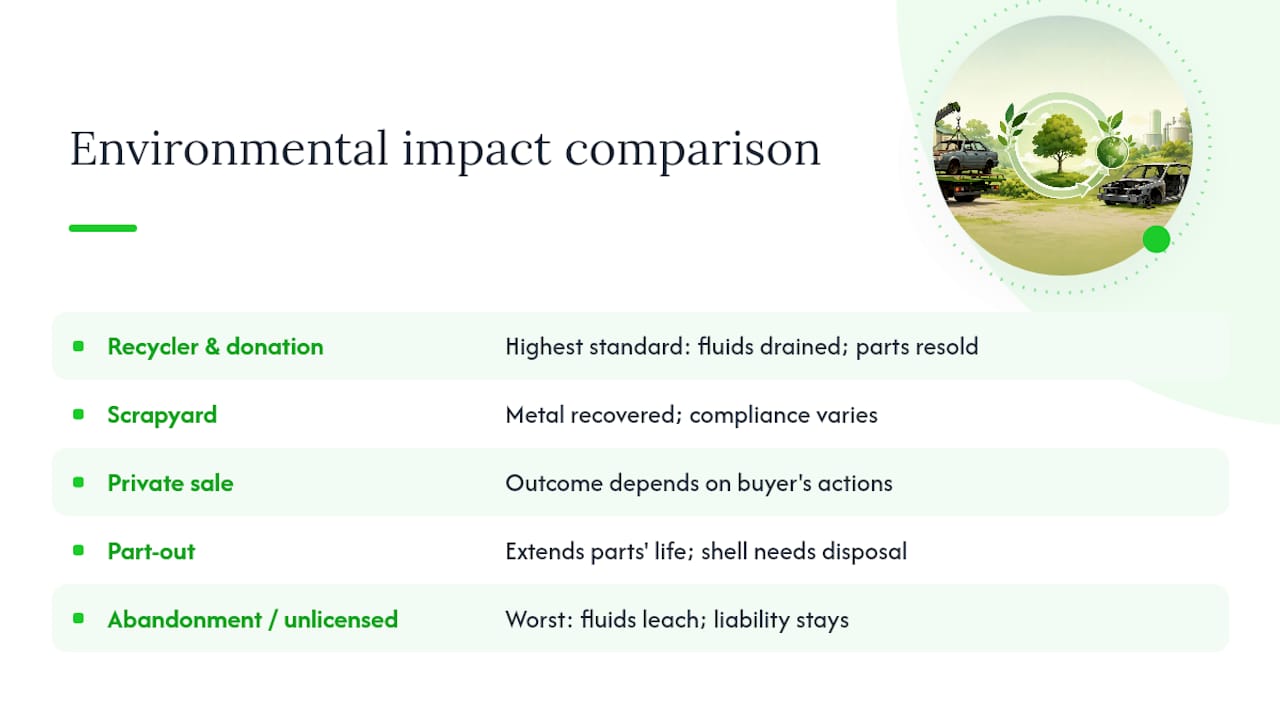
Licensed auto recycler or junk-car buyer: the highest environmental standard. Fluids are drained and properly disposed of, usable parts are resold (extending their life), and the remaining metal is shredded and recycled. Steel recycling uses significantly less energy than producing new steel from raw ore.
Scrapyard: similar to a licensed recycler for metal recovery, though environmental compliance varies by operator. Always verify licensing.
Private sale: the environmental outcome depends entirely on what the next owner does with the car. A buyer who repairs and drives it extends the vehicle's life. One who abandons it creates the same problem you started with, just somewhere else.
Donation: typically handled by licensed recyclers on the charity's behalf, so the environmental outcome is similar to the recycler route.
Part-out: good for extending the life of individual components, but the remaining shell still needs proper disposal. Leaving a stripped carcass on your property is not a disposal strategy.
Abandonment or unlicensed disposal: the worst outcome. Fluids leach into soil and groundwater, and the liability stays with the last registered owner.
What homeowners consistently get wrong (and how to fix it)
The mistakes that delay or derail a junk-car pickup are almost always the same three things, and all three are fixable in under ten minutes.
First, homeowners describe the car's condition but forget to describe where it is. "In the backyard" tells a dispatcher almost nothing. Is it behind a fence? Down a slope? On soft ground? That information determines what equipment arrives.
Second, they leave the plates on. In Alberta, your plates belong to you, not the car. A driver who takes a car with plates still attached creates a registration headache for everyone. Pull them off the morning of pickup.
Third, they skip the written quote. A verbal offer that changes at the curb is the most common complaint in this industry. Any buyer worth calling will confirm the number in writing before the driver leaves the yard.
The fix for all three: a 10-minute checklist before you make the first call. Locate your title, take three photos of the car and its surroundings, note any access obstacles, and remove your plates. That's it. Everything else the buyer handles.
Southsidecashforjunkcars's model is built around exactly these friction points — written quotes, same-day pickup, and a process that doesn't require you to figure out disposal logistics on your own.
Same-day cash for your backyard car in Calgary and Okotoks
When you want the car gone today, not next week, Southsidecashforjunkcars is the direct route. Same-day pickup, cash paid the moment the driver arrives, and free towing anywhere in Calgary and Okotoks. No auction, no waiting for a private buyer, no hauling fees subtracted from your offer.
Before the driver arrives, have three things ready: your title (or registration if the title is unavailable), a government-issued photo ID, and your license plates removed from the vehicle. Clear a path to the car and note any access obstacles when you call. That's the entire checklist.
Southsidecashforjunkcars handles the paperwork, the tow, and the environmentally compliant disposal. You handle nothing after the call except collecting your cash.
Get an instant cash offer and schedule same-day pickup today.
Sources
- Schmidt's Auto Recycling — scrap catalytic converter prices in Canada
Always check your province's title transfer rules before completing any sale. In Alberta, transfers go through a registry agent, and the process differs from most U.S. states — what you read on an American site may not apply to your transaction.
FAQ
What is the easiest way to get rid of a junk car?
Calling a cash-for-junk-cars removal service is the easiest route: they quote you, pick up the car for free, and pay you cash on the same day. You handle nothing after the phone call except collecting your money.
How much can you get for scrapping a car?
Most junk cars bring somewhere between $200 and $1,500 depending on weight, completeness, and local scrap metal prices, with trucks, SUVs, and vehicles with intact catalytic converters typically landing at the higher end of that range.
Can you sell a junk car without a title?
Many buyers will still purchase and remove a car without a title if you can provide alternative documentation such as current registration and a government-issued ID. Confirm what your buyer accepts before scheduling pickup, since title rules vary by province and state.
What's the most a junkyard will pay for a car?
Scrapyard offers depend heavily on vehicle weight, the presence of a catalytic converter, and current metal prices. A complete, heavier vehicle in a strong scrap market can reach the top of the $200–$1,500 range, but a cash-for-junk service that also values usable parts will often beat a straight scrap offer.
How do I get rid of an old car that doesn't run?
A junk-car removal service is the practical answer: they bring a tow truck, so the car doesn't need to move under its own power. Southsidecashforjunkcars handles exactly this in Calgary and Okotoks, including vehicles with blown engines or failed transmissions.