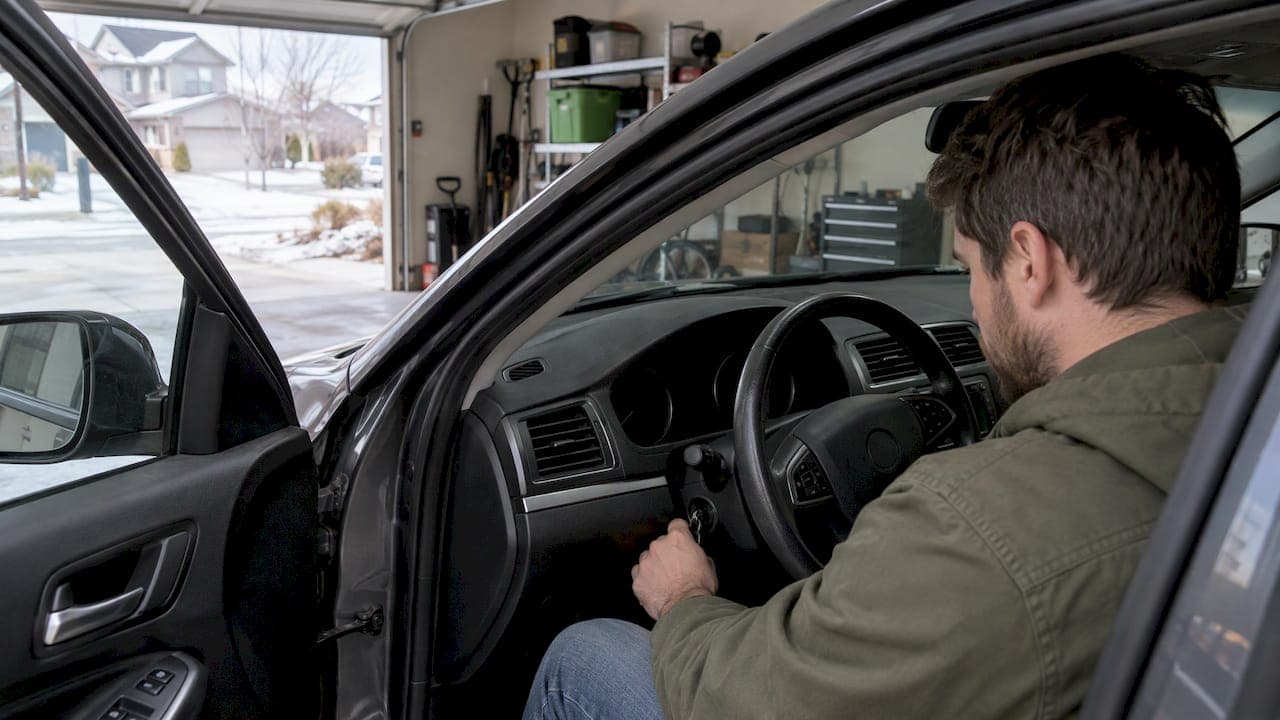
If your car won't start because of an immobilizer failure, you have two sensible routes: pay to diagnose and repair it, or sell it as-is to a buyer who takes non-running vehicles. Which one wins depends on the car's value, the cost of the fix, and how much hassle you are willing to carry. This guide walks through the quick checks worth trying first, what repairs tend to cost in Alberta, what you must tell a buyer, and how a same-day cash sale works in Calgary and Okotoks.
TL;DR
- A blinking security light, a car that cranks but won't fire, or a key the car stops recognizing are the classic signs of an immobilizer fault.
- Try the free checks first: a fresh key fob battery, a spare key, and removing other keys and metal objects from around the key.
- Key replacement and programming in Calgary commonly runs from the low hundreds into the high hundreds of dollars, and a control module fault can cost more.
- If the repair costs more than the car is worth, you can sell it as-is. Be honest about the fault, sign a proper bill of sale, and keep your paperwork.
- We buy non-running cars, including ones with immobilizer faults, in Calgary and Okotoks, with same-day pickup.
Table of Contents
- What an immobilizer failure looks like
- Common causes, from cheap to expensive
- Safe checks to try before you spend money
- What a repair costs in Alberta
- Your options for selling a car that won't start
- What you must disclose and what paperwork you need
- How to arrange safe removal of a non-running car
- Our view on selling a car with an immobilizer fault
- Ready to sell? Here is how we help
- Frequently asked questions
- Sources
What an immobilizer failure looks like
An immobilizer is a theft-prevention system. The car's computer checks a coded signal from your key or fob, and if the code doesn't match, it refuses to let the engine run. When that handshake breaks down, a perfectly healthy engine behaves like a dead one.
The usual symptoms:
- The engine cranks but never starts, or starts for a second and cuts out.
- A security or key-shaped warning light stays on or flashes.
- The car recognizes the key some days and not others.
- The dash shows a message about the key or the immobilizer.
These match the commonly listed symptoms of immobilizer failure: cranking without starting, a warning light that stays on or blinks, and intermittent key recognition. Manufacturers describe the light's normal behavior too. In Kia's Canadian owner's manual, the indicator should come on briefly and then go out, while a blinking indicator means the key coding was not recognized.
The pattern can be intermittent. A Porsche technical bulletin from July 2021 describes an immobilizer activation that left the engine unable to start, sometimes with the instrument cluster dark and an immobilizer error showing. That is one brand's documented case, but it shows why these faults can feel random.
Common causes, from cheap to expensive
The causes run on a ladder. The cheap ones are worth ruling out before you decide anything about selling.
- A weak key or fob battery. This is one of the most common causes of immobilizer-related no-starts, and it is worth eliminating before you suspect a deeper fault, as one UK diagnostics shop explains.
- A damaged or wet transponder chip. A dropped key, a cracked fob or water exposure can silence the chip in the key.
- Interference. Another smart key or a metal object such as a key chain near the key can disrupt recognition, according to Kia's owner's manual.
- Antenna ring, wiring or corroded connectors. The ring around the ignition reads the key. Cracks or loose wiring there can stop it from reading anything. Wear in ignition contacts and wiring is a known weak point in some older GM systems, according to trade reporting.
- Low battery voltage or poor grounds. Low voltage can trigger false security-disable signals, so technician training material advises verifying battery state of charge and ground connections before blaming any module.
- Computer or data bus faults. Corrupted data in the engine computer or failed communication on the CAN bus can show up as a security fault even when the key and immobilizer are fine, per a UK ECU specialist. This is the expensive end.
If every key is lost or none of them will program, the job becomes a specialist one. A technician walkthrough on all keys lost programming shows what a mobile locksmith does in a single visit, which helps you understand the quote you are given.
Safe checks to try before you spend money
None of these need tools, and none of them risk the car's electronics.
- Try your spare key. If the spare starts the car, the original key or its chip is the problem, and the car itself is fine.
- Replace the fob battery. It is inexpensive and the most common culprit.
- Clear the area around the key. Remove extra smart keys and metal objects such as key chains. Kia's guidance is to remove nearby metal objects or additional keys and try again.
- Cycle the ignition. On push-button cars, switch the ENGINE START/STOP button off and on again, as the same manual describes.
- Check the car's battery. A weak battery can mimic or cause a security fault. If the lights dim when you try to start, jump or charge it first.
- Don't modify the system. Kia warns against altering the system or adding devices to it. Aftermarket alarms and remote starters are a classic source of immobilizer trouble, so skip DIY wiring experiments.
If the failure keeps repeating after these steps, the manufacturer's advice is to contact a dealer. That is also the point where you should price the repair against the car's value.
What a repair costs in Alberta
There is no single price, because the fault can be in the key, the wiring or the control module. A written quote before any work is the sign of a shop you can trust, and some shops publish a diagnostic fee up front. One Ontario shop, for example, lists immobilizer diagnosis at $80 to $120 before HST, with repair costs depending on the fault.
For key-related faults in Calgary, a local mobile locksmith reports that standard transponder key replacements typically range from $180 to $440. Proximity smart keys and all-keys-lost situations can run from $250 to $625 or more. The same source says these prices generally come in 30 to 50 percent below Calgary dealership rates. Mobile service also means no tow to a dealership, which matters when the car won't move.
For comparison across Canada, Vancouver price lists show transponder keys at $180 to $280, smart keys at $280 to $420, and European luxury keys at $400 to $900. Prices are what these businesses published, and they change, so treat them as a range for planning, not a quote.

A locksmith will usually verify ownership before an all-keys-lost job, using your registration, title or matching government-issued ID. Have those ready.
When repair makes sense
Repair is usually the right call when:
- the car is newer, in good shape and worth considerably more than the fix;
- the fault is a simple key or battery issue;
- you need the car and are happy to keep it.
When selling as-is makes more sense
Selling is usually the better call when:
- the quote for a module, wiring or computer repair approaches what the car is worth;
- the car is old, high-mileage or has other problems, such as a blown engine or transmission trouble;
- the car has failed an inspection and needs more than the immobilizer;
- you don't want to arrange a tow, a diagnosis and a repair for a car you were going to replace anyway.
A quick rule: add up the likely diagnosis, the repair and any tow, then compare that to what you would get for the car running. If the gap is thin, a no-start immobilizer car is a candidate for a straight sale.
Your options for selling a car that won't start
An immobilizer fault does not make a car unsellable. It changes who will buy it and how.
- Private sale. You can list it as non-running, but most private buyers want a car they can test drive. Expect more questions, lowball offers and no-shows.
- Trade-in or dealer sale. Dealers may take it, but a non-starting car often gets a low number because they price in the repair risk.
- Online car-buying services. Many national services want a car that runs or can be driven, and some will decline non-runners. Confirm that before you book anything.
- A local junk or scrap car buyer. This is the option built for cars that don't run. The buyer prices the car on its parts and scrap value, and brings the tow.
We compare these routes in more detail in our guide to selling a junk car in Alberta: alternatives. If your car has other problems alongside the immobilizer fault, see our pages on selling a car with a blown engine or transmission failure and selling a non-running car.
What you must disclose and what paperwork you need
Honesty protects you. Tell any buyer plainly that the car has an immobilizer fault and won't start. A buyer who knows the car is a non-runner prices it that way and the sale closes cleanly.
Some disclosure rules apply to businesses specifically. In Alberta, automotive businesses must disclose in writing whether a vehicle was declared salvage or non-repairable, or needed repairs costing more than $3,000 including parts and labour after an incident or collision, according to AMVIC. The regulator also recommends that buyers consider an independent mechanical inspection, which is a reason to be open about the fault: a buyer may well look.
For the paperwork:
- Bill of sale. Alberta's standard bill of sale includes the buyer's and seller's names and addresses, the VIN, a description of the vehicle, the cost, and both parties' signatures. Keep a copy.
- Registration and transfer. To register a vehicle in Alberta, a new owner provides proof of ownership, valid insurance and acceptable identification to a registry agent, and an inspection may be required where applicable. That is the buyer's job, but your signed bill of sale is your record that the car left your hands.
- Plates and insurance. Take your own steps with your registry agent and insurer so you are not left responsible for a car you no longer own.
Our guide to Alberta vehicle transfer forms covers the forms in more detail.
How to arrange safe removal of a non-running car
A car that won't start can't be driven onto a trailer's path or out of a tight spot, so removal needs a little planning.
- Tell the buyer exactly what's wrong. Say the car won't start, whether the steering unlocks, and whether the transmission can be shifted into neutral. Those details decide what equipment the tow needs.
- Say where the car is. A driveway, a garage, an underground stall and a back lane all need different access. Clear the path if you can.
- Locate the keys. Even a key that doesn't start the car helps, since it may unlock the doors and steering. Hand over every key you have.
- Empty the car. Remove personal items, toll tags, garage openers and anything in the trunk.
- Confirm the price before the truck arrives. Agree on a figure and on what is included, including towing.
- Sign the paperwork at pickup. Get a copy of the bill of sale and confirm payment method.
If you can't be home, see our guide to junk car pickup without the owner in Alberta. And if you're weighing a tow to a shop instead, our guide to getting a junk car towed in Alberta explains what to expect.
Our view on selling a car with an immobilizer fault
We see this often: a Calgary owner has a car that was running fine last week, and now it cranks and won't catch. They've replaced a fob battery, maybe paid for a diagnosis, and the next quote is for a module or wiring job that costs more than the car is worth.
Our advice is simple. Try the free checks first. If a spare key or a fresh battery fixes it, keep the car. If not, get one written quote, then compare it with the car's value. When the numbers don't work, you shouldn't have to pay a tow, list the car, and field strangers on the weekend.
That is why we built our service around cars that don't run. We buy them in Calgary and Okotoks, whether the problem is an immobilizer, a blown engine, a failed transmission or something else, and we offer same-day pickup with no hidden fees. The process is three steps: you contact us, we pick the car up, and you get paid in cash. Because we resell parts and scrap metal, a car that won't start still has value to us, and we think that is a fairer deal than letting it sit.
Be upfront with us about the fault. It doesn't scare us off, and it keeps the price honest on pickup day.
Franz
Ready to sell? Here is how we help
If you've decided the repair isn't worth it, we can take it from here. We buy junk, non-running, damaged, scrap and failed-inspection cars, along with ATVs and side-by-sides, in Calgary and Okotoks. Towing is part of the service, and you are paid in cash when we pick up.
Tell us the make, model and year, and that the car has an immobilizer fault. You can start on our cash for cars page, or read about our scrap car removal service first.
Frequently asked questions
My car won't start because of the immobilizer. What should I do first?
Start with the free checks: try a spare key, replace the fob battery, and remove extra keys and metal objects from around the key. Then confirm the car's own battery is healthy. If the fault keeps coming back, get a written diagnosis or call the manufacturer's dealer.
Can I sell a car with an immobilizer failure?
Yes. Be honest that it won't start, agree on the price, and sign a bill of sale with both names, the VIN and the amount. A local buyer of non-running cars will usually handle the tow too. We buy these cars in Calgary and Okotoks.
How much does it cost to fix an immobilizer problem in Calgary?
It depends on where the fault is. A Calgary mobile locksmith reports transponder key replacement typically runs from $180 to $440, and smart keys or all-keys-lost jobs from $250 to $625 or more. Wiring or computer faults can cost more, so ask for a written quote first.
Can I reset the immobilizer myself?
Sometimes a simple cycle works, such as switching the ignition off and on or trying again after removing interfering keys. Beyond that, don't alter the system or add devices to it. Repeated failures call for a dealer or a qualified automotive locksmith.
Sources
- Kia Canada owner's manual: immobilizer system
- Porsche technical bulletin on immobilizer activation (NHTSA)
- Immobilizer symptoms and causes
- Types of immobiliser systems and faults
- Immobilizer and anti-theft systems in the shop
- Diagnosing security and anti-theft systems
- Immobilizer diagnosis pricing
- Car key replacement in Calgary
- Automotive key pricing in Vancouver
- AMVIC: vehicle condition disclosure
- Alberta standard bill of sale
- Register a vehicle in Alberta
- All keys lost programming