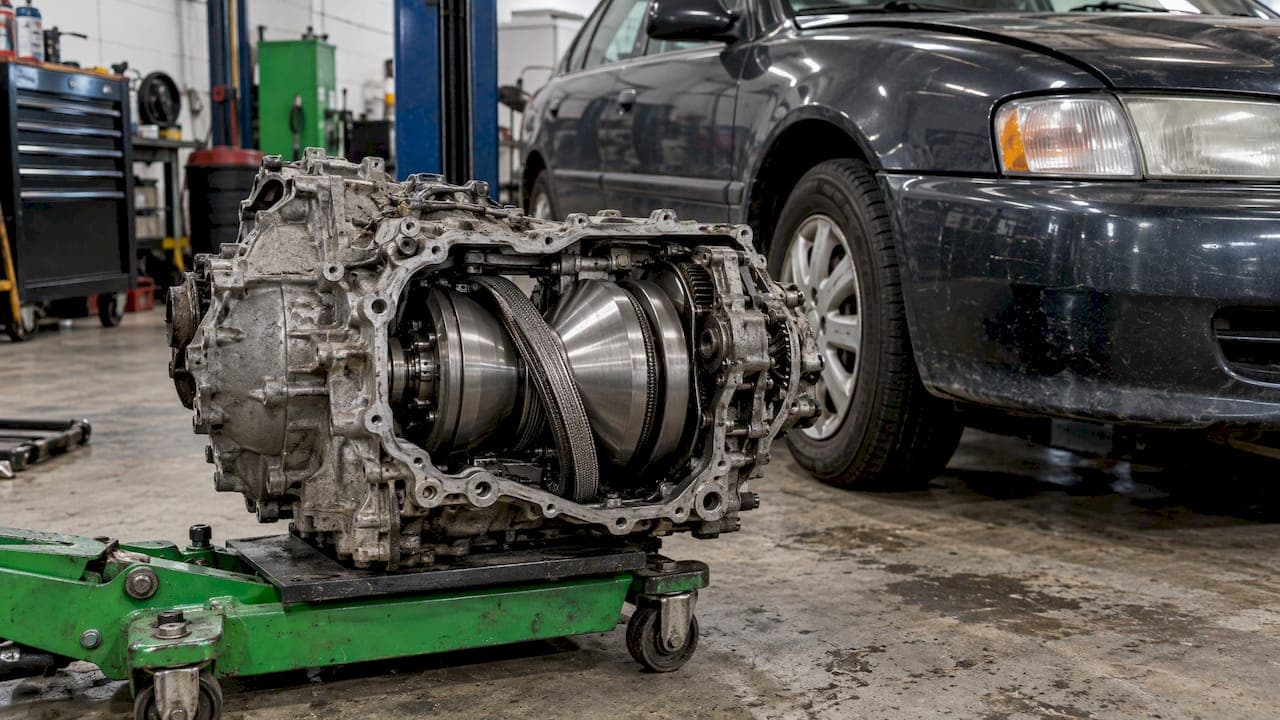
A failing CVT usually announces itself with shuddering when you pull away, a whine that follows engine speed, revs that climb while the car barely accelerates, or a warning light and limp mode. Some of these have cheaper causes than a dead transmission. Others mean you should stop driving today. This guide shows you how to tell the difference, what a fix realistically costs in Canada, and how to decide between repairing the car and selling it as-is for cash.
TL;DR
- Shuddering, whining, slipping revs, a burning smell and limp mode are the classic signs of CVT trouble. Overheating warnings or limp mode mean stop driving.
- Not every symptom is a failed transmission. Sensors, software, cooling and fluid condition can cause similar complaints, so get a written diagnosis before paying for a replacement.
- Costs vary widely. Published Canadian benchmarks run from about $2,700 for a used unit to $6,000 to $7,000 for a new dealer-installed one, depending on the vehicle.
- On an older, high-mileage car, replacement can cost more than the car is worth. That is when selling it as-is becomes the sensible option.
- We buy non-running cars, including ones with transmission failure, in Calgary and Okotoks, with same-day pickup.
Table of Contents
- What a CVT is and why it fails differently
- Signs your CVT is failing
- Is it safe to keep driving?
- Can a CVT be repaired instead of replaced?
- What CVT repair or replacement costs in Canada
- Check your warranty before you pay anything
- Repair or sell: a simple way to decide
- Perspective: what we see on the ground
- Selling a car with a failed CVT in Calgary or Okotoks
- How to reduce the chance of CVT trouble
- FAQ
- Sources
What a CVT is and why it fails differently
A continuously variable transmission replaces fixed gears with two cone-shaped pulleys joined by a steel belt or chain. The pulleys change width to alter the ratio smoothly, which keeps the engine in an efficient range. That design is also why CVTs fail in their own ways: the belt and pulley surfaces depend on clean fluid and controlled heat.
According to a CVT problems guide from The Car Lane, failures commonly come from fluid degradation, overheating, and internal wear such as a worn belt or chain, pulley surface wear and bearing failure. Calgary drivers should note one thing in particular: a Western Canadian transmission shop points out that fluid can degrade faster in harsh winters and stop-and-go driving, and dark, burnt-smelling fluid means less lubrication and more wear.
Bearings deserve a mention too. Tomorrow's Technician reports that bearing failure is widespread in JATCO CVT units, which several manufacturers use.
Signs your CVT is failing
The symptoms below come up again and again in Canadian shop guides. Action Transmission lists the same core set: low-speed shuddering or jerking, whining or humming that follows engine speed, delayed engagement from a stop, overheating, slipping or surging at highway speed, and warning lights or limp mode.
| Symptom | What you notice | How urgent |
|---|---|---|
| Shudder or vibration | Judder when accelerating from a stop or at low speed | Get it checked soon; stop if severe |
| Whine or hum | High-pitched noise that rises with engine speed | Get it checked soon |
| Slipping | Revs jump or climb while speed lags behind | Serious; limit driving |
| Delayed engagement | Hesitation before the car moves | Get it checked soon |
| Burning smell | Hot, acrid odor after driving | Stop driving |
| Warning light or limp mode | Dash light, reduced power, speed capped | Stop driving and arrange transport |
One sign worth knowing: a Canadian transmission shop describes slipping as the tachometer jumping up and down without any change in how far you are pressing the gas pedal.
What is normal and not a failure
Before you panic, know that CVTs behave unlike a conventional automatic. Subaru Canada explains that high engine revs under moderate or heavy acceleration, higher revs when the engine is cold, and some hissing or squealing after you select a gear can all be normal CVT control and fluid pressure at work. If the car drives smoothly and the only oddity is a droning engine under hard acceleration, that alone is not a diagnosis.
Is it safe to keep driving?
It depends on the symptom. The Car Lane says mild hesitation may allow short-term driving with close monitoring, while overheating warnings or limp mode mean no. A burning smell, severe shuddering or loss of drive also call for stopping and having the vehicle transported.

The reason is cost as much as safety. Integrity Drivetrain notes that continued slipping creates heat and spreads wear material through the hydraulic system and cooler, which reduces the chance of a targeted repair. A fault that could have been a modest fix becomes a full replacement.
Mitsubishi's own technical bulletin TSB-20-23-001 describes the same pattern. A CVT shudder or surge can show up as engine flare, lack of acceleration or car shake, and continued driving can allow repeated belt slip, abrasion debris and a warning light with stored trouble codes such as P0776, P0730, P0741, P084A, P0969 or P2719.
If you absolutely must drive, Mister Transmission advises keeping the trip short and gentle, avoiding towing, heavy loads and high speeds, and stopping at once if you notice slipping, a burning smell, grinding or whining, a warning light or loss of acceleration. Driving a failing unit to a shop 30 km away is a bad bet. A tow is cheaper than the damage.
Can a CVT be repaired instead of replaced?
Sometimes. A Calgary repair shop lists solenoid replacement, valve-body repair, belt service and rebuilds as options for some CVT problems. The Automobile Protection Association (APA) describes cases where a specific defective bearing was behind the failure, and it can be repairable at a fraction of the cost of a full replacement if caught before extensive internal damage. The APA also notes that some dealers may push for complete replacement to limit warranty risk, whereas independent specialists may repair particular internal components for far less.
The other side is honest too: CVTs are often replaced rather than rebuilt because they need specialized tooling, calibration, and parts that are hard to source, according to one US repair-cost site. Ask any shop whether your specific unit is a repair candidate or a swap.
Make sure it is the transmission
Symptoms alone do not prove the transmission is finished. Integrity Drivetrain says CVT complaints can start in sensors, wiring, software or cooling rather than in the belt and pulleys. Mitsubishi's bulletin likewise calls for a structured diagnostic process, software verification and stored-code analysis before replacement is authorized.
A proper diagnosis, per the same Integrity guide, includes scanning for transmission fault codes, checking the fluid for burnt odor or debris, and reading live data to find the root cause of pressure or ratio errors. Ask for the result in writing.
What CVT repair or replacement costs in Canada
There is no single Canadian price list, and anyone quoting one number for every car is guessing. Here are the figures we can point to, with their limits.
| Benchmark | Approximate figure | Notes |
|---|---|---|
| Used Nissan CVT, installed | about $2,700 or more, before tax | Quebec guide published October 21, 2026 |
| Specialist rebuild (Nissan example) | about $3,500 or more, before tax | Same guide |
| New dealer-installed Nissan unit | $6,000 to $7,000, before tax | Same guide |
| Remanufactured transmission in Canada | $3,500 to $8,000 | General range, not CVT-specific |
| Independent shop labour in Calgary | $100 to $130 per hour | 2026 estimate |
| Dealership labour | $145 to $190 per hour | 2026 estimate |
The first three rows come from MaTransmission's Quebec price guide, which uses Nissan examples and warns that diagnosis, vehicle, parts choice, labour, taxes and warranty can materially change the total. The remanufactured range and the labour rates come from On The Move's 2026 repair cost guide.
For a real-world sense of scale, the APA reported in 2022 that Nissan paid $37 million to replace CVTs in 11,284 Quebec vehicles, averaging $3,332 per warranty repair, with failures at an average of 66,000 km. That is Nissan-specific history, not a rule for every CVT, but it shows these repairs are rarely small.
Check your warranty before you pay anything
A CVT failure on a newer or lower-mileage car may not be your bill. Do these first:
- Read your warranty booklet. Note powertrain terms and any extensions.
- Look for manufacturer extensions. The APA says some automakers have extended powertrain coverage for specific CVT models beyond original factory terms.
- Check your VIN. Subaru Canada's CVT Warranty Enhancement Program covers certain 2010 to 2018 models for 10 years or 160,000 km, and owners can check coverage by VIN.
- Get the diagnosis in writing, plus two written estimates, as the On The Move guide recommends.
- Know your rights. In Ontario, the final bill is capped at 10% above the written estimate and a parts-and-labour warranty is required, according to the same guide. Other provinces have comparable protections, so confirm Alberta's rules with Service Alberta before authorizing work.
Repair or sell: a simple way to decide
The math is rarely complicated. Compare the quoted repair, including tax, with what the car would be worth running. Independent technicians in the GTA note in a Nissan CVT replacement cost article that on older, high-mileage vehicles, a full CVT replacement can sometimes exceed the vehicle's market value, which makes a fix-or-move-on assessment necessary.
A practical rule of thumb we use with callers (it is our rule, not an industry standard):
- Repair if the car is still under warranty or an extension, the quote is a small fraction of the car's running value, and the body, engine and safety items are sound.
- Sell if the quote approaches or exceeds the car's value, the car has other problems coming (rust, a failed safety inspection, accident damage), or you simply do not want to sink thousands into it.
- Get a second opinion if one shop says "full replacement" without a code scan or written diagnosis.
If you are leaning toward selling, our guide on what to do with a car with a blown transmission walks through the practical steps.
Perspective: what we see on the ground
We buy cars in Calgary and Okotoks every week that will not move under their own power, and a failed or failing transmission is one of the most common reasons owners call us. What we notice is that the decision is usually made late. People drive until the car stops, pay for a tow, then discover the quote is more than the car is worth.

Our advice is simple. Get the diagnosis first, in writing. If the repair makes sense, do it. If it does not, do not let the car sit in your driveway or a shop lot accruing storage fees and losing parts value. A car with a bad CVT still has value in its body, its other components and its scrap weight, and we pay for that value regardless of whether it runs. Our business is reselling parts and scrap metal from the vehicles we buy, which is why we can make an offer on a car other buyers would walk away from.
What we will not do is tell you to sell when a cheap fix would put you back on the road. A software update or a sensor can sometimes cure what looks like a dead transmission, and you should rule that out first.
— Franz
Selling a car with a failed CVT in Calgary or Okotoks
If the numbers say move on, we make it quick. We offer cash for junk, non-running, damaged and scrap cars, including ones with blown engines or transmission failure, plus ATVs and side-by-sides. Towing is free and pickup can be the same day.
The process has three steps: you contact us, we pick up the vehicle, and you get paid in cash. There are no hidden fees. You can start on our cash for cars page or read about our scrap car removal service.

Before you accept any offer from anyone, confirm the amount and what is included before the tow truck arrives. Our piece on comparing two or three offers and confirming before the tow explains how.
Before the tow truck arrives
- Have your ownership and registration documents ready, and a government-issued ID.
- Remove your plates and personal items, and cancel your insurance only after the car has left.
- Tell us honestly what is wrong, including the CVT symptoms, so the offer matches the car.
- If a lender has a lien on the car, tell us up front so we can plan the paperwork.
If you are also weighing whether a salvaged car could be rebuilt and resold, read salvage versus rebuilt title in Canada first. And if the trouble is further back in the drivetrain, see what shops check on a failed transfer case before you repair or sell.
How to reduce the chance of CVT trouble
If you are keeping the car, or buying another one with a CVT, a few habits matter:
- Follow the fluid schedule for your exact model. Use the fluid the manufacturer specifies, since CVT fluids are not interchangeable. Severe-service intervals apply to Calgary winters and heavy stop-and-go driving.
- Let the car warm up gently in cold weather and avoid hard launches on a cold transmission.
- Avoid towing unless the owner's manual explicitly allows it for your model.
- Act on the first symptom. A shudder at low speed that you ignore is how a bearing or valve problem turns into a full unit.
- Check for recalls and service bulletins by VIN before a repair, since manufacturers sometimes issue software updates or extended coverage for known CVT complaints.
FAQ
How can you tell if a CVT transmission is bad?
Look for shuddering when you pull away, a whine or hum that follows engine speed, revs rising without matching acceleration, hesitation from a stop, and warning lights or limp mode. Some high-rev behaviour is normal for a CVT, so a shop should scan for codes and check the fluid before calling it failed.
How much does it cost to replace a CVT transmission?
It depends heavily on the vehicle. One 2026 Quebec guide gives Nissan benchmarks of about $2,700 or more for a used unit, about $3,500 or more for a specialist rebuild, and $6,000 to $7,000 for a new dealer-installed unit, all before tax. Get two written estimates for your own car.
Can you fix a CVT without replacing it?
Sometimes. Solenoid replacement, valve-body repair, belt service, or fixing a specific defective bearing can work if the problem is caught before widespread internal damage. Ask for a code scan and written diagnosis first, since sensors, software and cooling can cause similar symptoms.
Will you buy a car with a failed CVT?
Yes. We buy running and non-running cars in Calgary and Okotoks, including those with blown engines or transmission failure, and we tow them free. Contact us through our main page to start.
Sources
- CVT Transmission Problems: Symptoms, Causes & What to Do, The Car Lane
- CVT Common Operating Characteristics, Subaru Canada
- CVT Transmission Issues & Maintenance Tips, Action Transmission
- CVT 101, Shift Fix Transmissions
- CVT Transmission Repair, DOT Transmissions
- Transmissions - CVT, Tomorrow's Technician
- Mitsubishi TSB-20-23-001
- CVT Transmission Problems: Symptoms & Next Steps, Integrity Drivetrain
- Can I Still Drive My Vehicle If I Suspect a Transmission Issue, Mister Transmission
- Transmission Repair Calgary
- Repairing a CVT transmission failure on a Toyota C-HR, APA
- Transmission Repair Cost
- Prix d'une réparation de transmission au Québec, MaTransmission
- APA update on Nissan CVT Transmission Failures
- How Much Should My Car Repair Cost in Canada? (2026 Guide), On The Move
- CVT Warranty Enhancement Program, Subaru Canada
- Nissan CVT Shudder or Whine? Replacement Cost (GTA)