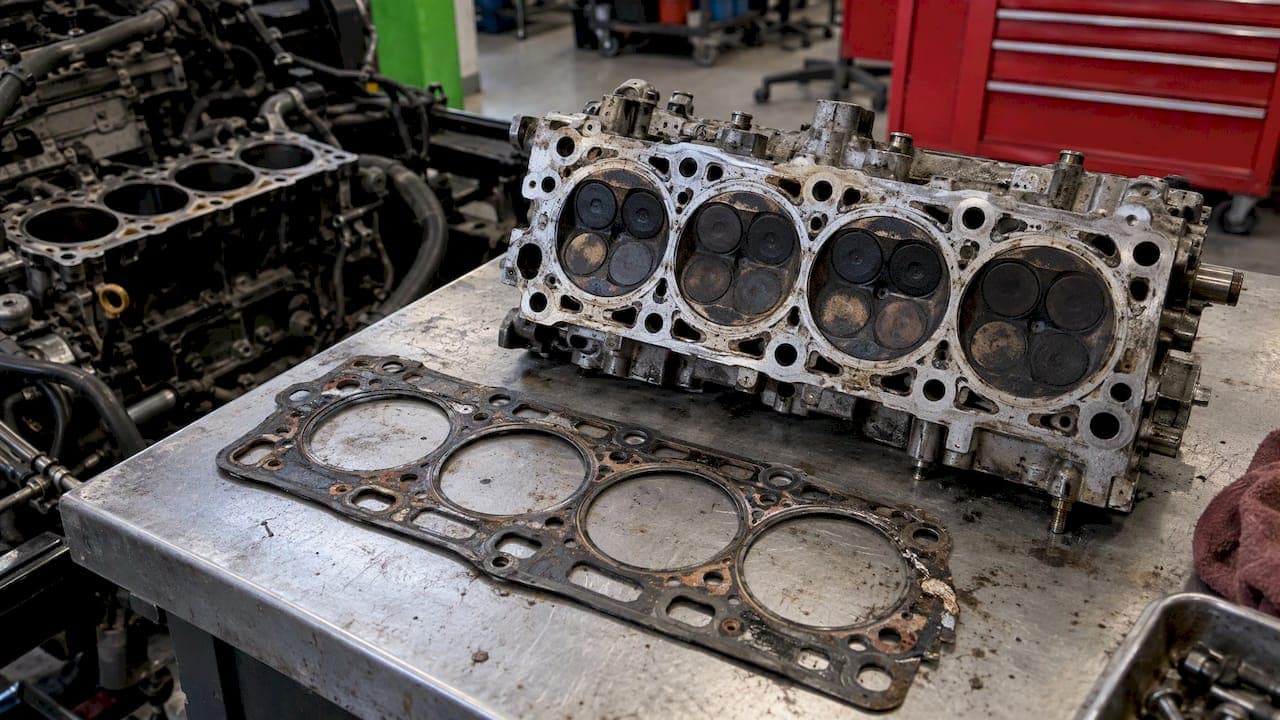
The classic blown head gasket symptoms are repeated overheating, coolant disappearing with no visible leak, thick white exhaust smoke with a sweet smell, bubbles in the coolant reservoir, and milky or frothy oil. No single sign proves the diagnosis, because other faults can mimic most of them. If two or three show up together, stop driving and have a shop run a combustion-leak or leak-down test. This guide covers each sign, what else it could be, what the repair involves, and how to decide whether to fix the car or sell it.
TL;DR
- The strongest combination: overheating, unexplained coolant loss, white exhaust smoke and milky oil appearing together.
- Every symptom can have another cause, so confirmation needs a test, such as a chemical combustion-gas test or a leak-down test.
- Driving on a failing gasket can turn a gasket job into a full engine replacement, so park the car once the temperature climbs.
- Repair typically runs about $1,000 to $2,000 and can cost more on larger or luxury engines. On an older car, that can exceed what the car is worth.
- If repair does not make sense, a non-running car with a blown gasket can be sold for cash in Calgary and Okotoks with free towing.
Table of Contents
- What a head gasket does and why it fails
- Nine blown head gasket symptoms
- Which symptoms mean the most
- How a shop confirms it
- Blown head gasket or cracked head?
- Can you keep driving with a blown head gasket?
- What repair involves and what it costs
- Repair or sell: how to decide
- Selling a car with a blown head gasket in Alberta
- Our perspective
- Get cash for a car with a blown head gasket
- FAQ
- Sources
What a head gasket does and why it fails
The head gasket is a seal between the engine block and the cylinder head. It keeps three things apart: combustion pressure in the cylinders, coolant in its passages, and oil in its own galleries. When it fails, those boundaries break down. O'Reilly Auto Parts explains that a failed gasket can let oil and coolant mix, let either one leak outside the engine, let coolant enter a cylinder, or let combustion gases push into the cooling system.

Those four paths explain almost every symptom on the list below. Coolant in a cylinder gives white exhaust. Exhaust gas in the cooling system gives bubbles and pressure. Coolant in oil gives a milky look. Pressure in the cooling system forces coolant out, which gives overheating.
Overheating is usually where the story starts. Fel-Pro notes that overheating is usually the initiating problem and that the gasket is generally the weaker link, so it often fails before the cylinder head itself cracks, although both can happen. In other words, the gasket often goes first, and the overheating that killed it can also have damaged the head.
Nine blown head gasket symptoms
1. Repeated or fast overheating
A temperature gauge that climbs again and again, even after you top up coolant, is the most common first sign. Combustion gas leaking into the cooling system displaces coolant and creates air pockets, so the engine cannot shed heat. K-Seal Canada lists repeated overheating among the most recognizable warning signs.
What else it could be: a restricted radiator, a stuck thermostat, a failed water pump or a dead cooling fan. The same K-Seal page points out that a restricted radiator can cause overheating on its own.
2. Coolant loss with no puddle
If the reservoir keeps dropping and you cannot find a drip under the car, the coolant may be burning in the cylinders or sitting in the oil. You may also see coolant leaking externally along the seam between the head and block.
What else it could be: a leaking hose, heater core, radiator or water pump. Check those first, since they are cheaper to confirm.
3. Thick white exhaust smoke
White smoke that persists after warm-up, with a sweet smell, suggests coolant is being burned. A Canadian repair shop, Parkside Motors, explains that a little white vapour at a cold start in Canadian weather is normal condensation and disappears as the engine warms up. That matters in a Calgary January, when every car puffs white at start-up. The concerning version keeps going, smells sweet and does not fade.
4. Bubbles in the radiator or coolant reservoir
With the engine cool and following your owner's manual, bubbling in the coolant while the engine runs suggests combustion gases are entering the cooling system. Never open a hot radiator cap. Pressurized coolant can cause serious burns, so let the engine cool completely first.
5. Milky or frothy oil
A light brown, milkshake-like film under the oil filler cap or on the dipstick means coolant and oil are mixing. It is one of the more telling signs, but not conclusive. K-Seal Canada notes that milky oil can have other causes, such as an intake-gasket problem. Short trips in cold weather can also leave some condensation residue under the cap.
6. Misfires and loss of power
If coolant leaks into a cylinder or compression escapes between two cylinders, the engine runs rough, shakes at idle or feels weak under load. O'Reilly notes that misfires can have other causes, such as ignition parts or fuel delivery.
7. Low oil pressure
Coolant-diluted oil lubricates poorly, so the oil light or pressure gauge may react, especially when hot. Treat any oil pressure warning as a stop-now signal.
8. Engine noise
Ticking, knocking or a rougher sound can follow when lubrication suffers or cylinders misfire. K-Seal Canada says rough running or knocking can also come from other faults, so noise alone tells you little.
9. A flashing check-engine light
Fel-Pro lists a flashing check-engine light among symptoms shared by a leaking head gasket and a cracked head. A flashing light usually means active misfires, which can damage the catalytic converter, so it is another reason not to keep driving.
Which symptoms mean the most
| Symptom | How specific to a head gasket | Common alternative cause |
|---|---|---|
| Milky oil plus coolant loss | High when both appear together | Intake gasket problem |
| Bubbles in coolant with engine running | High | Air trapped after a coolant service |
| Persistent sweet white smoke | Medium to high | Other coolant leaks into the intake |
| Repeated overheating | Medium | Radiator, thermostat, water pump, fan |
| Misfire or power loss | Low | Ignition or fuel faults |
| Knocking or rough noise | Low | Many mechanical faults |
The pattern matters more than any one row. Overheating alone sends you to a cooling-system check. Overheating plus milky oil plus disappearing coolant sends you to a gasket test.
How a shop confirms it
Symptoms alone do not confirm a blown gasket, which is why shops test. A Canadian repair shop, My Garage in Airdrie, describes a combustion-leak test that detects combustion by-products, a cooling-system pressure test combined with a borescope, and pressure-transducer testing. These can confirm a leak without immediately dismantling the engine, though sometimes disassembly is still needed.
Parkside Motors describes two common methods. A chemical coolant test changes colour when combustion gas is present, which makes it a quick screen. A leak-down test pushes compressed air into a cylinder and watches for the coolant level to rise, which is more direct evidence of leakage between a cylinder and the cooling system.
AutoZone adds a compression test to the list. Low compression in one or more cylinders supports a gasket diagnosis, but it does not prove it on its own.
If you are evaluating a used car before buying, a structured drive and inspection routine helps you notice overheating, rough running and smoke early. A car test drive checklist gives you a systematic way to do that.

Blown head gasket or cracked head?
This is the question that changes the repair bill. Overheating can warp or crack the cylinder head and damage the gasket at the same time. Hagerty's Rob Siegel writes that because the parts touch, symptoms alone often cannot tell the two apart. Fel-Pro's list of cracked-head symptoms matches the gasket list nearly line for line: overheating, low coolant, white tailpipe smoke, bubbling, milky oil, misfires and rough running.
What separates them is testing. Hagerty describes compression testing as a way to find a gasket breach between adjacent cylinders, and leak-down testing as a way to reveal bubbles in the radiator. A machine shop may also find head cracks that are invisible until the head is cleaned and inspected. An engine specialist can use pressure, vacuum or Magnaflux testing to locate cracks.
If the damage goes deeper, into the block itself, the economics change again. We cover that in how to diagnose a cracked engine block in Calgary.
Can you keep driving with a blown head gasket?
The short answer is no. O'Reilly advises parking a vehicle with a blown gasket, because driving with coolant in the oil, oil in the coolant or misfires can lead to wear, overheating and engine failure. Its guidance is not to drive once the temperature rises beyond normal.
Driving.ca reports that prolonged or repeated operation while overheating is strongly associated with head-gasket damage and engine failure, and that coolant-contaminated oil compromises lubrication and accelerates wear. K-Seal Canada adds that coolant loss can cause further cracking, and that contaminated oil can damage bearings and potentially require an engine rebuild.
Practical rules when you suspect a gasket problem:
- Pull over safely when the temperature gauge climbs and shut the engine off.
- Do not open the radiator or reservoir cap while hot.
- Do not top up and carry on. Each overheating cycle adds damage.
- Arrange a tow rather than a "short drive" to the shop.
- Tell the shop what you observed: when it overheats, what the smoke looks like, what the oil looks like.
If the engine has already seized or failed, our guides on a hydrolocked engine and on selling a car with a blown piston explain your options at that stage.
What repair involves and what it costs
This is a labour-heavy job. AutoZone explains that repair normally requires substantial disassembly: removing the intake and cylinder head, inspecting the head, then reinstalling or replacing it. The work often takes more than a day.
On cost, K-Seal Canada puts the average at roughly $1,000 to $2,000, and up to $2,000 or more, with luxury and high-performance vehicles costing more. Make, model, shop rates and OEM versus aftermarket parts all move the number. Get a written quote after the diagnosis, not before, since a cracked head, warped surface or bearing damage will add to it.
For Calgary-specific context, see our page on blown head gasket repair cost in Calgary.
Repair or sell: how to decide
A head gasket repair is a real option on the right car. A cracked head is not automatically scrap either: the economics depend on crack severity, head material, machining, parts availability and collateral damage, as the Islandd Automotive article notes. The question is whether the repair cost is justified by what the car is worth afterward.
Use these checks:
- Repair quote versus the car's repaired value. If the quote is more than about half of what the car would be worth running, you are spending a lot on an older vehicle.
- Other problems waiting. Rust, a weak transmission, failed inspection items or high mileage all make a $1,500 repair a harder bet.
- Damage already done. Overheating that continued after the first warning can leave scored cylinder walls, a warped head or bearing wear, and the quote grows.
- Your need for the car. If it is a spare, a second vehicle or something you were already planning to replace, selling it as is frees you from the repair.
- Time. A job that takes more than a day, plus parts and diagnosis, may mean a week or more without a vehicle.
When the numbers favour selling, you do not need to repair first. A buyer who purchases non-running vehicles prices the car as it sits, and you skip the shop bill entirely.
Selling a car with a blown head gasket in Alberta
Selling a car with a known fault is routine, provided you are honest about it. Here is what Alberta sellers should keep in mind.
Be upfront about the problem. Misrepresentation at the point of sale can be raised by a buyer with the provincial consumer-affairs office, according to the federal Office of Consumer Affairs on recourse for vehicle defects. The same page says a buyer with an unresolved complaint may consider repairs and small-claims proceedings after obtaining legal advice. Saying "blown head gasket, not running" in plain words protects you.
Know which rules apply. AMVIC says licensed businesses in Alberta must disclose vehicle history in writing, including specified prior damage and repair facts, while private sellers are not required to provide the Mechanical Fitness Assessment. Federally, the Office of Consumer Affairs notes that private-sale contracts are not subject to consumer legislation, and recovering compensation can be difficult if problems arise.
Check for a lien. The Financial Consumer Agency of Canada advises buyers to check for liens and notes that in some provinces private sellers must provide lien information before transferring ownership. If you still owe money on the car, sort that out before the sale.
Have your paperwork ready. Registration, photo ID and the vehicle's details make a quick sale easy. Write down what you know: symptoms, when they started and whether anyone tested it.
Our perspective
We see blown head gasket cars every week in Calgary and Okotoks, and the pattern is familiar. The owner notices overheating, tops up the coolant, keeps driving, and a few weeks later the car will not run at all. By then the repair quote has grown, and the conversation is about whether the car is worth saving.
Our view: the cheapest moment to decide is early. If your car is older, has other issues, or the quote lands near what the car is worth, selling it as is can be the cleaner financial move. You do not need to pay for diagnosis, repair and a week without a vehicle to get value out of it.
We buy cars running or not, including ones with blown engines, transmission failure or failed inspections. We pay based on what the car is worth to us, in parts and scrap value, and we tell you the number before we show up. Same-day pickup and towing are part of the service, with no hidden fees.
If you are on the fence, ask for a quote. It costs nothing, and it gives you a real number to compare with the repair estimate.
Franz
Get cash for a car with a blown head gasket
If the repair estimate does not make sense, we can take the car off your hands. Southside Cash For Junk Cars buys junk, non-running, damaged and failed-inspection vehicles in Calgary and Okotoks, with same-day free towing and payment on pickup. The process is three steps: contact us, we pick up the vehicle, and you get paid.

Start on our cash for cars page or read how scrap car removal works. For the wider picture on selling a damaged vehicle locally, see our guide to the Calgary junk car buyer process.
FAQ
How do you know if you've blown a head gasket?
Look for a cluster of signs: overheating, coolant loss with no visible leak, persistent white smoke, bubbles in the coolant and milky oil. Each one can have another cause, so confirmation needs a test such as a combustion-gas chemical test or a leak-down test at a shop. Do not rely on one symptom.
Will my car still drive with a blown head gasket?
Sometimes it will run, but you should not drive it. Coolant loss can cause overheating and cracking, and contaminated oil can damage bearings, which can turn a gasket repair into an engine replacement. Park it and arrange a tow.
How much does it cost to fix a head gasket?
A typical range is about $1,000 to $2,000 in Canada, and more on luxury or high-performance vehicles. The final figure depends on the engine, the shop's labour rate and whether the head or block is damaged. Ask for a written quote after diagnosis.
Can I sell a car with a blown head gasket?
Yes. Disclose the fault honestly, confirm there is no lien and have your registration and ID ready. A buyer of non-running vehicles, like us, will quote the car as it is, so you do not need to repair it first.
Is a blown head gasket worth fixing?
It depends on the car's value, its other problems and whether overheating has done further damage. If the quote is a large share of what the repaired car is worth, or the car is already near the end of its life, selling as is often makes more sense.
Sources
- Blown Head Gasket? Signs and Diagnosis, O'Reilly Auto Parts
- Identify the tell-tale signs of a blown head gasket, K-Seal Canada
- Can you drive with a blown head gasket? K-Seal Canada
- Head gasket repair costs, K-Seal Canada
- What is "Blowing a Gasket"? Parkside Motors
- Cylinder Head Gaskets, My Garage Auto & Tire
- Identifying Blown Head Gaskets & Cracked Heads, Fel-Pro
- Identifying cracked heads and blown head gaskets, Hagerty
- Can a Cracked Cylinder Head Be Fixed? Islandd Automotive
- Buyer Beware: Head gasket munchers, Driving.ca
- Head Gasket Leak Symptoms & How to Fix It, AutoZone
- What Does It Mean to Blow a Head Gasket? AutoZone
- Buying used, Alberta Motor Vehicle Industry Council
- The Complaint Roadmap, Office of Consumer Affairs
- Recourse for vehicle defects, Office of Consumer Affairs
- Risks associated with car liens, Financial Consumer Agency of Canada
- Classic Car Test Drive Checklist: Buyer's Guide