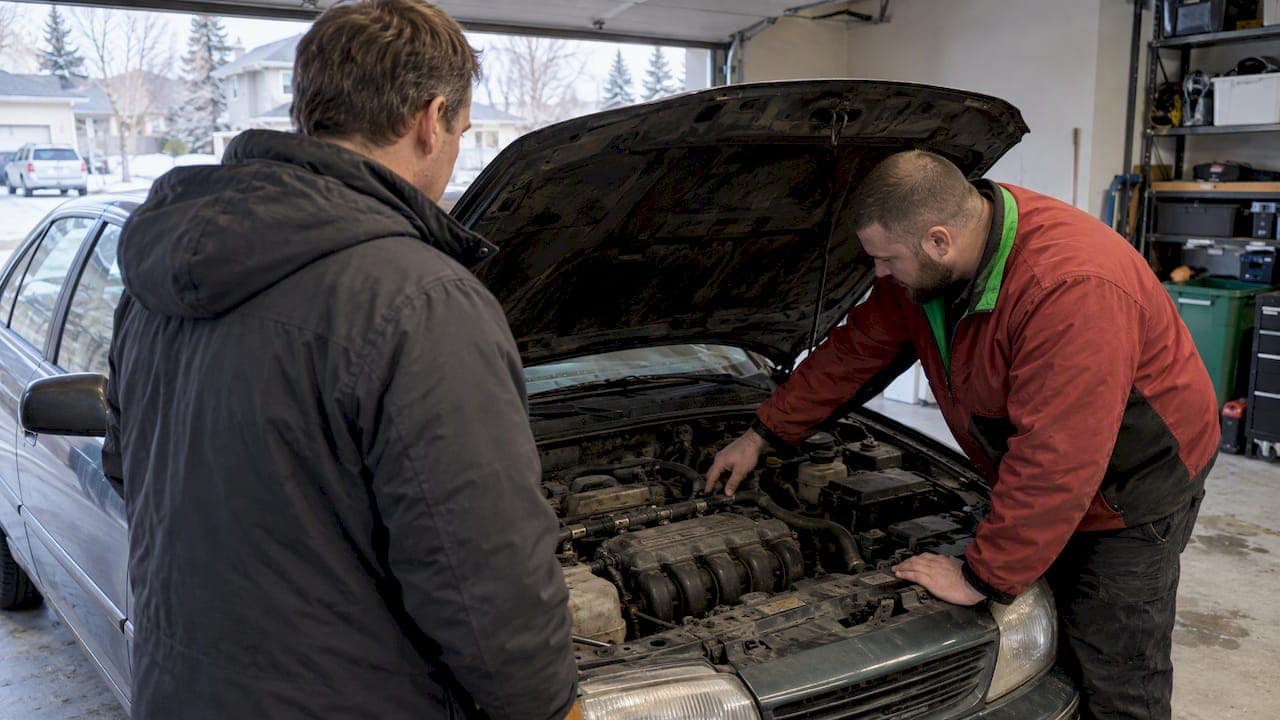
Yes, you can sell a car with a blown piston, and in Calgary you can do it the same day. The engine is dead, but the car still has value as parts, scrap metal or a project. The decision comes down to three routes: repair it, sell it privately as a mechanical project, or sell it to a buyer who tows it away and pays on the spot. Which one wins depends on what the car is worth with a working engine.
TL;DR
- A blown piston does not make a car unsellable. Describe the problem honestly and sell it as-is, in writing.
- Repair only makes sense if the car is worth clearly more than the bill with a good engine in it. For most older cars, it is not.
- Do not drive it to the buyer. Arrange a tow, especially if the engine knocks, smokes, leaks or has seized.
- Take your licence plate off, sign a bill of sale and keep a copy before the car leaves.
- We buy non-running cars in Calgary and Okotoks, with towing included and payment on pickup.
Table of Contents
- What a blown piston means for your car's value
- Repair or sell: the rod knock decision
- Your options for selling a blown-piston car
- Be honest about the damage, and put it in writing
- Do not drive it to the buyer
- Plates, fluids and personal items before pickup
- A same-day sale in Calgary, step by step
- Our perspective: why we buy engines that no longer run
- Get an offer for your blown-piston car
- FAQ
- Sources
What a blown piston means for your car's value
A piston can fail from overheating, running low on oil, detonation or simple age. When it does, you usually hear a heavy knock or see heavy smoke, lose compression, or the engine stops turning altogether. Metal fragments can scar the cylinder wall and circulate through the oil, so the damage is rarely limited to one part.
That is why buyers treat the car as a non-running vehicle. The price no longer reflects the engine. It reflects what the rest of the car is worth: the body, the transmission, the catalytic converter, the wheels, the interior and the metal weight.
The same logic applies to a bad head gasket, a thrown rod, a spun bearing or a seized engine. If you are asking whether any of those can be sold, the answer is the same: yes, if you are honest about the condition.
Repair or sell: the rod knock decision
Many people land on this page after a mechanic says "rod knock" or "bottom end damage". Rod knock means the connecting rod bearings are worn or failed, and it sits in the same family of problem as a blown piston. One repair shop guide puts an engine rebuild at $2,500 to $4,000 and a full replacement at $10,000 or more in the worst cases. A separate repair guide lists the usual options: replace the bearings, rebuild the engine, or replace the whole engine. Those figures come from general repair guides, not Calgary quotes, so get a local written estimate before you decide.
Here is a simple way to weigh it.
| Question | Lean toward repair | Lean toward selling |
|---|---|---|
| What is the car worth with a healthy engine? | Clearly more than the repair quote plus a margin | About the same as the quote, or less |
| How old is the rest of the car? | Low kilometres, clean body, good transmission | High kilometres, rust, other failures coming |
| Do you need the car? | Yes, and it is the right size for you | You already have other transportation |
| Can you wait? | Yes, a shop may have it for days or weeks | No, you want it gone this week |
| Are there other faults? | No | Failed inspection, body damage, worn suspension |
If the repair would cost more than the car could ever sell for, repairing it is just paying to own the same old car. If the car is newer, in good shape and valuable, get two written quotes first. A used or remanufactured engine is often cheaper than a rebuild, but you pay for labour either way.
The moment you add a second problem, such as rust, a bad transmission or a failed safety inspection, selling usually becomes the smarter move.
Your options for selling a blown-piston car
There are four realistic routes. They differ in speed, effort and how much risk lands on you.
Private sale as a mechanical project
You can list it online as a non-running car that needs engine work. This can bring the highest price when the car is a desirable model, because hobbyists and mechanics buy engine-out projects. The costs are your time, strangers coming to look at it, no-shows, and the need to arrange a tow for the buyer or wait for them to bring a trailer. Low offers are common, and you are still storing the car in the meantime.
Trade-in at a dealership
Some dealers will take a dead car as part of a trade, but expect them to price in the cost of moving and disposing of it. It can be convenient when you are buying another vehicle the same day. It is rarely the best number for the dead car itself.
A scrapyard or auto wrecker
Wreckers pay for metal weight and usable parts. The price is straightforward but varies with the market. Ask whether towing is included, because some charge for it and subtract the cost from your offer.
A junk car buyer that tows and pays on the spot
This is the fastest option. You describe the car, get an offer, and the buyer collects it. Our own Calgary blog says junk cars there usually bring $100 to $700, with the final figure depending on the vehicle. A blown engine does not stop the sale, it just means the car is priced as a non-runner.
Be honest about the damage, and put it in writing
Selling a car as-is does not mean hiding what is wrong with it. Tell every buyer the engine has a blown piston, that it does not run, and anything else you know about, such as a check engine light, leaks or collision damage. If a buyer later says they were not told, a clear written description protects you.
For a private sale in Alberta, the province's standard bill of sale records the transfer. It asks for the names and addresses of the seller and buyer, the VIN, the make, model, style, colour and year, the price, and signatures. Odometer reading, liens, payment method and special conditions are recommended additions, and the engine condition belongs in those special conditions. Something like "sold as-is, engine has a failed piston, vehicle does not run" is plain and enough.
Two more practical points:
- Alberta says the registration certificate is not itself proof of ownership in a private sale. If yours is missing, do not assume the car cannot be sold. Check what documents your buyer needs before the pickup day.
- Bring a Vehicle Information Report if you have one. It shows history and status, and a seller with both a bill of sale and a report is easier to deal with than one who only has keys and a story.
If there is a loan on the car, find out the balance and sort it out with your lender first. A lien needs to be cleared before ownership can move cleanly.
Do not drive it to the buyer
It is tempting to nurse a knocking engine across town to save a tow. Don't. A failing engine can seize without warning, lose oil pressure, leak fluid onto the road, or stall in traffic. If it is knocking, seized, leaking or cannot hold safe operation, have it towed.
That is one reason we include towing with our offers: the buyer who collects the car takes on that risk, not you. If you are curious how towing works in the province, we wrote up how to get a junk car towed in Alberta, and a separate piece on non-running car pickup options in Calgary.
Plates, fluids and personal items before pickup
Take your plate off
Alberta requires plates to be displayed when a vehicle is driven, and its licence plate rules also cover in-transit permits, including salvage moves. A car being hauled away does not mean your plate should stay on it. Remove it before the vehicle leaves and keep it, since plates belong to you in Alberta, not to the car.
Leave the fluids alone if you can
You do not need to drain a dead engine before selling. The safest approach is to let the removal provider handle the vehicle as it is. If you do remove oil, fuel, coolant, brake fluid, antifreeze or a battery, never pour them on the ground, down a household drain or into a cart. The City of Calgary's household hazardous waste program accepts used motor oil, fuel, automotive fluids, antifreeze, oil filters and lead-acid batteries at designated locations. Containers must be the original or sturdy, leak-proof, tightly closed and clearly labelled, and no larger than 20 litres.
If you want a wider view of how vehicle parts and fluids can be handled responsibly, this practical guide to reducing automotive waste is a useful read, though it is written from a UK perspective, so follow Calgary's rules above for local drop-off.
Clear out the car
Check the glovebox, trunk, door pockets and under the seats. Remove toll tags, garage openers, child seats, dash cams, and any documents with your address. Aftermarket stereos or custom wheels are yours to take if you want to keep them, but tell the buyer first so the offer matches what is actually on the car.
A same-day sale in Calgary, step by step
- Request quotes. Give each buyer the year, make, model, approximate kilometres and honest condition. Say "blown piston, does not run" up front.
- Confirm what the offer covers. Ask whether it depends on the described condition, whether towing is included, and how you will be paid.
- Schedule pickup. Neither Alberta's bill of sale page nor its plate page guarantees a pickup time or cash amount, so confirm same-day availability and payment method directly with the buyer.
- Check the paperwork. Verify the VIN against the car and sign the bill of sale. Both of you should keep a copy.
- Remove your plate and personal items.
- Collect payment, then release the keys and car. Keep your copy of the paperwork.
Then cancel or update your insurance once the car is gone, and keep the bill of sale for your records.
Our perspective: why we buy engines that no longer run
We are a local Calgary and Okotoks business, and the first call we get about blown pistons usually starts with an apology. People think the car is worthless or that they must fix it first. Neither is true. We buy cars that do not run, including those with blown engines or transmission failure, and we also take damaged, scrap and failed-inspection vehicles, ATVs and side-by-sides.
Our model is simple. We buy the vehicle, remove it, and make our money from the parts and scrap metal value in it. That means the engine failing is not the end of the story for us, it is just part of the price. It also means we have no reason to push you toward a repair that costs more than the car is worth.

If the car has real resale value with a healthy engine, we will not mind you getting a repair quote first. If it does not, you should not spend money on it. What we ask is that you tell us what is wrong, so the offer we give is the one we pay.
Our three-step process is contact, pickup, cash. No hidden fees, towing included, and a person you can call afterwards.
— Franz
Get an offer for your blown-piston car
If you would rather skip the listings, the no-shows and the tow bill, tell us about your car and we will give you an offer for pickup in Calgary or Okotoks. For more on how our scrap removal works, see our scrap car removal page, or read our guide to cars-for-cash pickup in Calgary.
FAQ
Can I sell a car with a bad head gasket?
Yes. A bad head gasket is a mechanical defect like any other, and buyers purchase such cars every day. Describe it accurately, mention any overheating or fluid mixing, and sell the car as-is with the condition written on the bill of sale.
Can you drive a car with damaged pistons?
You should not. A damaged piston can cause the engine to seize, leak oil or stall, which is unsafe and can wreck what remains of the engine. Arrange a tow instead of driving it to a buyer or a shop.
How much is a blown engine worth?
It depends on the car, not the engine. The buyer prices the body, parts, transmission and scrap weight. For Calgary, our blog's pricing guide says junk cars usually bring $100 to $700, and the actual offer for your car can be higher or lower.
Can you sell a car with a faulty engine?
Yes, in Canada, provided you describe the defect honestly and sell it as-is. In an Alberta private sale, use the standard bill of sale and add the engine condition to the special conditions. Confirm payment method and towing with the buyer before pickup day.
Sources
- Standard bill of sale, Alberta.ca
- Licence plates, Alberta.ca
- Household Hazardous Waste Program, City of Calgary
- Is Your Engine Rod Knocking? Engine Rod Repair Cost
- Engine Rod Knocking Repair Guide