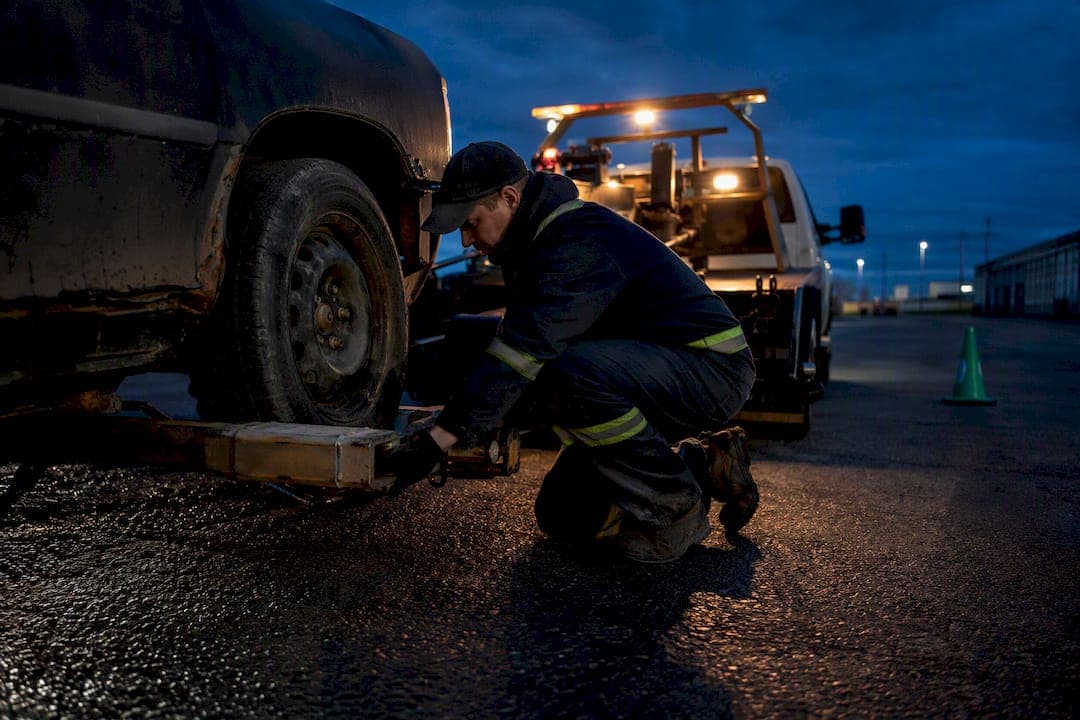
The fastest way to get a junk car quote in Alberta is to fill out an instant online form or call a local buyer directly, then ask for a written offer before anything gets towed. A firm number usually lands within minutes, and reputable buyers throw in free towing with payment handed over the moment the car leaves your driveway. Some local services run this exact process to serve owners in the Calgary region.
TL;DR:
- Most legitimate buyers offer a firm written quote that reflects your vehicle's actual condition and parts, which is usually valid for one to two days.
- Providing a detailed VIN, clear photos of the vehicle, and honest condition descriptions helps secure an accurate offer that won't change on pickup day.
- Expect a typical price variance of $50 to $200 between verified buyers, with gaps over $500 indicating unreliable or incomplete offers.
- Towing should be included in the initial quote; any charge beyond that typically signals an unprofessional or low-quality buyer.
- Rural pickups may take up to three days due to logistics, while urban areas generally see same-day service once an offer is confirmed.
Table of Contents
- How to Get an Instant Online Quote or Phone Quote
- What Information Buyers Need From You (And Why It Speeds Things Up)
- How Buyers Actually Calculate Your Offer
- Pickup, Payment, and Paperwork: What Actually Happens on Collection Day
- How to Compare Quotes and Spot a Bad Buyer
- Alberta-Specific Details That Affect Your Pickup
- Southside Cash For Junk Cars: A Local, Three-Step Option
- What Actually Matters Here (And What Doesn't)
- Get a Locked Junk Car Quote With Southside Cash For Junk Cars
- Sources
- FAQ
How to Get an Instant Online Quote or Phone Quote
Getting a real number out of a junk car buyer takes less time than most people expect, but the path you choose changes what you actually get. An online form gives you a preliminary estimate fast. A phone call gets you closer to a locked, written price on the first try, especially if your vehicle has any complications.
Here's how the online route typically works, step by step:
- Enter the basics. Year, make, model, and your general location (city or postal code) load the form's starting price range.
- Describe the condition. Running, non running, accident damage, missing parts, flood damage. Be honest here. Sugarcoating condition just means a lower revised offer later.
- Add the VIN if you have it. Entering your VIN pulls trim-level and options data that a bare year/make/model entry can't capture, and it's the single biggest lever for getting an accurate number on the first pass.
- Upload photos. Front, back, both sides, the interior, and close-ups of any damage or missing components. This step alone cuts down the follow-up calls buyers make to double-check details before confirming a price.
- Review the estimate. Most tools return a number within a minute or two. Treat it as a starting point, not gospel.
That estimate is preliminary. It's built off averages for your year, make, and model with your stated condition applied on top. The number that actually matters is the written offer a buyer confirms after reviewing your photos and details, because that's the price that holds at pickup.
Calling instead of clicking makes more sense in a few specific situations: your title has a lien or is missing, the car has damage that's hard to describe in a dropdown menu (fire damage, a rolled vehicle, a blown engine paired with body damage), or you need pickup locked in for today. A phone conversation lets a buyer ask clarifying questions in real time and often produces a firmer number faster than the online tool does.
Pro Tip: If the online form returns an error or a suspiciously low number for your VIN, don't assume that's your final offer. Instant tools sometimes fail to price uncommon trims or older models correctly, and calling the buyer directly almost always fixes it.
The gap between a preliminary online number and a confirmed written offer is where most seller frustration happens. Someone gets a $600 estimate online, calls to schedule pickup, and the buyer suddenly says $400 once they see the photos. That's not necessarily a scam. It's usually a sign the online estimate didn't account for missing parts, poor condition, or an incomplete description. The fix is simple: always push for the written number before you agree to a pickup time, and make sure that number reflects everything you told them, not the generic year/make/model average.
What Information Buyers Need From You (And Why It Speeds Things Up)
Every field a junk car buyer asks for exists to close the gap between a rough guess and a real offer. Skip fields, and you get a lowball estimate that changes at pickup. Fill them in accurately, and you get a number that actually sticks.
Here's what to have ready before you start a junk car valuation in Alberta:
- VIN. This is the single most valuable piece of information you can provide, since it identifies exact trim, engine size, and factory options.
- Year, make, and model. Obvious, but double check it against your registration, not memory.
- Odometer reading. High mileage on an otherwise clean car can shift parts value.
- Running status. Starts and drives, starts but doesn't drive, completely dead, or won't turn over at all.
- Ownership and title status. Clean title, lost title, lien on the vehicle, or registered to someone who's passed away. Title problems are the number one reason a pickup gets delayed after a quote is agreed.
- Location and access. A car in a driveway is a five-minute job. A car buried in a snowbank behind a locked gate, or one that needs a flatbed because it doesn't roll, takes longer to arrange and buyers need to know that upfront.
Condition details move the number more than most sellers expect. A missing catalytic converter is the big one. Catalytic converters contain platinum, palladium, and rhodium, and replacement units run anywhere from roughly $395 to $1,680 depending on the vehicle, so a buyer has to subtract that value if yours has been stolen or removed. Engine and transmission condition matter almost as much. A car with a healthy drivetrain is worth more for resale as a whole unit rather than parts. Collision or flood damage tells a buyer how much of the vehicle is salvageable versus scrap weight only.
Photos solve most of this without a single extra phone call. Get a shot of each side of the exterior, the odometer, the engine bay, the interior front and back seats, and close-ups of any damage, rust, or missing trim. If the catalytic converter has been cut out, get a photo of the underside showing the gap. Buyers use these images to confirm your written description matches reality, and mismatched photos are the fastest way to get a revised offer at pickup.
On paperwork: Alberta requires a bill of sale and the vehicle's title (registration) to transfer ownership. If your title is lost, you can usually request a replacement through Alberta's registry system before pickup day, which saves everyone a headache. If there's a lien on the vehicle, that has to be cleared or disclosed before a buyer will finalize a purchase, since they can't legally take ownership of a car with an open lien attached.
How Buyers Actually Calculate Your Offer
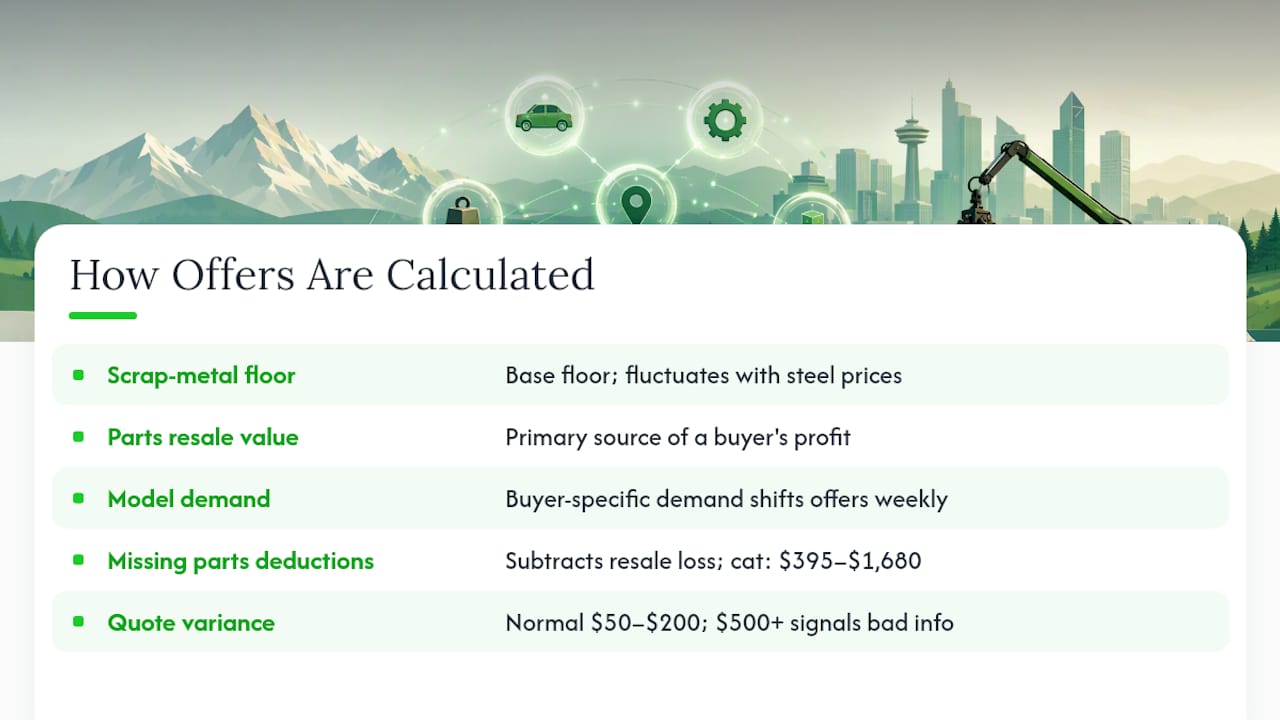
Your junk car quote comes from four things layered together: local scrap-metal prices, resale value of usable parts, how in demand your specific model is for parts, and deductions for anything missing or damaged. Buyers aren't pulling numbers out of the air. Offers typically get built from year, make, model, condition, current scrap prices, and recent comparable sales, which is why the same car can get different numbers from different buyers depending on their inventory needs that week.
Scrap-metal value is the floor. Steel prices fluctuate, and that fluctuation shows up directly in what a buyer can offer for a vehicle that's pure scrap weight with nothing salvageable. Parts resale value is where the real money usually sits. A 2016 sedan with a good transmission, working alternator, and intact catalytic converter is worth considerably more to a buyer than the same car stripped of those components, because those parts get resold individually to repair shops and other buyers rather than melted down.
Where the money actually goes: Sellers should expect normal quote variance of $50 to $200 between buyers, which reflects differences in each buyer's current parts demand and scrap contracts. A gap of $500 or more usually means one buyer is working from incomplete information, not that someone's trying to lowball you.
That variance is exactly why getting two or three quotes matters, and it's covered in more detail in the vetting section below. A $150 difference between two written offers is normal market noise. A $500 gap means one of those numbers was built on a wrong assumption, either about your car's condition or about parts demand that buyer doesn't actually have.
Missing or stolen parts subtract from your offer in predictable ways. Catalytic converter theft has been a persistent problem across Alberta in recent years because of the precious metals inside, and a buyer factoring in a $395 to $1,680 replacement cost isn't padding their margin. They're pricing in a real repair expense before that part can go back into circulation. The same logic applies to a missing engine, a pulled transmission, or stripped interior components. Every part that's gone is value the buyer can't recover on resale.
A buyer's volume and network also shape what they can pay. A junk car buyer with an established scrap contract and steady parts resale channels can often pay more per vehicle than someone operating without those relationships, simply because they're not guessing at resale value. This is part of why a local, established buyer in Calgary can sometimes beat a random national tow service on price. They already know what a given model's parts are worth in the Alberta market.
Pickup, Payment, and Paperwork: What Actually Happens on Collection Day
Pickup day should be short and predictable if the quote process was done right. The driver verifies the vehicle matches what was described, you sign a bill of sale, you get paid, and the keys change hands. That's the whole transaction.
Here's the typical sequence once a tow truck shows up:
- Vehicle verification. The driver does a quick walkthrough to confirm the car matches your description and photos. This is normal and takes a few minutes.
- Signing the bill of sale. This document transfers ownership and protects you from future liability tied to the vehicle, including parking tickets, impound fees, or registration issues after the sale.
- Payment. Reputable buyers pay on the spot, typically cash, check, or e-transfer. Ask which method a buyer uses when you're getting your quote, not when the tow truck is already in your driveway.
- Keys and vehicle handover. Once payment is confirmed, the car is loaded and gone.
Towing itself should never cost you anything. Established buyers build towing into the offer because the scrap and parts value they'll recover covers the transport cost. If a buyer tries to charge a towing fee on top of their offer, that's a signal to look elsewhere, and it's worth reading through what proper tow scheduling in Alberta looks like before you commit to anyone.
Timing splits pretty cleanly between urban and rural Alberta. In Calgary and other major centers, same-day pickup is common once a written offer is confirmed, sometimes within a few hours of the call. Rural pickups, especially in areas with limited tow truck coverage or during winter road conditions, can take one to three business days. That's not a red flag. It's logistics. A tow truck covering a large rural radius simply has more ground to cover than one working within city limits.
Before the truck leaves your property, confirm the price one more time out loud with the driver. This sounds redundant, but it's the single easiest way to avoid a last-minute reduction. If the written offer said $450 and the driver shows up saying $350 because of "additional damage" they haven't actually inspected yet, you're within your rights to say no and call the office that quoted you. A legitimate written offer with a stated validity window shouldn't change unless the vehicle's actual condition differs from what you described.
Once the bill of sale is signed and payment clears, you're done. Keep a copy of that bill of sale for your own records. It's your proof the vehicle changed ownership on that date, which matters if any tickets, tolls, or registration notices show up afterward tied to the car's old plates. The buyer typically handles the deregistration or scrap notification process on their end, but having your copy protects you either way.
How to Compare Quotes and Spot a Bad Buyer
Getting two or three quotes before you commit is the single best protection against getting lowballed, and it takes maybe twenty extra minutes total. Price differences of $50 to $200 between legitimate buyers are normal; anything wildly outside that range deserves a second look before you agree to anything.
Before accepting an offer, run through this checklist:
- Get the offer in writing, including the dollar amount and how long it's valid for. A written quote with a stated validity period protects you from a bait-and-switch at pickup.
- Confirm the pickup time in writing, not just verbally over the phone.
- Ask directly about towing fees. The answer should be free, every time, with no exceptions or hidden charges added later.
- Ask how you'll be paid and confirm that method works for you before the truck is scheduled.
- Ask who handles the paperwork for ownership transfer and deregistration.
Red flags show up early if you know what to listen for. A buyer who asks for any upfront payment for towing is not operating the way reputable removal services do. A buyer who refuses to give you anything in writing, even a text message confirming the price, is leaving themselves room to change the number later. High-pressure language like "this price is only good if you say yes right now" is a tactic, not a policy. Legitimate buyers can hold a written price for at least a day or two without issue.
Pro Tip: Ask each buyer the same question in the same words: "Is this price firm, and what would change it?" A straight answer means they've priced your car properly. A vague or evasive answer means they're leaving room to lower it after they've got your car on the truck.
Two to three quotes is the sweet spot for comparison. Any fewer and you can't tell if a number is fair or a lowball. Any more and you're spending time on diminishing returns, since variance beyond that range comes down to random inventory needs rather than better research. If one offer comes in noticeably higher than the other two, ask that buyer directly what's driving the difference. Sometimes it's a genuine parts-demand match. Sometimes it's a number that won't survive the in-person inspection.
Alberta-Specific Details That Affect Your Pickup
A few things about doing this in Alberta specifically are worth knowing before you book anyone.
- Ask about AMVIC. The Alberta Motor Vehicle Industry Council regulates vehicle sales and licensing for automotive businesses operating in the province. It's reasonable to ask a buyer whether they're operating under proper local licensing, and a straightforward answer is a good sign you're dealing with an established business rather than someone working out of a personal truck with no accountability.
- Urban timing is faster. Calgary and other major Alberta centers generally see same-day pickup once a written offer is confirmed, sometimes within hours.
- Rural timing needs buffer. Remote and rural pickups often take one to three business days, especially outside peak driving season.
- Winter conditions change scheduling. Road bans, heavy snow, and extreme cold can push rural pickups back further than usual. If your car is sitting somewhere with limited winter access, mention that upfront so the buyer can plan the right equipment.
- Confirm transfer paperwork at pickup. Alberta's vehicle transfer process requires a signed bill of sale and the title; check with the City of Calgary or Alberta's registry services if you're unsure about a lost or damaged title before pickup day.
- Rural sellers should ask about tow radius. If you're outside a major center, ask directly whether the buyer services your area regularly or if you're a special trip, since that affects both timing and sometimes the final offer.
Southside Cash For Junk Cars: A Local, Three-Step Option
Certain local companies follow the process this guide describes, built to serve cities like Calgary and Okotoks. The structure is three steps: contact them with your vehicle details, get a scheduled pickup, and get paid in cash when the car leaves. No lengthy negotiation, no hidden towing charge tacked on after the fact.
That three-step model exists because most of the friction in selling a junk car comes from unclear pricing and delayed payment, not from the actual mechanics of removal. A written offer removes the guesswork. Same-day pickup, where scheduling allows, removes the waiting. Payment on the spot removes the "we'll mail you a check" delay some buyers use to slow-walk a payout.
Some buyers purchase vehicles regardless of condition, running or not, including cars with blown engines, failed transmissions, collision damage, or failed inspections. That covers the majority of what actually ends up as a junk car quote request in Alberta, whether it's a daily driver that finally gave out or a vehicle that's been sitting for a season already.
The checklist covered earlier in this guide, written offer, free towing, payment at pickup, clear paperwork, lines up directly with how this local process works. If you've already gathered your VIN, snapped a few photos, and confirmed your title status, you've done the prep work that makes a same-day pickup realistic rather than aspirational.
What Actually Matters Here (And What Doesn't)
Most advice on selling a junk car spends too much time on maximizing every last dollar and not enough on the thing that actually costs sellers money: a vague, unwritten quote that changes once the tow truck shows up. The research on this is consistent. Buyers who won't commit a number to writing, or who quote you a range instead of a figure, are the ones most likely to revise that number downward on pickup day.
The conventional wisdom says get your car detailed, top off fluids, maybe fix a small thing to boost resale value. For a car that's genuinely headed to scrap or parts, that effort rarely pays off. What actually moves your number is accurate information upfront, your VIN, honest condition notes, real photos, and a buyer willing to put a price in writing before the truck leaves the lot.
If you take one thing from this guide, make it this: prioritize a written offer with a validity window over chasing the highest verbal number you can find. A firm $400 in writing beats a verbal "maybe $600" that turns into $350 once the driver actually sees the car. Alberta's junk car market has enough legitimate, local options that you don't need to gamble on an unverified promise.
— Franz
Get a Locked Junk Car Quote With Southside Cash For Junk Cars
Some buyers offer a written price up front, same-day pickup when scheduling allows, free towing included, and payment handed over before the vehicle leaves your property.
To get started, have your VIN, a few clear photos of the vehicle, and your title or registration ready. Reach out through the cash for junk cars page to describe your vehicle's year, make, model, and condition, and you'll get a real number back quickly, not a placeholder that changes at pickup. Drivers in the surrounding neighborhoods, including Woodbine, can use the same process to book a pickup close to home.
Compare that offer against others if you'd like. This service model is designed for owners wanting the whole transaction handled in one call and one visit, with no unexpected towing fees or renegotiation at pickup. Fill out the form, get your written quote, and pick a pickup time that works for you.
Sources
Before booking a pickup, the City of Calgary's official site is a useful starting point for confirming local logistics and municipal contacts if you run into title or registration questions. For a broader look at what other removal routes involve, Southside's rundown of Alberta selling alternatives covers options beyond a straight scrap sale. And if towing timing is your main concern, the guide to getting a junk car towed in Alberta breaks down what affects scheduling in more detail.
FAQ
What Is the Average Price of Scrap Cars in Alberta?
Prices vary by vehicle condition, weight, and current scrap-metal rates, with normal variance between buyers running $50 to $200. A car with intact parts and no missing catalytic converter will land well above a stripped, scrap-only vehicle.
Who Will Pay the Most for a Junk Car?
Buyers with strong local parts resale networks and steady scrap contracts, like Southside Cash For Junk Cars in Calgary and Okotoks, typically pay more than buyers guessing at resale value, because they already know what your model's parts are worth locally.
Can I Sell My Car for $1 in Alberta?
You can technically list any sale price on a bill of sale, but doing this for a vehicle with real scrap or parts value means leaving money on the table; a proper written quote almost always beats a symbolic dollar transfer.
How Do I Calculate the Scrap Value of My Car?
Scrap value comes from current local metal prices combined with your car's weight, condition, and any resalable parts still intact, which is why getting an actual quote from a buyer is more accurate than estimating it yourself.