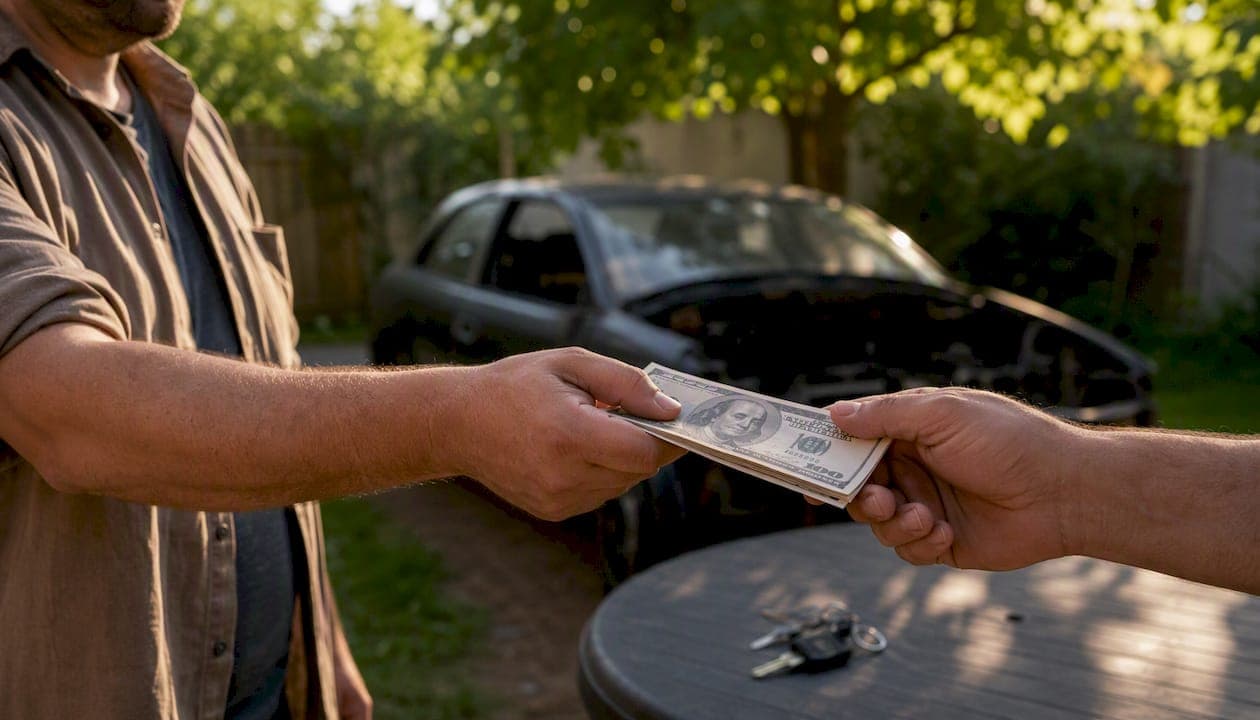
When you sell a junk car, you'll most likely get paid one of three ways: cash at pickup, a company check, or a bank transfer (ACH). Cash at pickup is the fastest and most common option, especially when you have a signed title ready. Company checks are standard with larger buyers or when a lien is involved. ACH transfers are less common but growing, particularly with online-first buyers.
Less common options include:
- Peer-to-peer apps (Zelle, Venmo): occasionally offered by smaller local buyers or private sellers; faster than a check but riskier with unknown buyers
- Prepaid cards or store credit: rare, usually offered when the title is missing; almost always means a lower payout
- Mailed checks: used when buyers are remote or when lien payoffs require coordination with a lender
Pro Tip: Before you schedule a pickup, ask the buyer directly: "Do you pay cash at pickup if I have the signed title?" Reputable buyers answer that question without hesitation. If they hedge, treat it as a red flag.
Scrap metal market prices, your state DMV's title transfer rules, and the buyer's own policies all influence which method you'll receive. Southsidecashforjunkcars pays cash at pickup with free same-day towing, which removes most of the guesswork.
Key Takeaways
Cash at pickup with a signed title is the fastest, safest junk car payment method, and getting multiple quotes before accepting any offer is the single most effective way to increase your payout.
| Point | Details |
|---|---|
| Cash at pickup is fastest | Immediate payment the moment the title is signed and the car is loaded. |
| Title determines your options | Missing title usually means a lower offer or a non-cash payment method. |
| Verify before you release the car | Count cash, call to confirm checks, and wait for ACH confirmation before handing over keys. |
| Get multiple quotes | Shopping at least three offers is the most reliable way to avoid a low first bid. |
| Southsidecashforjunkcars | Pays cash at pickup with free same-day towing, no hidden fees, and a three-step process. |
Table of Contents
- What are the junk car payment methods you'll go through step by step?
- How does each payment option actually compare?
- What paperwork do you need before you get paid?
- When will you actually get paid, and how do you stay safe?
- How do you get the best payout fast?
- Which payment method would I actually accept?
- Southsidecashforjunkcars pays cash at pickup, no surprises
- Sources
- FAQ
What are the junk car payment methods you'll go through step by step?
The standard flow at reputable junk-car buyers is: get an offer, schedule pickup, get paid. Payment happens at pickup in most cases, not days later.
- Get an offer. Call or submit your vehicle details online. Have your VIN, a rough description of condition, and your zip code ready. Most buyers quote within minutes. Carfax recommends preparing vehicle details and paperwork before you contact anyone.
- Schedule pickup. Confirm the quoted amount, the payment method, and whether towing is included at no charge. Same-day or next-day pickup is standard with established buyers.
- Get paid. Sign the title over, hand over your keys, and receive payment. Cash is handed to you on the spot. A company check is given at the same moment but clears later. ACH transfers may post within minutes or take 1–3 business days depending on your bank.
Reputable buyers aim to complete the entire process same-day or within 24–48 hours. "Paid at pickup" means you receive the payment instrument the moment the car is loaded, not after the buyer processes it back at their facility.
How does each payment option actually compare?
Here's how the five main options stack up across the factors that matter most to sellers.
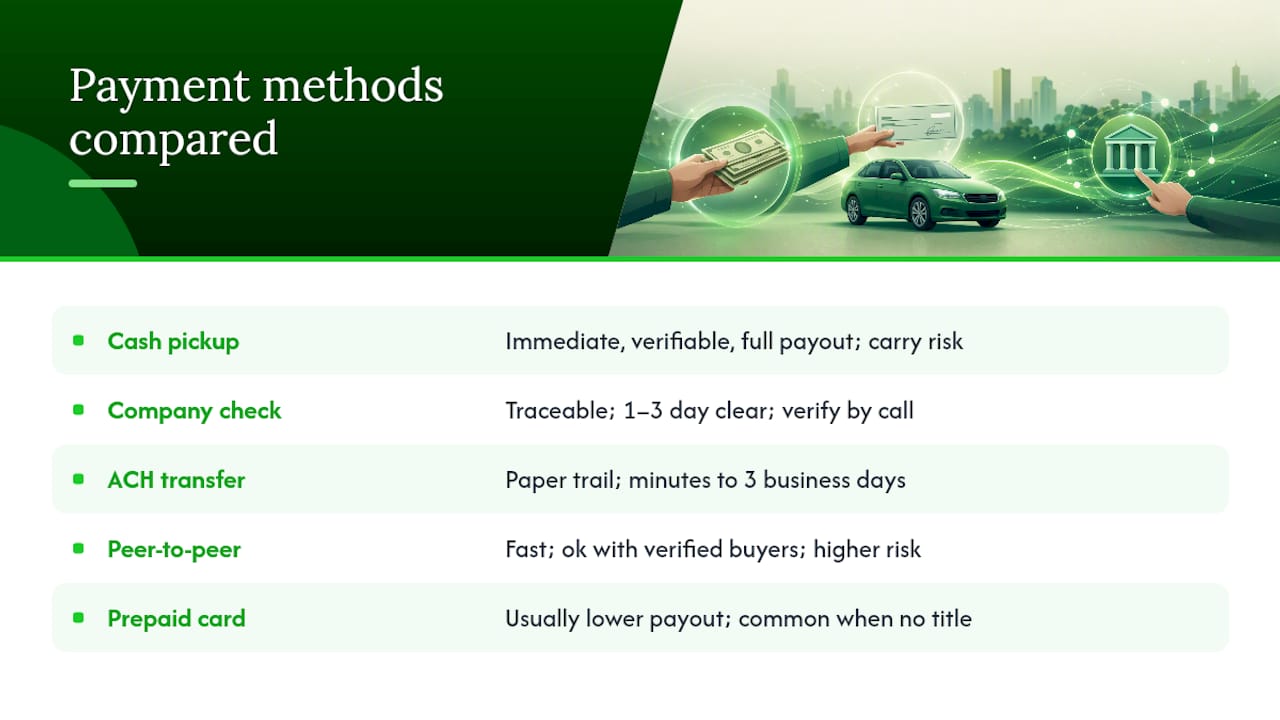
Cash at pickup is the cleanest option. You count the bills, sign the title, and you're done. The only real concern is carrying a large amount of cash home. Some buyers, including Southsidecashforjunkcars, pay cash on the spot with free towing included, so there's no deduction for hauling.
Company checks are traceable and common with larger operations. The catch: a check handed to you at pickup still needs to clear your bank, which takes 1–3 business days. Call the buyer's main business number (not the number on the check) to verify it's legitimate before depositing.
ACH transfers give you a clean paper trail and are increasingly offered by online-first buyers. Confirmation in your bank app is the only proof you need. The wait can be as short as a few minutes with same-bank transfers or up to three business days across different institutions.

Peer-to-peer apps like Zelle or Venmo work well with buyers you can verify. Scrap America notes that contactless options are available in some situations, but the risk rises sharply with buyers you found through a classifieds post rather than an established business. Google's payment platform policies require account verification and have dispute limitations that differ from traditional banking, so understand those terms before accepting.
Prepaid cards or store credit almost always signal a lower payout. Buyers who can't or won't pay cash or check typically offer these when the title is missing. As iPull-uPull explains, buyers with the title pay cash; without it, they often shift to check or withhold payment until paperwork arrives.
Pro Tip: If a buyer offers a prepaid card, ask what the cash equivalent would be if you produced the title. The gap between those two numbers tells you exactly what the missing title is costing you.
What paperwork do you need before you get paid?
Your title is the single most important document. Without it, most buyers will either refuse the sale, reduce the offer, or shift to a non-cash payment method.
Documents to have ready:
- Signed title (signed on the back, transferring ownership to the buyer)
- Photo ID matching the name on the title
- Bill of sale (required in some states; many buyers provide their own form)
- Release of liability/notice of sale (filed with your state DMV after the sale to protect you from future tickets or liability)
- Lien release or lender coordination if you still owe money on the vehicle
How each document affects payment:
- Title present and signed: qualifies you for cash at pickup or a company check at full offer value.
- No title: buyer may pay by check and hold funds until they receive the title paperwork, or reduce the offer to account for the added administrative work.
- Active lien: you cannot legally transfer the title until the lender releases it. If you junk a car that still has a loan, the lender can sell the vehicle at auction and bill you for any remaining balance. Coordinate with your lender first, use part of the sale proceeds to pay off the balance, and get a written lien release before signing the title over.
Pro Tip: File your release of liability with your state DMV the same day you sell. If the buyer drives the car before registering it and gets a ticket, that ticket can follow your name until the transfer is officially recorded.
Title transfer rules vary by state. Check your state DMV's website for the exact forms required in your jurisdiction before the pickup date.
When will you actually get paid, and how do you stay safe?
Cash at pickup is immediate. Everything else involves some wait, and that gap is where scams tend to happen.
Timing by method:
- Cash: the moment you sign the title and the car is loaded
- Company check: in hand at pickup; clears in 1–3 business days
- ACH: minutes to 3 business days after the transfer is initiated
- Mailed check: 3–7 days after pickup, sometimes longer
Fraud red flags to watch for:
- Buyer asks you to release the car before payment is confirmed
- Pressure to accept a wire transfer or e-payment without completing paperwork first
- Check drawn on an unfamiliar business name that doesn't match the buyer's company
- Requests for your bank account number or Social Security number beyond what a standard title transfer requires
- Offers significantly above market that come with complicated payment instructions
Verification steps by payment type:
- Cash: count it in front of the driver; use a counterfeit-detection pen for large amounts
- Company check: call the buyer's main business line (look it up independently) to confirm the check is legitimate before the driver leaves
- ACH: wait for the transfer to appear in your bank app before handing over the keys
- Peer-to-peer: confirm the recipient account belongs to the actual business, not a personal account with a similar name
Pro Tip: For checks over $500, walk into your bank branch and ask the teller to verify the check before you deposit it. Many banks can confirm whether a check is drawn on a real, funded account within minutes.
How do you get the best payout fast?
Preparation is what separates a seller who gets a fair offer from one who takes the first number they hear.
- Gather your VIN, title, and honest condition notes. Note whether the catalytic converter is present, whether the car is complete, and whether it runs. Buyers price based on scrap metal weight and parts value, so accuracy gets you a more accurate quote.
- Take clear photos. Four exterior angles plus the odometer. Buyers who can see the car before pickup are more likely to honor their quote at arrival.
- Get at least three quotes. Forbes Advisor recommends shopping multiple offers before accepting any single bid. The first number is rarely the best one.
- Compare net payout, not just the quoted price. Use this checklist:
| What to compare | Why it matters |
|---|---|
| Quoted amount minus towing fees | Some buyers deduct towing; others include it |
| Payment method offered | Cash at pickup vs. delayed check changes your actual receive date |
| Title requirements | No-title buyers often pay less or use non-cash methods |
| Lien payoff handling | Does the buyer coordinate with your lender, or is that on you? |
- Ask one scripted question when you call: "Do you pay cash at pickup if I have the signed title?" A buyer who says yes and confirms free towing is giving you the two things that matter most: speed and no hidden deductions.
For more on getting top cash for your vehicle, the condition and completeness of the car are the biggest levers you control before making that first call.
Which payment method would I actually accept?
Cash at pickup with a signed title is the right call in most situations. It's immediate, verifiable, and leaves no room for a check to bounce or a transfer to stall.
Three scenarios where the calculus shifts:
You have the title and need cash today. Accept cash at pickup only. Don't let a buyer talk you into a check "for convenience." If they can't pay cash, find a buyer who can.
You don't have the title. A company check from a verified buyer is your best option. Confirm the buyer's business name, call their main line, and wait for the check to clear before considering the transaction complete. The payout will likely be lower, so weigh whether getting a duplicate title first (a straightforward DMV process in most states) is worth the extra day or two.
The car has a lien. Don't accept any payment until you've spoken with your lender and confirmed the payoff amount. A check made out jointly to you and the lender is common in this situation. It's slower, but it's the only way to transfer a clean title. Walking away from a buyer who won't accommodate that process is the right move.
The one situation where a delayed check is worth accepting: the payout after lien payoff is materially higher than what a cash buyer offers. If the net difference justifies the wait and the paperwork, take the check from a verified buyer. Otherwise, cash at pickup from a reputable local buyer is the fastest path to a clean transaction.
Southsidecashforjunkcars pays cash at pickup, no surprises
If you've read this far, you know what the best outcome looks like: cash in hand the moment your car is loaded, free towing, a signed title transfer, and no deductions you didn't agree to upfront. That's exactly what Southsidecashforjunkcars delivers for sellers in Calgary and Okotoks.
The process is three steps: call or submit your vehicle details for an instant offer, schedule a free same-day pickup, and get paid cash on the spot when the driver arrives. No waiting for a check to clear, no ACH delays, no surprise towing fees subtracted at the end. Running or non-running, failed inspection or blown engine, Southsidecashforjunkcars buys it.
Get your cash offer for your junk car today and have it gone by tonight.
This article is general information, not a substitute for advice from a qualified financial advisor. Consult a qualified financial professional about your own circumstances before acting on anything here.
Sources
The following sources informed this guide and are worth bookmarking for your own research:
- Forbes Advisor: How to Get Cash for Junk Cars
- How to Sell a Junk Car Easily
- What Happens If You Junk a Car That Still Has a Loan on It?
- Policies
FAQ
Who pays the most for a junk car?
Buyers who factor in both scrap metal value and reusable parts typically offer the most. Getting at least three quotes from local buyers before accepting any offer is the most reliable way to find the highest payout, as Forbes Advisor recommends.
What do you do with a junk car you still owe money on?
Contact your lender first to get the exact payoff amount, then coordinate the sale so the lender receives their portion directly. If you skip this step, the lender can sell the car at auction and bill you for any remaining debt.
Does missing a title change how you get paid?
Yes. Buyers who accept no-title vehicles typically pay by check rather than cash and often reduce the offer to cover the extra paperwork. Getting a duplicate title from your state DMV before selling usually results in a higher cash payout.
Can you do a payment plan when selling a junk car?
Payment plans are not a standard junk car payment method from the buyer's side. Sellers receive a lump sum at or shortly after pickup. The only "plan" scenario is a lien payoff arrangement where the buyer coordinates with your lender, but that is a payoff process, not an installment plan.