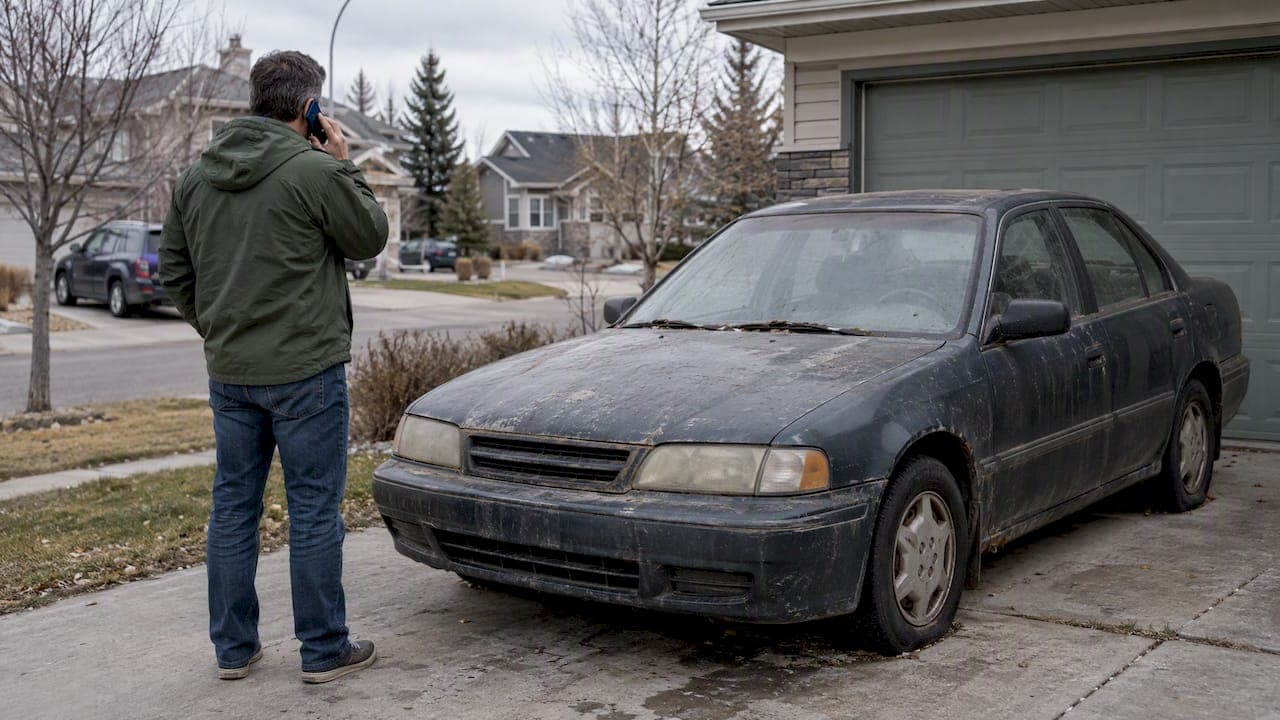
Call 311 for a vehicle abandoned on private property in Calgary, and ask for a service-request number so you can track the case. Calgary Parking handles street cases, while Alberta's Vehicle Seizure and Removal Regulation lets an authorized officer attach a notice that can lead to removal after the required notice period. Private land gets assessed first, so expect a check before any tow.
TL;DR:
- Report private property cases to 311 with the exact location and vehicle description, then save the request number; Calgary Parking handles public streets, and 911 handles immediate danger.
- Take dated photos from a safe distance, noting how long the vehicle has been there, blocked access, and visible hazards; record the plate or VIN only if safely visible.
- Calgary assesses nuisance, condition, access, and safety before authorizing removal from private property; property owners cannot remove, dismantle, sell, or dispose of vehicles without authority or owner consent.
- Alberta’s process requires an authorized officer to issue a removal notice; after seizure, disposal may follow 15 days after a disposal notice unless the vehicle is claimed and seizure costs are paid.
- Calgary Parking lists a $138 towing fee for an abandoned vehicle seized by the city, not for a private tow; private towing requires the owner’s permission.
Table of Contents
- What the law and city rules say about abandoned or derelict vehicles
- Who enforces which case, and which number to call first
- How to report effectively: photos, wording and channels
- What happens after you report: tag, tow, impound, disposal
- What property owners may and may not do
- Practical removal options in Calgary
- Why we say follow the city's steps first
- How we can help: same-day cash and free towing in Calgary
- FAQ
- Sources
What the law and city rules say about abandoned or derelict vehicles
Two layers of rules apply: a provincial regulation and Calgary's own bylaws. The provincial regulation sets the process an officer follows once a vehicle is judged abandoned. It is officer-led, not permission for you to tow a car yourself.
- The abandoned-vehicle notice states the date, time and location, and warns that the vehicle will be removed if it is still there after the required notice period.
- After seizure, a notice of disposal can follow, and the vehicle may be disposed of 15 days later unless it is claimed and seizure costs are paid, as set out in the Vehicle Seizure and Removal Regulation.
- The city's land-use rules define a dilapidated vehicle by its condition: incapable of safe operation, partially or fully dismantled, or substantially damaged. Condition matters more than registration status.
The notice-and-removal process is mainly applied on public streets. For private property, the city assesses nuisance, condition, access and safety before authorizing removal, as Calgary Parking's bylaw guidance explains. The passage of time does not automatically give you the right to remove the vehicle yourself.
Who enforces which case, and which number to call first
Routing mistakes cost days, so match the problem to the right agency before you dial.
- Call 311 for private-property complaints. The 311 Calgary FAQ says to call or use the online service or app, give the exact address and a vehicle description, and ask for the service-request number.
- Contact Calgary Parking for public-street problems. Calgary Parking manages street enforcement and the Municipal Impound Lot, and it publishes pick-up instructions on its impound and towing page.
- Call 911 for immediate danger. A leaking vehicle, a fire risk or a car creating an imminent safety threat is an emergency, not a bylaw matter.
- Say "private property" or "public street" in your first sentence. The 311 team routes requests based on that detail, and a wrong guess sends your case to the wrong desk.
- Know what the city will not do. The city inspects and can order removal, towing and impound, but it does not promise a universal removal time.
If you are unsure whether a vehicle sits on your land or the road allowance, say so and let the agent sort it out. A short clarification at the start beats a transfer halfway through the call.
How to report effectively: photos, wording and channels
A good report gets routed once and acted on quickly. The city's illegal dumping and abandoned vehicle guidance tells residents to document the problem before reporting it.
- Take clear, dated photos from a safe spot that show the vehicle and how it relates to your fence, driveway or garage.
- Capture the plate or VIN only if you can see it without approaching the vehicle.
- Note how long the vehicle has been there, whether it blocks access, and any hazards such as leaking fluid.
- Report by phone, app or the online form at Calgary's 311 page, and save the service-request number and every timestamp.
Calgary's own guidance also stresses exact location and specific details, so describe where the vehicle sits in plain terms: "rear lane, behind the garage at the east fence."
Pro Tip: Open the call with one sentence: "There is an unregistered vehicle on private property at this address, blocking my driveway." That single line prevents most routing delays.

What happens after you report: tag, tow, impound, disposal
Expect a sequence rather than a single visit. An officer typically assesses the vehicle first, and tagging and a later check are common. If the vehicle obstructs traffic or is a hazard, a tow can happen much faster, according to Calgary Parking.
- Towed vehicles go to the Municipal Impound Lot at 400 39 Ave SE, run by Calgary Parking.
- If nobody reclaims a seized vehicle in the window the regulation allows, disposal follows and seizure and disposal cost liability applies.
- Depending on the finding, the city may recover disposal or towing costs, per its reporting guidance.
Impound fee example: the abandoned-seizure towing fee Calgary Parking lists is $138. That is a city impound fee, not a quote for privately hired removal, so a private tow will be priced separately.
What property owners may and may not do
Frustration with a stuck vehicle is understandable, but acting on your own can create legal trouble. Calgary's guidance warns against several shortcuts, and the safe route is short.
- Do not remove plates, sell, dismantle or dispose of the vehicle unless you have legal authority or documented owner authorization, per Calgary's guidance.
- File a 311 complaint so enforcement officers can decide whether ticketing, a notice, towing or another remedy applies.
- Arrange an authorized tow only with the owner's permission. Written consent protects you if anyone disputes the removal later.
- Ask a local buyer to purchase the vehicle if the registered owner agrees to sell.
- Request an inspection if the owner is uncooperative and the vehicle is a hazard, then follow the staff's advice on authorized removal.
Calgary's good-neighbour guide adds that vehicles on property should be registered, insured and operable, and that derelict vehicles or ones blocking access can be ticketed and towed.
Practical removal options in Calgary
You have three realistic routes, and the best one depends on who owns the vehicle and how urgent it is.
- City enforcement: the right choice when you want the city to assess a potentially abandoned or dilapidated vehicle and follow the statutory seizure steps. It is thorough, but you do not control the schedule.
- Private towing: use an authorized Calgary tow company only with the owner's permission, to avoid legal risk. If a tow to impound is needed, a licensed operator handles the transport.
- Local cash-for-junk buyer: a lawful option when the owner is willing to sell. We offer pickup and free towing for non-running or damaged vehicles, which can clear a blocked driveway or yard quickly.
If you want background first, our guide on how to remove junk cars from property walks through the practical steps, and our summary of Calgary junk car bylaws covers the policy in plain language.
Why we say follow the city's steps first
We see these situations often, and our advice is consistent: if the vehicle is a public-safety hazard, report it to the city before anything else. When the owner is known and willing, a quick sale is usually the fastest clean ending for everyone. Either way, keep your photos, your notes and your 311 service-request number in one place. Documentation settles most disputes before they start.
— Franz
How we can help: same-day cash and free towing in Calgary

If the owner is willing to sell, we can arrange to have the vehicle picked up and the owner paid. We buy junk, damaged and non-running vehicles in Calgary and Okotoks, with free towing and instant cash. The process is simple: contact us, we confirm ownership, we schedule pickup, and payment happens on the spot. If there is any safety or public-access issue, report it to the city first. When the owner is ready, request your cash offer and we will take it from there.
FAQ
Is parking free in Calgary in the evening?
It depends on the zone and the posted signs, so check the sign or the Calgary Parking site for the specific street or lot. Rules differ between paid zones, residential areas and private lots. Private lots can also ticket and tow regardless of the time of day.
What are the laws around abandoned vehicles?
Alberta's Vehicle Seizure and Removal Regulation lets an authorized officer attach a notice that leads to removal after the required notice period, with disposal possible 15 days after a disposal notice if the vehicle is not claimed, per the provincial regulation. Calgary's land-use rules also define dilapidated vehicles by condition.
Can you park on the street next to someone's house?
Generally yes, if the spot is legal and the vehicle is registered, insured and operable. It cannot block driveways, waste containers, fire hydrants or the street itself, according to Calgary's good-neighbour guide. Derelict vehicles can be ticketed and towed.
How do you deal with inconsiderate parking?
Document it with dated photos, then report it to 311 or Calgary Parking depending on whether it is on private property or a public street. Keep the service-request number so you can follow up. Call 911 only when there is immediate danger.